




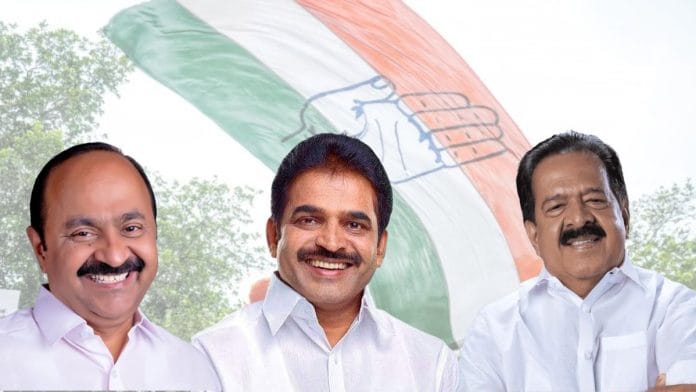

Who will be the Kerala chief minister if Congress comes to power in the state?
With the United Democratic Front (UDF) smelling victory, that’s the question doing the rounds in Kerala’s political circles.
Mohammed Shiyas, Ernakulam District Congress Committee president and loyalist of Leader of Opposition, VD Satheesan, set the cat amongst the pigeons when he stated that the next CM should come from Ernakulam district (read Satheesan). This saw Congress leaders from different camps reacting to it sharply, even as Satheesan himself played down the comment.
Then it was Kannur MP K Sudhakaran’s turn to come out backing KC Venugopal on Facebook, where he took potshots at Satheesan for lacking organisational experience. A number of Venugopal loyalists in Kerala also took to social media to hail their leader in its wake.
Also read: Minorities are backing UDF again. Will it break LDF’s streak in Kerala?
Ideal candidate
There is more than a fortnight left before the formal announcement of the results, but Satheesan, Venugopal and Ramesh Chennithala have all begun jockeying for the crown.
Congress, buoyed by the consolidation of minority communities in its favour this time around, needs to take a long-term call in the state.
From a Congress viewpoint, who would be the ideal Chief Minister for Kerala at this point? It should be Shashi Tharoor, given how he ticks all the boxes.
However, with elected MLAs having a natural edge over MPs like Tharoor or KC Venugopal, it would be tough for the Congress high command to foist someone with two by-elections to follow in the next six months.
Satheesan and Chennithala
The selection would depend on a possible understanding struck between Satheesan and Chennithala.
However, under no circumstances would Chennithala yield. Satheesan too would not give up without a fight. This ensures that the Congress high command eventually takes the call.
When it comes to eligibility, Satheesan has a natural claim. As the LoP, he led from the front and managed to forge a rainbow coalition of disparate forces ranging from the Jamaat-e-Islami to the Marxist turncoats.
However, Satheesan also has a disadvantage. He’s not an acceptable choice to the Nair Service Society (NSS) or the Sree Narayana Dharma Paripalana (SNDP) Yogam.
The Hindu vote
Congress can only shed its dependency on the Indian Union Muslim League (IUML) if it can woo the Hindu bloc back into the alliance, or at least the Nair vote bank that it always commanded.
This became incumbent in the face of the Bharatiya Janata Party (BJP)’s growth in the state. The ‘Hindu’ voter had ditched the Congress in favour of the Hindutva party.
Regardless of how it fares in the Assembly election, the BJP’s growth in the capital city of Thiruvananthapuram at its expense should set off alarm bells for the Congress.
Many Congress leaders have inadvertently begun using the jargon of the Jamaat-e-Islami. For instance, in a post-election TV debate on 24 News, that I was a part of, VD Satheesan loyalist and official INC Kerala spokesperson Raju P Nair stated that minority communalism cannot be compared to majority communalism. He resorted to RSS bashing, while taking a softer approach on Islamism. The Marxists can get away with such contradictions but not the Congress in Kerala. They’re forgetting that the UDF is traditionally a Christian-Nair-Muslim coalition, with each bloc having a vital role to play.
Also read: BJP is blocking UDF from a landslide. How did Hindutva gain ground in Kerala?
Winning back Thiruvananthapuram Corporation
A Nair CM might solve the problem of further erosion of its Hindu vote. But regardless, it needs to get its act together in the Thiruvananthapuram Corporation.
The city of Thiruvananthapuram is dominated by Nairs. And many of them are “proud Hindus”, unlike their counterparts in the rest of the state who downplay their identity.
Many of them might have become BJP voters lately, but it doesn’t mean that they cannot be won back by the Congress. Most of them remain open and liberal in their voting preferences.
To inspire confidence among the Nairs in the state capital, Congress needs to name someone who can position himself as their leader, while also being acceptable to the Christians and Muslims.
That could be none other than K Muraleedharan, son of K Karunakaran, originally Kerala’s ‘Hindu Hriday Samrat’, but also someone who was deeply secular in his outlook.
K Muraleedharan’s credentials
Muraleedharan is contesting from the tough Vattiyoorkavu constituency, locked in a triangular contest with the incumbent CPI(M) MLA VK Prasanth and BJP’s R Sreelekha. At 68, Muraleedharan is still in his prime, even if he is not among the frontrunners among chief-ministerial aspirants.
He was catapulted to the Kerala Pradesh Congress Committee (KPCC) chief’s position in 2001 after K Karunakaran ceded the CM’s chair to AK Antony. Muraleedharan’s three-year tenure in the role is still hailed for its bipartisanship and organisational dynamic.
Congress began to lose its Hindu vote bank to the Left and the BJP only after K Karunakaran’s exit in 2005. While Karunakaran eventually returned to the Congress, the prodigal son had to wait until his father’s demise in 2010 to return to the party. Then KPCC chief Ramesh Chennithala kept him at bay.
Having spent six years outside the party, Muraleedharan never regained his clout within Congress. Nor did Muraleedharan reinvigorate the erstwhile Karunakaran faction, who stuck their lot with Chennithala.
Hindu polarisation in Kerala
In the run-up to the local body polls in Kerala in December, the CPI(M) had charted a soft-Hindutva course after its Ezhava vote bank drifted toward the BJP in the Lok Sabha poll. The Global Ayyappa Conclave was held against this backdrop, but the Sabarimala gold theft scandal took the sheen off it.
Two types of angry Hindu voters emerged in its wake:
The first section wanted to defeat Pinarayi Vijayan by voting for whoever stood a chance to do that, which in this case was the Congress. The second section, despite their anger with Vijayan, still preferred to vote for the Left to prevent the UDF from forming the government, because they were wary of the IUML bloc in it.
Most people would argue that this section is invariably BJP-minded. But ask them who they voted for in the past, and you can discern that they were originally Congress voters.
Also read: Right hook: Inside the tactical coalition between CPI-M and ‘untouchable’ SDPI in Kerala
Hard choices
Muraleedharan has now spent a decade and half without party positions. He could have taken the easy route by contesting from Guruvayoor as suggested, but chose to take the fight to the Marxist camp in Vattiyoorkavu.
The choice of Muraleedharan would be extremely hard on Chennithala who had a claim back in 2011 too. He had an edge over Oommen Chandy in the Congress Parliamentary Party. However, there are doubts whether Chennithala’s brand of politics is past its sell-by-date in Kerala.
Meanwhile, KC Venugopal is supposedly banking his bets on Chennithala and Satheesan not coming to an agreement, with numbers in the Parliamentary Party likely to be in his favour. A lot of Congress veterans in Delhi would also be keen to liberate Rahul Gandhi from his confidant’s clutches by deputing him to Kerala.
As for Satheesan, he has never been a minister in the state cabinet, having missed out to VS Sivakumar in 2011. It might be too soon for Satheesan to assume the position, he needs to build bridges with community outfits.
Congress stands at a critical juncture in Kerala polity today.
The party needs to perform to stay relevant after five years and not bank on minority consolidation. It has been reduced to the latter in many states.
More importantly, it needs to regain the Hindu vote bank it ceded to the BJP.
Anand Kochukudy is a senior journalist based in Kerala. He tweets @TheKochukudy. Views are personal.
(Edited by Theres Sudeep)