





Kerala is viewed as a monolith from an outsider’s perspective. Yet the Malabar district, then part of the Madras Province under the British, had a very different milieu compared to the princely states of Travancore and Kochi, which later merged to form present-day Kerala. These differences persist even today, particularly in societal and religious conventions.
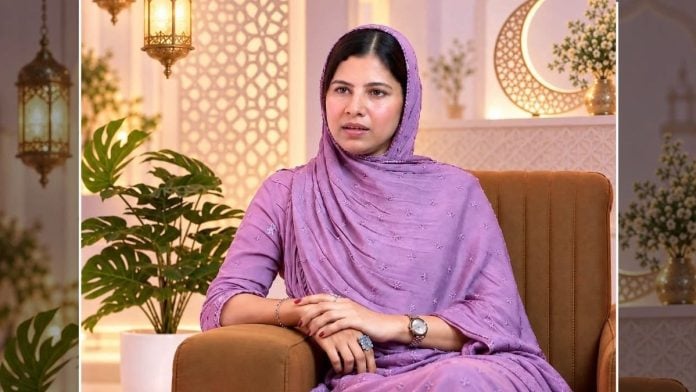
Being a feminist and a female Muslim academic at a college in Malabar can pit the entire Muslim orthodoxy against you, as Shabnam Noorjahan found out recently. A professor of Zoology at Farook College, Kozhikode, and a vocal Sufi Muslim, Noorjahan has become a thorn in the flesh of the clerical orthodoxy in recent times.
In 2023, Noorjahan, who also holds a master’s degree in psychology, published her first book, “Islam: Pranayam, Samarpanam”, which dealt with questions of identity and Sufism. Last month, following the misogynist statements issued by Kanthapuram AP Aboobacker Muslaiyar, Noorjahan came out all guns blazing against the Grand Mufti, enraging a cross-section of Malabar Muslims conditioned by centuries of patriarchy.
How a viral video sparked a backlash
The ‘chronology’ behind Musaliyar’s statement began when videos of Muslim girls wearing hijabs and dancing during Onam celebrations at Farook College, Kottakkal, went viral on social media. This, in turn, led to the proliferation of such videos and reels from the more conservative campuses in Malappuram. And it eventually culminated in girls making their presence felt on Milad-i-Sherif, which closely followed Onam, infuriating the conservative class.
Following the statement, Kerala’s secular political leaders momentarily hesitated to call him out, before Chief Minister VD Satheesan unequivocally condemned it. While the likes of Fathima Thahaliya, the first woman MLA of the Indian Union Muslim League (IUML), opportunistically offered their veiled support for the cleric, it was left to Noorjahan to offer a Muslim counterperspective beyond the activists and ‘ex-Muslim’ figures.
The churn that has engulfed the Muslim community in Malabar following the cleric’s statement has come to terrify the more orthodox sections. Kerala Minister for Local Self Governments KM Shaji courted controversy recently when he stated that Muslim girls were the biggest followers of atheist social media pages in Kerala. This is a more recent phenomenon in the state where the gatekeepers of the community are far removed from the aspirational Muslim women.
It was in this context that ‘Noora-e-Rumi’, a women’s Sufi gathering conceived by Noorjahan — held at a resort near the Farook College premises — courted controversy. An avowed follower of the 13th-century mystic poet and philosopher Rumi, whom she considers her Guru, Noorjahan’s endeavour is to get to Islam’s core, beyond the literal. None of her students in college had participated in it, and it was strictly meant for “emotionally grounded adult Muslim women seekers”, as Noorjahan puts it.
But all hell broke loose after Haneef Kayakkodi, secretary of the Kerala Jamiyyathul Ulama, flagged it as an attempt to misguide Muslim students. In a Facebook post, the Salafi preacher urged parents to impress upon their daughters the danger lurking behind Sufism.
“The soul of Farook College derived its inspiration from the Quran and the Sunnah. But, of late, forces from inside and outside have begun targeting the institution”, he said.
This triggered a wave of hate campaigns targeting Noorjahan, alleging that she was coaxing girls in her class to reject hijabs, become feminists and take to Sufism. Noorjahan pointed out how she herself sported the hijab—albeit casually throwing a shawl around her head as the practice was, before the advent of Gulf money in Kerala. She also vehemently denies the charge that she used the classroom to propagate Sufism.
Also read: Muslim dissenters need cover in India. The Republic cannot blame only the Qaum
‘Sufinist’ Noorjahan
But Noorjahan owns up to the fact that she is a feminist, and that speaks against the niqab, the veil that covers the face.
“As a teacher dealing with impressionable 18-year-old girls, it is my bounden duty to explain to them how their faces are their doors and windows to the world, and how hiding it means restricting themselves from fulfilling their potential,” she said.
There was a ban on niqabs enforced by the Muslim Educational Society (MES) in their institutions in the past, and Noorjahan vocally supported it, while the likes of Thahiliya dubbed it a “denial of agency”. Noorjahan also points out how she has to touch on issues of religion while teaching biology and evolution in her class, which is being misrepresented to claim that she was propagating Sufism.
Noorjahan is dubbed a ‘Sufinist’ — coined by merging the terms Sufi and feminist — by some of her critics. She is very much aware of her role as a change agent in an institution where girls consistently outnumber boys. This pattern of girls outnumbering boys is pretty much common across colleges in Malabar today.
There is another layer to the criticism against Noorjahan. She is the daughter-in-law of Hussain Madavoor, vice-president of the Kerala Nadvathul Mujahideen (KNM), who also doubles up as the Imam of the Palayam Mosque in Kozhikode. Kerala Jamiyyathul Ulama, whose secretary Haneef Kayakkodi initiated the cyber campaign against Noorjahan, is the supreme body of scholars of the KNM.
In fact, so much pressure has been exerted on the soft-spoken Madavoor that he was forced to tender a clarification on Facebook, distancing himself from his daughter-in-law’s views on Sufism. While the KNM is historically tied to the Kerala Renaissance movement, it lost its reformist zeal at some point, and has lately metamorphosed into taking dogmatic positions.
Farook College was established in 1948 as a continuation of the Renaissance movement under the aegis of the Salafis, commonly referred to as Mujahids. This was 18 years after Samastha Kerala Jamiyyathul Ulama, a Sunni scholars’ organisation, passed a resolution at its Mannarkkad conference in 1930 stating that women should not learn to write.
According to MN Karassery, the 1930 resolution has not been rescinded to this day.
The Egyptian strand of Salafism has gradually come to be replaced with the Saudi Arabian version in Kerala, especially with the advent of Gulf money courtesy of the migration of Malayalis. This, Noorjahan claims, has equally affected the Sunnis in Kerala, beyond performative aspects like hijabs to taking more hardline positions.
Also read: Muslim personal law is in conflict with POCSO. It needs reform
A privileged Muslim woman
Noorjahan is a privileged Muslim woman.
She is financially independent and comes from a well-heeled family. But it is not easy for even such a privileged Muslim woman to ‘smash patriarchy’ in Malabar, with almost every religious body and cleric opposing her. Noorjahan has only found support from writers like MN Karassery, PK Pokker and KEN Kunjahammad, apart from the ‘ex-Muslims’ on social media.
In fact, one of the first tactics deployed by the clerical orthodoxy was to dub her a “liberal Sufi”, trying to portray her as a non-practising Muslim. But Noorjahan refuses to take it lying down, claiming her pursuit of Sufism is a spiritual quest, without relying on the more literal interpretations of the Salafis (and the Sunnis) swearing only by the Sharia.
The Jamaat-e-Islami organ Madhyamam allegedly refused to publish a column by KEN Kunjahammad in support of Noorjahan, even if it seemingly budged under pressure after the writer went public with it. But that didn’t stop the flagbearers of Political Islam in Kerala from accusing Noorjahan of not adhering to Sharia and dubbing her version of Islam as akin to the “ Hindu philosophical way of reading Islam”.
Kayakkodi’s social media post against Noorjahan was reminiscent of a similar Facebook post by Abdulla Basil of the Wisdom group — a splinter Salafi faction — which triggered online hate against journalist Aparna Kurup, following her hosting of a debate on Kanthapuram’s statement. Basil has yet again immersed himself in this issue by publicly accusing Noorjahan of preaching Sufi ideals in her class.
In fact, Basil alleged on a primetime debate on News18 Kerala that a student had complained about Noorjahan’s mocking of niqabs and going beyond her syllabus in the classroom. According to Noorjahan, however, she came to know about the existence of such a complaint only after Basil flagged it on TV. She contended that it is easy to get a student to register a complaint through the Wisdom group’s organisational network at Farook College, dubbing it an intimidation tactic.
Noorjahan has also spoken out about a Khutubah (sermon) in the campus mosque where she was allegedly accused of ‘betrayal’. This is pretty much the dominant sentiment on social media, where she is accused of drawing a salary from a Salafi-run institution while working against its values.
Also read: From Shah Bano to Waqf—how Muslim politics has produced just intermediaries, not intellectuals
An opinionated Muslim woman
Nonetheless, KEN Kunjahammad, an atheist and Marxist fellow-traveller, had served as a Malayalam professor in Farook College until his retirement. So, it would appear that the primary issue for the clerical orthodoxy against Noorjahan is her being a Muslim woman with an opinion.
As in the case of Kurup, none from the secular political class came to the defence of Noorjahan, going to show how both the Left and the Congress are still more beholden to the Muslim clergy than the common masses. From the Jamaat-e-Islami and the Sunnis to the Salafis, the idea is to discredit Noorjahan as a ‘deviant’ from Islamic values.
Islam isn’t a monolith, and many interpretations of it can co-exist, declares Noorjahan. And she is vocal about how Farook College’s image as a secular institution is being sullied by vested interests. Nevertheless, Noorjahan proudly proclaims that she remains as much a Muslim as anyone else.
Anand Kochukudy is a senior journalist based in Kerala. He tweets @TheKochukudy. Views are personal.
(Edited by Saptak Datta)