



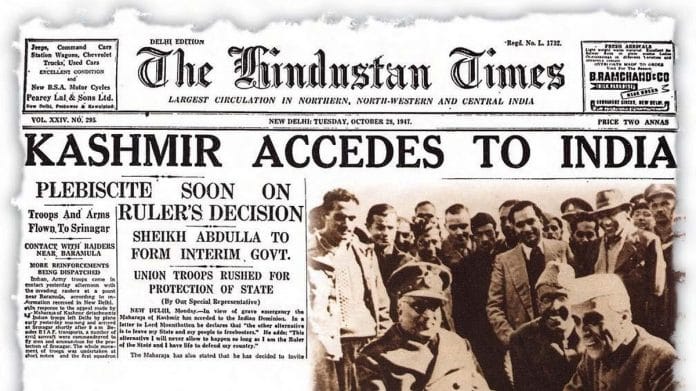
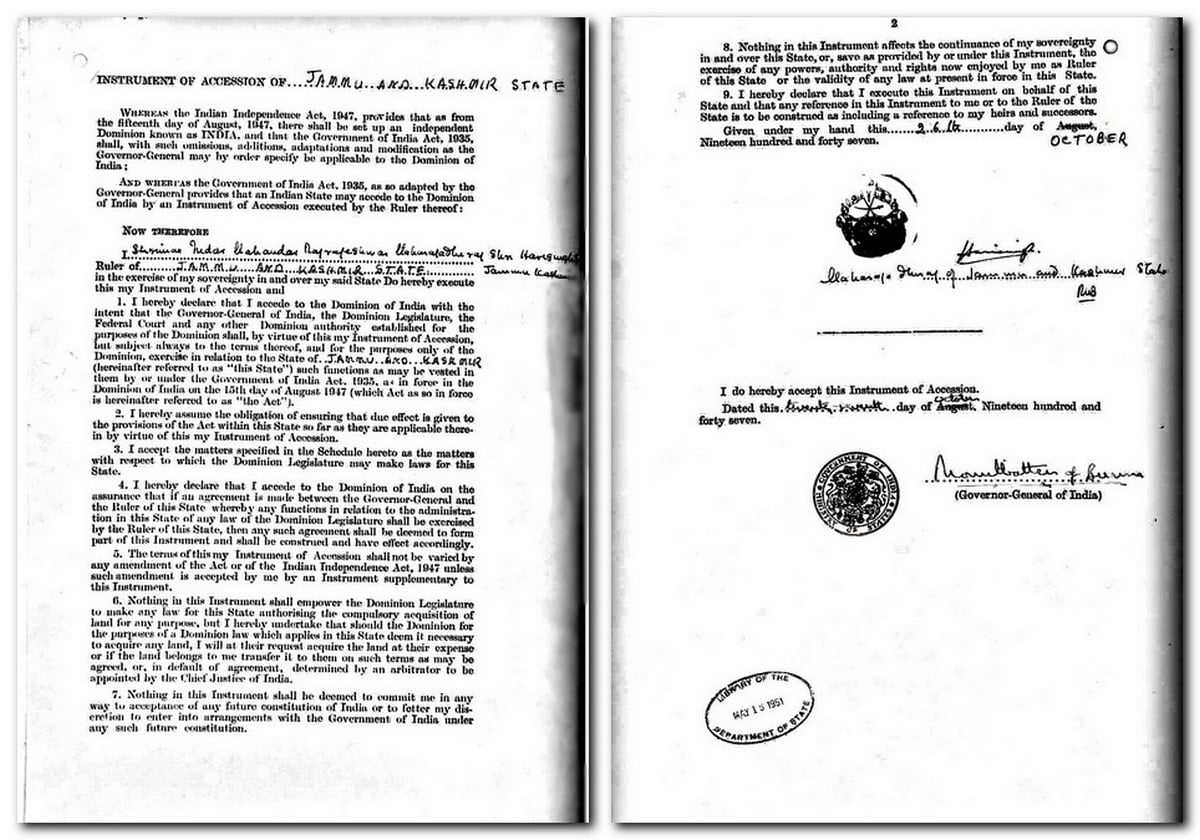
The date on which Maharaja Hari Singh signed Jammu and Kashmir’s Instrument of Accession to India continues to attract attention in the historiography of Kashmir. The contemporaneous record places the Instrument’s execution on the night of 26 October 1947, followed by Indian military intervention and Governor-General Mountbatten’s formal acceptance of the accession on 27 October. The Instrument itself, the Maharaja’s accompanying letter, Mountbatten’s correspondence and aide-memoire, the Chiefs of Staff statement of 31 October and the Government of India’s 1948 White Paper form part of that record.
Yet the late historian Alastair Lamb argued that the Instrument and the Maharaja’s letter were actually signed on 27 October, after Indian troops had begun landing at Srinagar, and antedated to make accession appear to precede intervention. Subsequently, other historians such as Victoria Schofield, Andrew Whitehead, Srinath Raghavan and Sam Dalrymple have also expressed doubts about whether the Maharaja signed the Instrument on 26 October. However, it appears they have not considered the vital evidence contained in the diary entries of Sardar Patel’s daughter, Maniben, which serve as an important chronological marker for the events that took place on 26 and 27 October 1947.
The core of the case advanced by the proponents of the antedating hypothesis is that States Department secretary VP Menon did not travel to Jammu on 26 October and that the Maharaja therefore could not have signed the Instrument on that date. This claim rests principally on three points: the discrepancies between the memoirs of Menon and Kashmir premier Mehr Chand Mahajan; British diplomat Alexander Symon’s account placing Menon in Delhi late on 26 October; and Nehru’s acknowledgement of receiving signed documents on 27 October.
Also Read: Pakistan created a Gurdaspur myth for way too long. The truth was very different
The Menon–Mahajan discrepancy
In his 1956 memoir, Menon describes travelling to Jammu with Mahajan on 26 October to secure the Maharaja’s signature on the Instrument of Accession. Mahajan’s 1963 memoir instead places their joint journey on the morning of 27 October to obtain signatures on “supplementary documents about the accession”. It is therefore argued that Menon’s account of a journey to Jammu on 26 October 1947 is fabricated.
However, Mahajan’s memoirs only establish that he and Menon went to Jammu on 27 October. They do not exclude the possibility that Menon travelled to Jammu on his own on 26 October to obtain the execution of the Instrument.
Sir Alexander Symon’s contemporary record
Writing at 3.30 pm on 26 October 1947, Alexander Symon, the British deputy high commissioner in New Delhi, recorded that, after much trouble, he established telephonic contact with Menon at the Prime Minister’s residence. Menon told him that he was leaving for Kashmir by air in ten minutes and could not spare the time to see him before his departure. He added that he would see Symon at about noon the following day.
Symon then attempted to intercept Menon before his departure. He records that, “in view of the importance of establishing contact without delay”, he first went to Willingdon Aerodrome and, on being informed that the aircraft would leave from Palam, proceeded there immediately. At Palam, he found Menon “on the point of returning to Delhi because he had left it too late for the aeroplane to reach Kashmir before nightfall”. Symon then arranged to meet Menon at his residence at about 5 pm. There, Menon told him that he had just returned from a meeting of members of the government and that he would leave for Jammu the following morning, expecting to return by lunchtime.
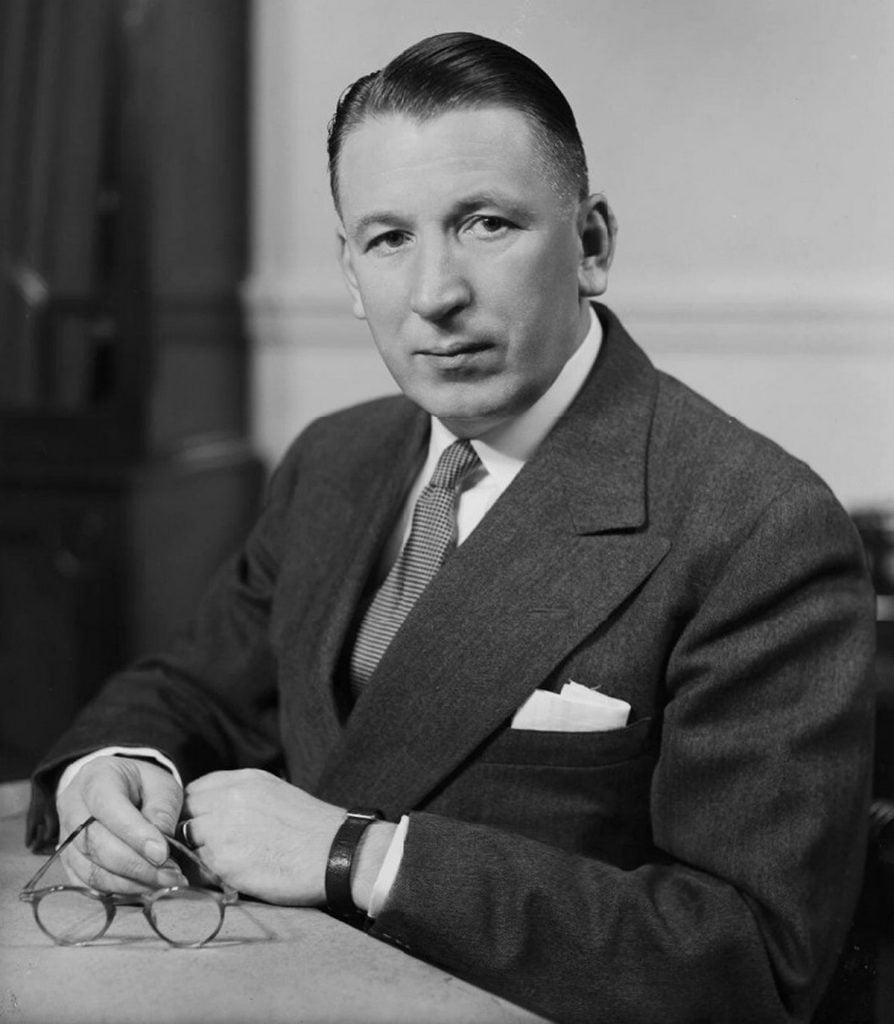
Menon’s stated intention at 5 pm clearly establishes that his plan at that moment was to depart the subsequent day. It does not establish his movements for the remainder of the day or demonstrate that his plans could not have changed once again later that evening.
Symon’s statement that Menon had “left it too late” reflects his understanding of the situation at the time. It is what Symon presumed to be the reason for the aborted journey, rather than independent evidence of its cause, since he records no such reason having been given to him either by Menon or anyone else. Further, his assertion that it was too late for the aircraft to reach Kashmir “before nightfall” proceeds on the assumption that Menon intended, or considered it necessary, to reach Jammu before nightfall.
Lamb treats Symon’s evidence as crucial to establishing that Menon did not travel to Jammu on 26 October. He relies on Menon’s presence in Delhi at about 5 pm and the supposed impossibility of landing at Jammu after nightfall. In doing so, however, he appears not to have adequately considered contemporary aviation practices
It leaves open the possibility that Menon may have been prepared to arrive after nightfall if circumstances so demanded. The inability to reach Jammu before nightfall and the inability to undertake the journey at all are two different propositions. The former neither renders the latter impossible nor necessarily establishes it. Symon’s evidence, therefore, establishes that Menon’s contemplated afternoon journey did not take place, that he was present in Delhi at approximately 5 pm and that he intended to visit Jammu the following morning. It does not establish the reason for the aborted journey, Menon’s movements thereafter or the impossibility of a subsequent flight to Jammu. Neither does it exclude the possibility that Menon’s plans could have changed once again later that evening and he may have travelled to Jammu.
Lamb treats Symon’s evidence as crucial to establishing that Menon did not travel to Jammu on 26 October. He relies on Menon’s presence in Delhi at about 5 pm and the supposed impossibility of landing at Jammu after nightfall. In doing so, however, he appears not to have adequately considered contemporary aviation practices, particularly the use of improvised arrangements to facilitate aircraft operations under exceptional circumstances at airfields lacking conventional night landing facilities.
Contemporary aviation practices and the burden of proof
The absence of conventional night-landing facilities or air traffic control facilities at an airfield cannot in itself determine what was or was not operationally possible in practice. The absence of permanent night-landing facilities is hardly conclusive evidence that a flight could not have taken place. Long before October 1947, aircraft had undertaken night landings at inadequately equipped airfields using improvised arrangements, including temporary flare paths, gooseneck flares, vehicle headlights and other forms of improvised ground illumination. British wartime airfield histories as well as later Kashmir operations in India document night operations conducted under such conditions.
There is evidence to show that by October 1947, the authorities concerned with aviation in India had acquired considerable experience in responding to urgent operational requirements. The air bridge established during Operation India (October-November 1947) to evacuate refugees required aircraft to operate round the clock between Delhi and several points in Pakistan, including Multan, Bannu, Peshawar, Rawalpindi and Risalewala near Lyallpur (now Faisalabad), where adequate or standard night landing technology was non-existent.
The question is not whether a later journey by Menon can now be affirmatively proved, but whether Lamb has conclusively established that it could not have occurred
The situation in October was not one of ordinary peacetime commercial aviation in which pilots could be expected to conduct aircraft operations solely within the limitations of conventional airport infrastructure. Therefore, the relevant question was not simply whether Jammu possessed permanent night-landing lights. It was whether it was impossible to land despite the absence of such facilities. Wing Commander Dewan’s dusk landing on 25 October and Manekshaw’s recollection that burning pine torches were used for their departure from Srinagar early on 26 October are significant in the same context. This wider emergency operational context does not appear to have entered Lamb’s analysis.
The possibility of night flying and landing does not establish that Menon undertook a late-evening flight to Jammu on 26 October 1947 and returned the same night, nor is it necessary to establish that he did. The question is not whether a later journey by Menon can now be affirmatively proved, but whether Lamb has conclusively established that it could not have occurred.
Lamb’s categorical exclusion of a later journey is a separate factual proposition that required independent evidentiary support. The burden of establishing it rested on him since it was he who maintained, contrary to the record, that Menon could not have travelled to Jammu on 26 October. That burden cannot be discharged merely by identifying discrepancies in Menon’s memoirs or by asserting the operational impossibility of the journey. Further, the onus to establish the converse does not shift to others merely because Lamb asserts the negative proposition.
The distinction is particularly important because a later journey by Menon on 26 October remains an evidentiary possibility. It could have occurred without contradicting the presently established chronological markers. Menon could well have been in Delhi at approximately 5 pm, met Symon and nevertheless undertaken a later journey to Jammu if he subsequently learnt that the aborted journey was now possible, if plans or arrangements changed or if circumstances demanded it. An unrecorded departure in the evening and return to Delhi in the night would not necessarily have been impossible.
Menon’s account and its discrepancies
Menon’s own description of the events of 26 October requires particularly close scrutiny because it contains chronological inconsistencies.
According to Menon, he flew to Jammu with Mehr Chand Mahajan soon after the Defence Committee meeting. On reaching the palace, he found the Maharaja asleep after having driven through the night from Srinagar. Menon states that he woke him, informed him of what had transpired at the Defence Committee meeting, and that the Maharaja was ready to accede at once. The Maharaja then signed the Instrument of Accession and composed his letter to the Governor-General describing the situation in the State, requesting military assistance, and setting out his intention to establish an interim administration involving Sheikh Abdullah.
Menon then describes his return to Delhi: “With the Instrument of Accession and the Maharajah’s letter I flew back at once to Delhi. Sardar was waiting at the aerodrome and we both went straight to a meeting of the Defence Committee which was arranged for that evening.”
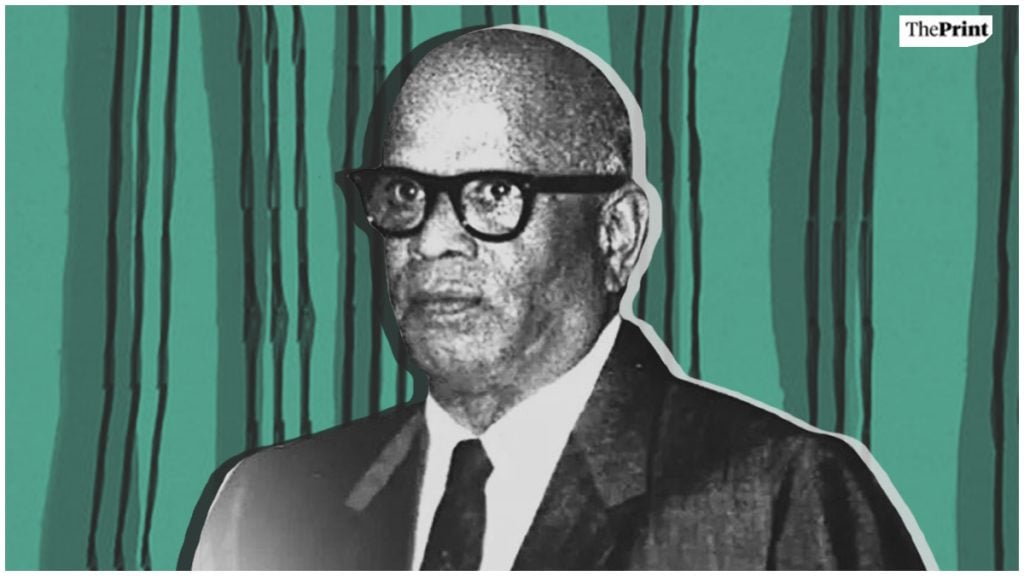
Menon states that, after a lengthy discussion at this meeting, it was decided that the accession of Jammu and Kashmir should be accepted, subject to the proviso that the will of the people would subsequently be ascertained. It was also decided that an infantry battalion should be flown to Srinagar the following day. This decision had the fullest support of Sheikh Abdullah, who was in Delhi at that time and had been pressing the Government of India on behalf of the All Jammu and Kashmir National Conference to send immediate help to the State to resist the tribal invasion from Pakistan.
There are four difficulties in this account. First, the Menon-Mahajan discrepancy. Menon’s identification of Mahajan as his companion on a journey to Jammu on 26 October is erroneous. It is contradicted by Mahajan, who places their joint journey on 27 October.
Second, Menon’s reference to proceeding to a meeting of the Defence Committee “arranged for that evening” is also erroneous. The committee had already held its ninth meeting that morning. Its next recorded meeting, the tenth, was on 28 October. The only other meeting held on 26 October was that of the Cabinet, which affirmed the decisions the Defence Committee had taken that morning.
The possibility of an earlier journey by Menon on 26 October for the Instrument, followed by a separate journey with Mahajan on 27 October for supplementary documents, has not been excluded
Third, Menon attributes the decisions to accept the accession and dispatch an infantry battalion to Srinagar to the supposed evening meeting of the Defence Committee on 26 October. There was no such meeting at which Menon could have presented the Instrument of Accession upon his return from Jammu. Indian troops were indeed flown to Srinagar the “next day” — on 27 October — but the decision to send them was taken at the ninth meeting of the Defence Committee at 11 am on 26 October, before Menon left for Jammu. The formal acceptance of the accession followed a meeting chaired by the Prime Minister on the evening of 27 October, at which Menon presented all the documents. This, however, was not a meeting of the Defence Committee.
Fourth is the question of Sheikh Abdullah’s presence when the accession was accepted. Sheikh Abdullah was present in Delhi on 26 October, when the Defence Committee took its decision on accession and military intervention. He was not in Delhi on 27 October, when the accession was formally accepted.
Although these inconsistencies impeach the literal accuracy of Menon’s memoirs, it is necessary to examine the available contemporary evidence before drawing any wider conclusion from them.
Contemporaneous evidence of Maniben Patel
The diary of Maniben Patel, Sardar Patel’s daughter, was published in 2001. It is crucial evidence that has not been considered thus far and may help explain some of the discrepancies in Menon’s memoirs. The entries from 24 to 28 October, which detail Menon’s movements and the meetings of Kashmir’s deputy prime minister Ram Lal Batra (spelled “Balra” in the diary) with Indian leaders, are reproduced below. The endearment “Bapu” here refers to Sardar Patel.
24.10.47: Assembly Secretary Kaul visited Bapu. 10.00 am- Bapu went with Shankar for Emergency committee meeting. 9.00 pm-Deputy Prime Minister, Kashmir, Balra called on Bapu.
25.10.47: Dr Saiffuddin Kichlu, Jawaharlal called on Bapu at 8.00 a.m. 10.00 a.m. – Bapu for Defence Council. 5.00 p.m.– Bapu for informal meeting. 9.15 p.m.- Panditji and Sheikh Abdullah arrived to meet Bapu.
26.10.47:8.30 a.m. Pattabhi called on Bapu. Mathai conveyed Jawaharlalji’s message so went to the latter’s residence. Bapu attended Defence Council meeting. I dropped off at Birla House where Lady Mountbatten stayed till 12.45 hours. Telephone from Mussoorie – Bapu to go to Bombay with Ghanshyamdasji. 3.00 p.m. – to Panditji’s House, Sheikh Abdullah, Menon, Mahajan, Balra, Sardar Baldev Singh arrived. Menon, deputed to Srinagar yesterday, returned this morning – again leaving for Kashmir tomorrow. 8.15 p.m.- Balra, Deputy PM, Kashmir called on Bapu,
27.10.47: 8.00 to 9.30 a.m. – Partition Committee meeting with Rajendrababu, Gopalaswamy Ayyangar, Hirubhai and three others. Rajendrababu stayed on for half an hour more. 11.00 a.m. – Bapu for Asian Labour Conference. 3.00 p.m. – The Statesman’s reporter Stevenson; Bapu with Shankar, Menon left for Defence meeting straight from Palam.
28.10.47: Jawaharlal’s telephone calling Bapu to his residence. 8.30 a.m. Maulana and Indo-British Goodwill Mission delegates called on Bapu. 10.30 a.m.- Bapu again called on Jawaharlal at his residence and both went to Governor-General and thence for Defence Council meet, with -Baldev Singh Public meeting at Gurgaon and one other place. Sent Menon to deliver message to Mountbatten that Panditji and he should not go to Lahore tomorrow. Went with Menon to Birla House to persuade Jawaharlal to cancel visit to Lahore.
Menon’s possible conflation of events of 26 and 27 October
On 26 October, Maniben records a Defence Council meeting followed by Menon’s presence at Nehru’s residence at about 3 pm. She notes that Menon, who had returned from Srinagar that morning, was “again leaving for Kashmir tomorrow”. This entry is indicative of Menon’s intended movements as Maniben understood and recorded them, suggesting that he was then expected to leave for Kashmir the following day. This is consistent with the lack of any apparent urgency, at least at that stage, for Menon to travel to Jammu and return to Delhi immediately with the executed Instrument, as all substantive decisions had already been taken and were being implemented.
Maniben’s diary independently corroborates certain elements of Menon’s later recollection. This lends weight to the possibility that he accurately recalled the principal events of 26 and 27 October but conflated their chronology and participants when he reconstructed them years later, attributing events of one day to the other
Maniben’s entry for 27 October records Patel, accompanied by his private secretary Vidya Shankar and Menon, proceeding “for Defence meeting straight from Palam”. Significantly, she describes the gathering simply as a “Defence meeting” and does not identify it as a meeting of the Defence Council or Committee, the Joint Defence Council or the Emergency Committee — bodies which she elsewhere refers to by name in her diary.
It is therefore quite possible that the entry refers to an informal meeting of a smaller group of ministers concerned with defence matters, chaired by the Prime Minister. The possibility that Menon innocuously referred to this defence-related meeting as a meeting of the Defence Committee in his retrospective account cannot be ruled out. This is particularly so since having himself attended the relevant meetings, Menon would have been familiar with when they took place, their proceedings and what decisions were taken at them.
Notably, Maniben’s diary independently corroborates certain elements of Menon’s later recollection. This lends weight to the possibility that he accurately recalled the principal events of 26 and 27 October but conflated their chronology and participants when he reconstructed them years later, attributing events of one day to the other.
This possibility can be examined by identifying the events described by Menon, establishing their actual chronology from Maniben’s diary and other contemporaneous records, and determining whether events from separate days appear to have been transposed and combined into a single narrative.
Important events on 26 October
- 9th meeting of the Defence Committee in the morning
- Decision to send troops the next morning, 27 October (direction 1 of Defence Committee 9)
- Preparation of the Instrument of Accession (IoA) and its provisional acceptance (direction 6 of Defence Committee 9)
- Evening Cabinet meeting that affirmed the decisions of the Defence Committee
- IoA signed in the night (official version)
Important events on 27 October
- Infantry battalion flown to Srinagar in the morning
- Menon’s visit to Jammu with Mahajan for supplementary documentation
- Evening meeting with the Prime Minister
- Formal acceptance of accession
Menon’s recollection of 26 October, nine years later
- Journey to Jammu with Mahajan soon after the 9th Defence Committee meeting
- Waking up the Maharaja
- The Maharaja preparing the letter and signing the IoA
- Flying back at once to Delhi with the documents
- Being met at the airport by Patel
- Going straight from the airport to an evening meeting of the Defence Committee
- Acceptance of accession after discussions
- Direction to send an infantry battalion the next day
It is apparent that Menon correctly remembered Sheikh Abdullah’s presence in Delhi, his own journey to Jammu after the Defence Committee meeting at which the dispatch of troops was directed, and his obtaining the Maharaja’s signature on the Instrument after waking him.
However, he appears subsequently to have associated with that journey events belonging to his documented journey of 27 October. These include Mahajan’s presence, the return through Palam, being met by Patel and proceeding directly to a defence-related meeting that evening, as well as the acceptance of the accession.
Significantly, Menon’s memoir contains no separate account of the journey of 27 October. If, as Mahajan records, that journey concerned only “certain supplementary documents about the accession”, Menon may simply not have retained it as a distinct event, particularly if the IoA had already been executed on the night of 26 October. However, two independently identifiable components of his narrative are undisputedly located on 27 October. One is Mahajan’s presence on the flight. The other is the sequence from the return to Palam through the defence meeting to the acceptance of the accession.
It appears that in his retrospective account, Menon merged the closely connected events of 26 and 27 October into a single telescoped narrative centred on 26 October — the politically decisive day on which the Defence Committee 9 and the Cabinet met, the decision to accept accession and dispatch troops was taken and the IoA was signed —thereby obscuring the actual chronology of the events and the participants involved.
It is therefore possible that the chronological inaccuracies in Menon’s account may reflect no more than an imperfect recollection of events rather than support the more far-reaching conclusion of antedating drawn by Lamb.
The 27 October documents and Nehru’s letters
Mahajan records that he accompanied Menon to Jammu on 27 October for the execution of “certain supplementary documents about the accession”. He says that “formal documents were signed” that day but does not identify any of them as the principal Instrument of Accession.
It has been argued that Mahajan considered the documents supplementary to the communication carried by RL Batra on 24 October. This overlooks the source of Mahajan’s description. Mahajan does not himself characterise the documents as supplementary to Batra’s communication. The description is attributed to Nehru, not supplied retrospectively by him to explain the relationship between the documents.
Whatever confusion Mahajan may have had concerning the precise character of an earlier accession-related document, there is no basis for imputing the same confusion to Nehru, who would have been familiar with the nature and requirements of the statutory IoA. In any event, writing more than fifteen years later, with Menon’s account and the official chronology already available, Mahajan could have said explicitly that the Instrument was executed on the 27th had that been his meaning.
Instead of satisfactorily accounting for Mahajan’s description, Lamb characterises it as “rather mysterious” and dismisses it. If Mahajan’s retrospective account is to be relied upon for the precision of his recollection of the events of 26 and 27 October, and to impeach the credibility of other accounts, due weight must also be given to the stated purpose for which Nehru asked him to undertake that journey. Mahajan’s choice of the word “supplementary” cannot be displaced by Lamb’s ipse dixit merely because an alternative interpretation accommodates his reconstruction. Any departure from the ordinary meaning of Mahajan’s words must therefore be supported by evidence.
Nehru’s letter of 27 October to the Maharaja states: “Shri V.P. Menon returned from Jammu this evening and informed me of the talks there. He gave me the Instrument of Accession and the Standstill Agreement which you had signed”.
Nehru thus confirms delivery of signed documents on 27 October without specifying when each was executed. The distinction matters because delivery on the 27th does not, without further evidence, establish execution on that date.
Since the substantive decisions on accession and dispatch of troops had already been taken and were being implemented, no material decision appears to have depended upon the immediate physical production of the signed Instrument before any authority. The Governor-General’s formal acceptance was in any event to follow on 27 October. Little would therefore have turned in practical terms on whether Menon delivered the signed Instrument separately on the night of the 26th or returned the following day with the complete accession documentation. A prior execution of the principal Instrument and subsequent delivery alongside supplementary documents remains plausible and consistent with Nehru’s letter.
Also Read: Getting princely states into the Constituent Assembly was a Patel and Menon masterstroke
Date of accession of Jammu and Kashmir: 26 October 1947
Lamb identified significant chronological inconsistencies in Menon’s retrospective account of the events of 26-27 October 1947. The evidence establishes that Menon was in Delhi until approximately 5 pm on 26 October, that Mahajan did not accompany him to Jammu that day, and that the two travelled together to Jammu on 27 October to obtain signatures on additional documents. These findings call into question the accuracy of Menon’s recollections, but not necessarily the date of execution of the Instrument of Accession.
Mahajan’s account establishes that he did not travel to Jammu on 26 October, not that Menon could not have travelled without him. Symon’s account fixes Menon’s presence in Delhi at a particular hour, not throughout the evening or night. It does not identify the absence of night-landing facilities as the reason for Menon’s abandonment of the journey, nor does it establish that a flight or landing after nightfall was impossible. Maniben Patel’s diary provides a possible explanation for the conflation of events in Menon’s memoir, while Nehru’s correspondence establishes the delivery of signed documents on 27 October, not necessarily the execution of the Instrument of Accession that day. Mahajan’s reference to “supplementary documents” identifies a purpose for the journey on the 27th distinct from the execution of the principal Instrument.
Although the discrepancies undermine a literal reading of Menon’s chronology, they do not establish that the Instrument was executed on 27 October. Lamb’s single-journey reconstruction may offer a plausible and economical explanation of certain inconsistencies, but plausibility is not proof, nor is parsimony a substitute for evidence. The possibility of an earlier journey by Menon on 26 October for the Instrument, followed by a separate journey with Mahajan on 27 October for supplementary documents, has not been excluded.
Since Lamb advances the hypothesis that the Instrument was antedated, the evidentiary burden of displacing the contemporaneous and near-contemporaneous evidence placing its execution on 26 October rests on him. Considered as a whole, the evidence upon which he relies does not discharge the burden, and his reconstruction ultimately infers more than what the evidence establishes. The continued plausibility of a two-journey reconstruction, with Menon subsequently conflating aspects of the events of 26 and 27 October, is itself sufficient to undermine the categorical conclusion that the Instrument must have been antedated.
The contemporaneous documentary record, corroborated by the converging testimonies of key participants, establishes that the Instrument of Accession was executed on 26 October 1947. That date therefore remains the historically supported date of execution.
Amit Krishankant Paul is a lawyer, independent researcher and author. Views are personal.
(Edited by Asavari Singh)