






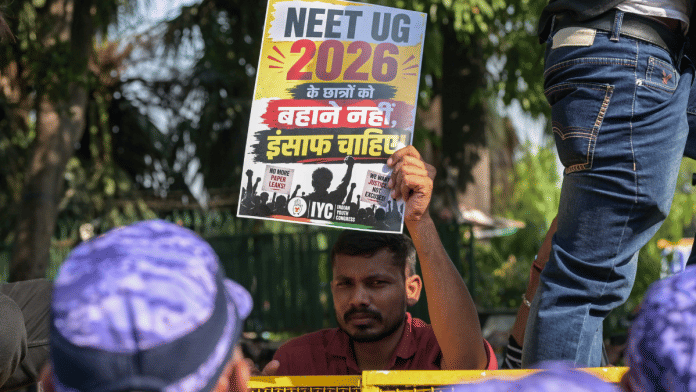


When NEET was proposed in 2010, experts argued that a single national-level entrance test for medical courses would uphold merit and improve the quality of education. However, the experience in the past few years has shown that it has not been the case at all. The NEET system ran into trouble as soon as it was introduced, with several states—Tamil Nadu, West Bengal, Gujarat, Andhra Pradesh, and Karnataka—opposing the change from the combination of state-administered entrance tests.
Over two million candidates across thousands of examination centres appeared for the National Eligibility cum Entrance Test (Undergraduate) (NEET-UG) in May 2026, the medical entrance examination conducted by the National Testing Agency (NTA). Within days of the examination, reports emerged that the process may have been compromised, with allegations that question papers had been leaked prior to the test, raising concerns about the integrity of the examination.
Early findings prompted scrutiny and raised concerns regarding a possible breach of confidentiality, though the full extent of the leak remained subject to investigation. Upon reviewing the findings, the NTA cancelled the NEET-UG exam, announced a re-examination, and waived additional fees while retaining candidate registrations.
The Supreme Court verdict
The one-country, one-test, NEET for medical admissions was initially proposed to take place from 2012 onwards. More than 80 cases opposing the undergraduate NEET were filed; two of these by state governments and the rest by private and minority institutes. On 18 July 2013, in a 2-1 split verdict on the validity of the NEET, a bench led by former Chief Justice Altamas Kabir held that the MCI and the Dental Council of India lacked legal authority to control admissions to MBBS, BDS and postgraduate courses. This view was shared by Justice Vikramjit Sen.
The 2024 NEET discrepancies were a big blow. The NEET (UG) examination was conducted by the NTA on 5 May at 4750 centres in 571 cities (including 14 cities abroad) for more than 24 lakh candidates. It was marred by allegations of question paper leaks.
The Supreme Court on 18 June made it clear to the Centre and the National Testing Agency (NTA) that it did not want “even .001 per cent negligence” on the part of anyone in the conduct of the undergraduate National Eligibility-cum-Entrance Test (NEET-UG) 2024 to be spared.
The court said that the NTA, which holds the exam for medical admissions in the country, should be able to take a firm stand and, if necessary, own up to having made mistakes if there were any made while holding the NEET-UG 2024.
“You (NTA) must stand firm. If there is a mistake, say ‘yes, there is a mistake. This is the action we are going to take’. At least that will inspire confidence in your performance,” Justice Bhatti said, addressing advocate Kanu Agrawal, appearing for the NTA and the Union government. Justice Nath agreed with his companion judge, remarking orally that the allegations on NEET were “very serious”.
Justice Bhatti told the Centre and NTA that they should not treat the petitions filed by NEET aspirants and academicians as adversarial.
“Imagine a person who has played fraud on the system becoming a doctor. That would be deleterious to society,” Justice Bhatti pointed out to the government and the NEET agency.
Justice Bhatti highlighted the honest effort put in by lakhs of children to prepare for NEET exam. Cheating thwarted honest effort and ambition. He further emphasised, “We all know the labour children put in, especially for this exam.”
With the exam coming under Supreme Court scanner, the NTA had on 13 June agreed to withdraw and cancel the score cards of 1563 candidates who were given grace marks. The agency would be conducting a re-test for them on 23 June.
The judge said all that was required was an honest examination of what may have gone “wrong”.
“If someone sits down at a table and goes through the performance of most candidates, one can find out what has gone wrong… how many cell phones were used and what were the places to which papers had come… We want timely action,” Justice Bhatti said, speaking for the Bench.
The hearing was based on two petitions filed by a total of over 30 candidates urging the apex court to take cognisance of the NEET controversy. The court has seen several petitions filed with similar prayers since the NEET results were declared early in June.
Petitioners urged the court to ask for an investigation report on the controversy ahead of the counselling date of 6 July.
Justice Nath issued notice and directed the Union and NTA to submit their responses in two weeks. The vacation bench listed the case for hearing along with the other petitions challenging various aspects of the conduct of NEET-UG 2024 on 8 July.
Ulimately, the SC ruled that the leaks were localised and not nationwide and refused to cancel the exam.
The present controversy raises a critical question: Are students and others affected adequately protected, while examining the legal framework, liability of actors, and the need for reform?
A paper leak falls within the category of ‘unfair means’ in legal terms, as defined under the Public Examinations (Prevention of Unfair Means) Act 2024. Section 3 of the Act expressly includes the unauthorised leakage of question papers or answer keys as a specific form of unfair means in the conduct of public examinations.
NEET examination is conducted by the National Testing Agency (NTA), an autonomous body under the Ministry of Education. The institutional role of the NTA is to ensure transparency, efficiency, and accountability in the conduct of national-level examinations.
At the administrative level, NTA prescribes a rigorous set of operational guidelines, which function as the first line of defence against breaches which are as follows
- Strict confidentiality protocols for question papers
- Secure printing, packaging, and transportation systems
- Multi-layered sealing and controlled access mechanisms
- Biometric verification and identity authentication of candidates
- Real-time CCTV surveillance and digital monitoring at examination centres
Although these measures are not legislative in character, their violation may trigger disciplinary actions as well as criminal liability.
The law treats paper leaking, and related public examination acts not merely as academic misconduct but as serious criminal violations affecting public order and institutional integrity. The conduct attracts serious criminal liability because it directly undermines fairness in public examinations and jeopardises the future of lakhs of deserving students. It is not governed by a single comprehensive statute but by a composite framework of administrative regulations and criminal laws. This layered structure is designed to ensure both preventive safeguards and punitive consequences, thereby addressing examination malpractices comprehensively.
Beyond administrative norms of NTA, statutory provisions assume critical importance, such as:
The enactment of the Public Examinations (Prevention of Unfair Means) Act 2024 marks a crucial legislative development aimed at preserving the credibility of public examinations in India. The key provisions include:
Section 3 — Unfair Means in Public Examinations:
Criminalises question paper leakage, unauthorised access to papers or answer keys, possession or circulation of leaked material, tampering with answer sheets, and use of digital means to facilitate cheating.
Section 4 — Offences by Service Providers and Institution:
Applies to printing presses, logistics contractors, examination vendors, technical agencies, and institutions, when negligence or collusion results in breach of confidentiality.
Section 5 — Organised Examination Fraud:
Targets solver gangs, middlemen, multi-state rackets, and criminal networks commercially distributing leaked papers.
Section 6 — Abetment:
Punishes indirect assistance, facilitation, encouragement, or logistical support provided to offenders.
Section 7 — Attempt to Commit Offence:
Criminalises attempts to leak papers or access confidential material even if the act remains incomplete.
Section 8 — Offences by Companies and Organisations:
Holds directors, managers, and responsible institutional officers liable unless they can establish due diligence and lack of knowledge.
The Act treats offences as cognizable and non-bailable, reinforcing deterrence. It recognises this offence as an organised one involving coordinated networks rather than isolated actors. To counter this, the law introduces penal provisions, including:
Rigorous imprisonment ranging from three to 10 years
Fines between Rs 10 lakh and Rs 1 crore
Attachment of property in organised fraud cases
With all the above provisions some of the questions go unanswered:
- Why are the provisions not backed by law or statutes
- Why are paper setters concentrated in one single region—Pune
- Who selects these paper setters
- Under which provision/law/rules are these paper setters selected
- Under which law are the omissions and commissions punishable
- Why are such repeated leaks taking place
- Why lessons learnt have not been acted upon
For students who have spent countless hours preparing, the paper leaks are deeply upsetting. It creates concerns about equal opportunities and raises doubts about whether the examination system is functioning effectively. Students experience uncertainty, frustration, and anxiety.
The stress of NEET increases significantly, affecting both their academic performance and mental well-being. Students feel betrayed by the system and doubt whether merit will be rewarded fairly. Apart from this, re-examinations create additional pressure as students are compelled to continue intense preparation even after completing the original exam, leaving them exhausted and burnt out.
Karnataka introduced the concept of Common Entrance Test (CET) for the first time in the 1990s, when the undersigned was Chief Minister of Karnataka. This was for admission particularly to engineering and medical courses including dental.
With the introduction of CET, Karnataka came to be known as the Mecca of professional education. The entire country looked upon Karnataka for quality and affordable professional education, which attracted many reputed IT firms and also their necessary human resource capital for the nation.
The judiciary also upheld the system in the judgment in the Unnikrishnan Vs State of Andhra Pradesh in the year 1993. Justice Jeevan Reddy, in the judgment, put down several forward looking approaches to professional education. Right from the inception of CET there was no instance of paper leak. The integrity of examinations has been maintained throughout.
The Chinese government had even sent a delegation to examine the CET system in Karnataka. The said system was adopted by the Chinese too.
The time tested system of CET adopted in Karnataka still continues for admission to engineering and various other professional courses across the country. The system was replaced with NEET as the Government of India thought it appropriate to introduce “one country, one test” for admission to medical colleges. The judiciary also upheld the decision.
Uniformity in conduct of admission test through NEET has created several complexities:
- Absence of uniform secondary examination system in the country
- The centralisation is wrought with inequalities prevailing in the various education systems across the country.
- The changeover from state administered entrance test to NEET has produced disparities and has virtually killed the initiatives of various states in ensuring quality and standardised education at the level of UG medical courses.
- NEET has also resulted in mushrooming of coaching classes and commercialisation of education all over the country. Colleges have also started NEET coaching classes. NEET favours students from urban and economically privileged backgrounds who have access to coaching centres and resources. While many students in private colleges get special coaching as part of their regular classes, those in government colleges do not get this facility. This discriminates against students from rural and backward regions which lack these resources, thus putting them at a disadvantage in the competitive examination. It hinders rural, poor, and government school students from securing admissions in medical colleges.
- Thus the initiatives taken by Government of India, State governments and judiciary to abolish capitation fees has again made the backdoor entry in the form of coaching classes and additional courses offered by various colleges across the country.
- The intense competition and high stakes of NEET has resulted in immense stress among students. Unfortunate incidents of student suicides due to NEET-related stress have raised serious concerns about the mental health and well-being.
- NEET enforces a standardised syllabus, which may not always sync with the curriculum in the state boards. This puts state board students at a greater disadvantage as they need to adapt to a different methodology of preparation.
- NEET is conducted in English and Hindi, posing a language barrier to students who have studied in regional languages. This language barrier hinders many students from performing to their full potential.
In the past seven years, the number of applicants has almost doubled from 12 lakh in 2017 to nearly 23 lakh in 2026. The widespread leak of question papers has undermined the integrity of NEET.
It is quite clear that fraud has been committed in the NEET system. It needs major surgery. The integrity of NEET has been compromised and students and parents have lost faith in the system. The ultimate result will be inferior quality of doctors both within the country and those who opt for post graduation abroad. It will reflect in the career and prospects of the students and the medical profession as a whole.
When in crisis the present NDA regime has always failed. It has not only failed the Gen-Z, but failed the people during the Covid-19 pandemic, employment generation, fall in rupee and on many other fronts.
This has created total unrest in the Gen-Z and the discontent among them is engulfing the country. Dozens of student suicides have not awakened the consciousness of the Prime Minister or the education minister. The call for resignation of Education Minister Dharmendra Pradhan has fallen on deaf ears, resulting in widespread demonstrations and agitations by Gen-Z all over the country including the Cockroach Janta Party. Their unrest is reaching its pinnacle.
The Government of India has to wake up and provide solace by taking accountability of the paper leak and assuage the unrest among the students. Time has come for a thorough review. If possible, delegate the process to the respective states. Both the judiciary and the administration must provide clarity in the education system.
M Veerappa Moily is former Chief Minister of Karnataka & former Union Minister. Views are personal.