




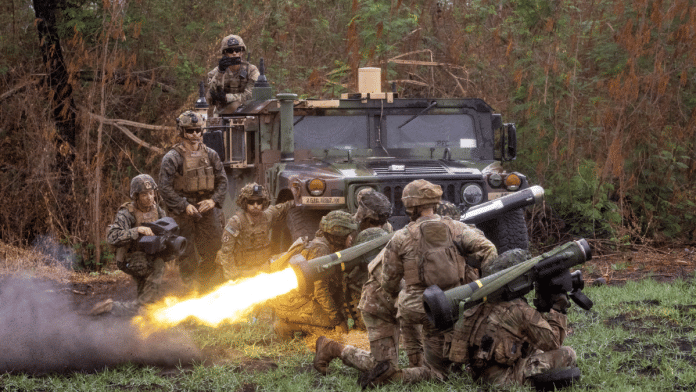

India and the United States have finally concluded the long-pending deal for Javelin anti-tank guided missile with an “initial” purchase of 100 missiles and 25 command launch units. The journey began in 2009 and had been repeatedly held up, principally over the extent of technology transfer and local production. Tata Advanced Systems has now signed an agreement with the Javelin joint venture of Lockheed Martin and Raytheon to explore production in India. Ironically, there is no mention of transfer of technology.
The deal sounded an alarm for Atmanirbharta in defence as the indigenous Man-Portable Anti Tank Guided Missile (MPATGM) with almost matching capabilities at a relatively lower cost, is all set for mass production. The second cause of concern is the very high cost of the Javelin when compared to the emergence of cheap drones as the most potent tank killer. In 2022 the Javelin costing approximately $200,000 per missile was the prima donna of anti tank warfare in Ukraine. Since 2023, it is the FPV drone costing only $400-500 which has become the scourge of tanks and the Javelin is barely mentioned. There is also speculation that this is a token deal in the larger interests of long-term India-US high technology defence cooperation to tide over President Donald Trump’s transactional era.
Be that as it may, the die is cast. However, a hundred Javelins and 25 CLUs are unlikely to transform India’s anti-armour capability. The more important question is what follows.
Will India use the Javelin as a limited, high-end capability while rapidly inducting its indigenous MPATGM and thousands of cheap attack drones? Or will it eventually use the Javelin as the basis for replacing its approximately 6,000 legacy second-generation ATGM launchers?
The first would be sensible. The second would be an expensive folly.
Contours of future conflicts
India’s future wars with Pakistan and China are unlikely to resemble the large-scale wars of the twentieth century. Nuclear deterrence places severe constraints on political objectives and geographical expansion. Neither side can assume that a conventional war can be fought indefinitely without risking escalation.
Thus, nuclear weapons limit but do not eliminate conventional war. They can instead produce a paradox: limited wars may become more likely precisely because the objectives are limited. These may take the form of high-end stand-off exchanges with air power, drones, missiles and other PGMs, as in Operation Sindoor. They can also take the form of preemptive operations in the plains or in mountains along the Line of Actual Control/Line of Control to seize critical territory, followed by a prolonged confrontation that puts the onus of escalation on the adversary. The confrontations in Eastern Ladakh from 2020-24 and the earlier Kargil War of 1999 are good examples of this model.
These confrontations can lead to kinetic exchanges and small-scale physical attacks to seize territory. A tactically important height, observation post, logistics node or limited piece of territory can acquire disproportionate political and military significance.
In a nut shell, territory continues to be a major factor, it still has to be defended or captured and that cannot be done by air power, missiles, drones or PGMs alone, but requires traditional combined arms. Thus, legacy weapon systems based on state of the art technology continue to be the sine qua non of the battlefield.
Javelin – the expensive icon of anti-tank warfare
There is little doubt about the Javelin’s capability. It is a mature third-generation, fire-and-forget ATGM with an imaging infrared seeker, top-attack capability and tandem warhead. It can defeat all modern tanks and a host of other hard targets. Its ability to engage from concealed positions and allow the operator to relocate immediately after launch gives it considerable survivability. The Indian Army does require such a capability.
While it is an icon of anti-tank warfare, it is certainly not futuristic or cost-asymmetric technology like drones.
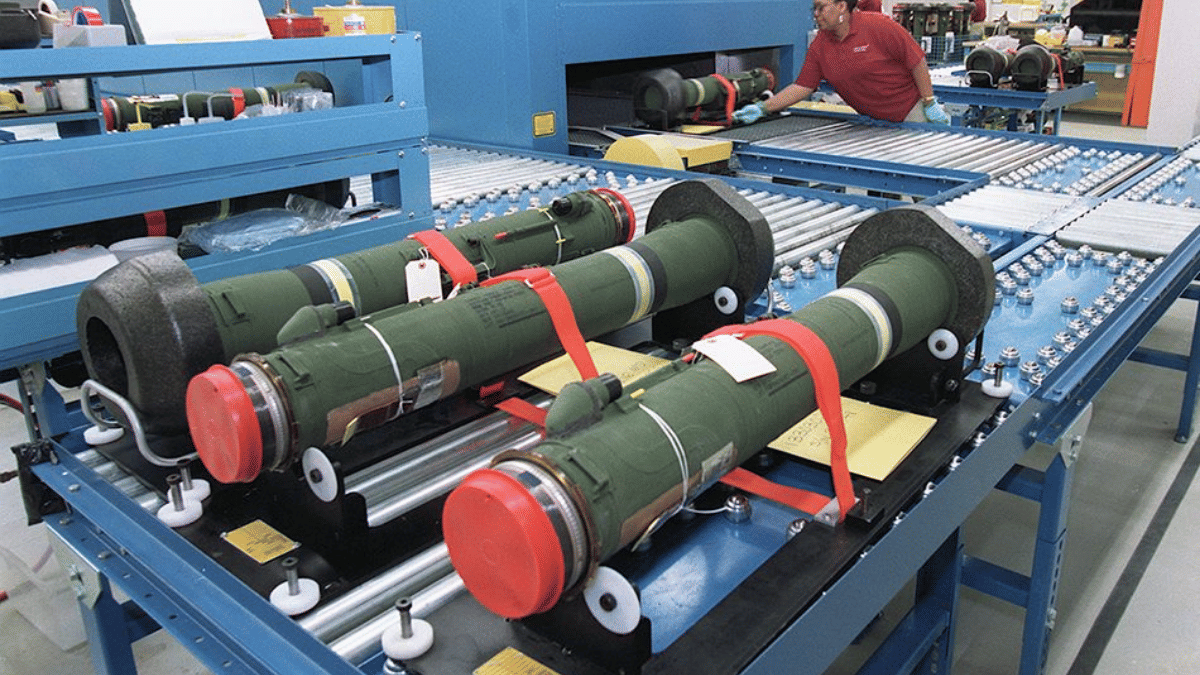
In the Ukraine war, for instance, drones have accounted for more tank, ICV, and other weapon platform kills than any other system. A Javelin missile costs orders of magnitude more than an FPV attack drone. Depending on the acquisition and configuration, a Javelin missile is commonly cited at around $200,000 or more. A basic FPV attack drone can cost only a few hundred dollars. At $400–500 apiece, the cost of one Javelin is theoretically equivalent to roughly 430–540 FPV drones. Even the cost of the indigenous MPATGM missile, though costing half as much as a Javelin, is equivalent to 215-270 FPV drones.
Legacy ATGMs and drones are complementary
Drones are cheap but cannot defend or capture ground, which requires combined arms weapons systems, of which ATGMs are an intrinsic part. As an anti-tank weapon, drones have vastly different range, penetration, seeker technology, weather tolerance, communications resilience and assured kill probabilities compared with modern ATGMs. Many will also be defeated by electronic warfare or physical countermeasures. An adversary with superior or matching drone capability can neutralise the mass and cost advantage of drones. It can even create an anti drone bubble around an attacking force.
In the foreseeable future, drones will complement third or higher generation ATGMs as a synergised anti-tank system while holding or capturing ground.
MPATGM should be India’s workhorse
India’s quest for a state-of-the-art, third-generation ATGM with fire-and-forget, top-attack, and tandem warhead capabilities began in 1983 with the establishment of the Integrated Guided Missile Development Programme. Under the Nag umbrella project, the Defence Research and Development Organisation (DRDO) is currently developing several ATGMs for infantry, mechanised forces and helicopters.
The base variant of Nag is a land-attack fire-and-forget ATGM with top attack capabilities and a range of about 4 kilometres; it can be mounted on the Nag Missile System (NAMIS) tracked platform based on BMP2. It also has a vehicle-based version.
Man Portable Anti-Tank Guided Missile (MPATGM) is the shoulder-fired version of the Nag ATGM, designed for infantry and special forces, and is ready for production. Currently, all Infantry Battalions are equipped with Fagot Launcher Adapted for Milan Equipment ATGMs at the scale of 8 and 2 for plains and mountains respectively. These missiles do not have tandem warhead and top attack capability and are ineffective against Explosive Reactive Armour of modern tanks.
When the Javelin negotiations began in 2009, MPATGM was still a developmental proposition. Today, the circumstances are different.
DRDO has demonstrated the missile’s top-attack capability against moving targets during trials in January 2026. The system incorporates an indigenous imaging infrared seeker and fire-control system and is now moving towards mass production.
The choice is therefore no longer between a proven American missile and an unproven Indian technology. India now has an indigenous third-generation man-portable ATGM approaching operational maturity.
That should become the Army’s principal man-portable anti-armour weapon.
The objective should be to produce it in large numbers, continuously improve its seeker, warhead and resistance to electronic and physical countermeasures, and develop a family of variants.
All Infantry Battalions in the plains and selected high-altitude areas, and in the mountains must be equipped with MPATGM at the scale of 8 and 4 launchers, respectively.
ATGM for mechanised forces
In the mechanised infantry, each BMP-2 is mounted with a Konkurs missile launcher, while T–90 tanks are equipped with 9M119M missiles fired through the main gun. Both these ATGMs are second-generation, wire-guided systems and lack the ‘fire-and-forget’ capability. They lack a tandem warhead and are only capable of direct horizontal attack, which is defeated by the tank’s reactive armour, restricting their use against ICVs and other similar targets. The Futuristic Infantry Combat Vehicle and Future Ready Combat Vehicle (future main battle tank) are still on the drawing boards and unlikely to see mass production before 2035-40.
There is a case to mount a third-generation ATGM launcher on all or a select number of BMPs. Reconnaissance and Support Battalions are being equipped with the NAMIS tank destroyer with 6 ready to fire missile tubes. Nag Mk2 has been successfully mounted on the Zorawar light tank. It is logical that a single or twin tube variant of the Nag ATGM should be mounted on the BMP 2. It would also be prudent to wait for the tube-launched variant of Nag ATGM for the T90 tank.
The Javelin enigma
The future of anti-tank warfare is a judicious mix of high-technology ATGMs and mass-produced FPV and AI-enabled autonomous drones. India has a very advanced ATGM development project under the Nag umbrella. NAMIS and MPATGM are reported to be set for mass production. The primary problem of indigenous production is the gap – stretching to years – between promise and delivery. It is for this reason that the Javelin deal becomes an attractive proposition as an interim stop gap measure before indigenous production takes off in two to three years.
In this light, despite the notorious “please Trump” label, I welcome the Javelin deal. However, 100 missiles and 25 CLUs would make hardly any difference, considering that India has an inventory of about 6,000 second- generation anti-tank launchers. In my view, approximately 100 CLUs and 400-500 missiles would meet the Indian Army’s interim requirement. It is debatable whether a joint Make in India project would be viable for this number.
Javelin ATGM, even with three more repeat orders, must remain an interim arrangement. India must remain steadfast in its commitment towards Aatmanirbharta in respect of third or higher generation ATGMs. It must guard against the temptation of opting for the Javelin as the final solution at the cost of indigenous systems, even if it comes with the sop of absolute transfer of technology.
India’s answer should instead be a high-low mix: a small number of exquisite Javelins, large numbers of indigenous MPATGMs and an enormous arsenal of cheap, intelligent and expendable drones.
The future battlefield will not belong to the army with the most expensive missile. It will belong to the army that can combine precision with mass—and sustain both for as long as the war lasts.
Lt Gen H S Panag PVSM, AVSM (R) served in the Indian Army for 40 years. He was GOC in C Northern Command and Central Command. Post retirement, he was Member of Armed Forces Tribunal. He tweets @rwac48. Views are personal.
(Edited by Prashant Dixit)