



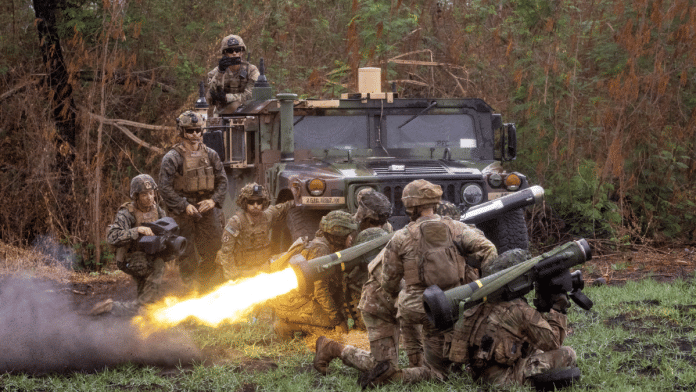
New Delhi: India have signed a deal with the US for the acquisition of Javelin anti-tank guided missile systems for the Indian Army. This marks India’s formal entry as a customer of the famed shoulder-fired weapon even as both countries work towards its eventual joint production in India.
The US Embassy in India said Friday that the Indian Army had signed a Letter of Offer and Acceptance (LOA) for the purchase of the Javelin. “The United States welcomes the Indian Army’s signing of a Letter of Offer and Acceptance (LOA) for the purchase of the Javelin,” the embassy said in a statement.
The agreement, it added, “opens the door for future collaboration between the U.S. and Indian defense industries”.
US Ambassador to India Sergio Gor said the agreement demonstrated the depth of American support for the Indian Army and created “new opportunities for our defense industries to work together”.
The signing of the LOA is significant as it moves the Javelin procurement from the stage of a US-approved possible Foreign Military Sale to an actual contracted acquisition.
The immediate requirement is being met through an emergency procurement, while India and the US are simultaneously working on a much larger proposal for joint manufacturing of the missile in India.
Also read: Emergency procurement done, India & US working on co-manufacturing Javelin anti-tank missiles
What India is buying
The US Defence Security Cooperation Agency (DSCA) had in November last year notified the US Congress of a possible Foreign Military Sale to India of the Javelin Missile System and associated equipment for an estimated $45.7 million.
India had requested 100 FGM-148 Javelin rounds, one additional Javelin missile for “fly-to-buy” evaluation and 25 Javelin Lightweight Command Launch Units (LwCLU), also referred to as Javelin Block 1 Command Launch Units.
Great news! India plans to acquire Javelin, the world’s premier anti-tank system, strengthening the U.S.-India defense cooperation. But what makes the U.S.-made Javelin so effective? Swipe to learn more… pic.twitter.com/Qt79aZDDVk
— U.S. Embassy India (@USAndIndia) August 28, 2026
The package includes training equipment, missile simulation rounds, a battery coolant unit, technical manuals, lifecycle support, spare parts and systems integration and testing.
The signing of the LOA now means that India has formally contracted for this package. Though the final numbers bought is unspecified, it is learnt that India has ordered 60 missiles and fewer launchers than originally plannedl with the deal now costing Rs 294 crore.
The Javelin is a medium-range, fire-and-forget anti-tank guided missile that can be operated by a single soldier. Weighing about 15.9 kg, it is designed to engage armoured vehicles as well as fortified positions.
The weapon has acquired considerable battlefield fame through its extensive use by Ukrainian forces against Russian armour during the ongoing Russia-Ukraine war. It is operated by the US military and more than two dozen international customers.
Emergency buy before Indian production
The immediate procurement, however, is not the end goal for India.
Sources in the defence and security establishment said the present purchase is essentially a one-off emergency acquisition while New Delhi and Washington continue discussions on setting up a manufacturing capability for the Javelin in India.
The idea of producing the missile domestically has been under discussion for some time.
As reported by ThePrint, in July last year, India submitted a proposal to the US for co-production of Javelin missiles.
This followed an agreement assigned between State-owned Bharat Dynamics Limited (BDL) with the Javelin Joint Venture (JJV), owned by Raytheon and Lockheed Martin, in February last year to explore opportunities for manufacturing the weapon in India.
Lockheed Martin had then said the agreement would allow the JJV to evaluate the possibility of manufacturing Javelin in India to meet potential future requirements of the Indian Ministry of Defence and strengthen India’s anti-tank capabilities.
The larger co-production proposal is, therefore, strategically more important than the initial 100-missile purchase.
If concluded, it would give India access not merely to the weapon but potentially to a domestic manufacturing ecosystem around one of the world’s most widely used man-portable anti-armour systems.
The 17-year journey
In June 2024, ThePrint reported that the deal expanded to an Israeli system, and soon, an indigenous solution, 15 years after the initial decision. But India and the US were back at the negotiating table for the joint production of the shoulder-mounted Javelin anti-tank guided missiles.
About 15 years after the initial decision was taken only to be spiked later for an Israeli system and then for an indigenous solution, India and the US are back to the negotiating table for the joint production of the shoulder mounted Javelin anti-tank guided missiles.
It was way back in August 2010 that India publicly announced its plans to acquire the Javelins. In a written reply in the Lok Sabha, the then Defence Minister A.K. Antony informed Parliament that his ministry was planning to issue a Letter of Request to the US for procurement of 3rd Generation Anti-Tank Guided Missile (ATGM), Javelin.
He had said that the procurement was being planned under the US FMS (Foreign Military Sale) route and would involve transfer of technology.
Back then in 2010, the Army had a shortfall of 44,000 ATGMs of various kinds against a sanctioned holding strength of about 81,000. The Army till then was only operating the 2nd generation 2-km-range Milan of French origin and 4-km-range Russian Konkurs ATGMs.
However, news came in 2012 that the Javelin deal hit a roadblock over transfer of critical technology and reluctance of the American government to participate in the field trials.
Manufactured under a joint venture of Raytheon and Lockheed Martin, the missile till then had been showcased only at joint exercises held between both the countries.
India then decided to buy the Israeli Spike ATGM but the larger procurement plan failed with the DRDO saying they can make a similar system. Eventually, the Army bought limited numbers of Spike in multiple orders.
(Edited by Ajeet Tiwari)
Also read: Trade deal sorted, India & US move on to pending defence pacts—P-8I aircraft first, engines next