




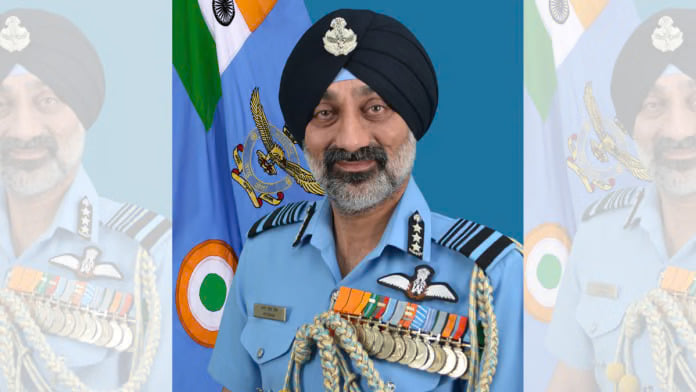

The debate over Integrated Theatre Commands, or ITCs, in India has been reignited by the recent statement from the Chief of the Air Staff Air Chief Marshal AP Singh. While speaking to PTI, he clarified that the Indian Air Force is not in favour of permanently splitting fighter assets geographically, advocating instead for a tailored structure built around India’s specific security requirements rather than replicating foreign models.
Air Chief Marshal (ACM) Singh also mentioned that the “transformation of this scale” should be implemented in phases so that operational readiness is “never compromised” and warned against the “trap” of trying to predict the future battlefield with “excessive certainty”.
The Chief of the Air Staff (CAS) is set to retire on 31 October 2026. With his retirement, the entire composition of the Chiefs of Staff Committee (COSC) would change from the one that operated under former Chief of Defence Staff General Anil Chauhan.
The proposal pending consideration at the Ministry of Defence (MoD) on this subject was forwarded by the previous COSC. With new incumbents, the issue would likely require a relook.
Urgent need for reforms
Higher defence management in India does need reform. That much is settled, and everyone agrees. What remains unsettled—and what must be settled after rigorous analysis—is the precise shape of that reform. The structures India ultimately adopts must reflect its strategic ambition, its resource constraints, foreign dependencies, geographic challenges, threat perception and the character of the wars it is likely to fight.
Geographic theatre commands, as widely understood from American and Chinese practice, are a borrowed construct. They may not fit India’s scenario. The country needs an Indian solution to an Indian problem. The proposal to distribute existing combat power under various theatre commands, defined geographically, appears to be a solution looking for a problem.
The wars of 1962, 1965 and 1971 led to discussion on reforms of higher defence management; however, they never gained sufficient momentum to cause any significant change. Institutional inertia trumped innovation.
Things changed after Kargil (1999).
The Kargil conflict exposed both operational coordination problems and a deeper higher-defence weakness. The Kargil Review Committee (KRC) noted that Service Chiefs had come to function more as operational commanders than as staff officers advising the government. It called for a review of apex decision-making and the relationship between the MoD and the services.
The reforms picked up pace. The recommendations of KRC led to the Group of Ministers (GoM) in 2001. The report from GoM was very comprehensive, and the recommendations covered various issues besides higher defence management. Many of these (HQ IDS, DIA, Andaman & Nicobar Command, Strategic Forces Command, NTRO elements, procurement structures, border management improvements, etc.) were implemented in the following years.
The Chief of Defence Staff (CDS) recommendation remained pending. That recommendation reappeared clearly in the Naresh Chandra Task Force (2012). The Shekatkar Committee (2016) added a few layers later. All these efforts culminated in the creation of the CDS and the Department of Military Affairs (DMA) in 2019. Parliament codified the effort of jointness by passing the Inter-Services Organisations Act (2023).
One of the key responsibilities assigned to DMA was facilitation of restructuring of Military Commands for optimal utilisation of resources by bringing about jointness in operations, including through establishment of joint/theatre commands.
One of the key responsibilities assigned to the CDS was to bring about jointness in operations, logistics, transport, training, support services, communications, repairs and maintenance, etc of the three services within three years of the first CDS assuming office.
Also read: Air Marshal Dixit inherits an Air Force in demand, yet short of allies
ITC takes shape
The efforts to create ITC began in earnest under General Bipin Rawat, the first CDS. The efforts continued to gain momentum under General Chauhan, his successor. General Chauhan’s team reportedly advanced a detailed proposal to the MoD.
The exact details of the proposal are not known. However, the version that frequently appears in media narration envisages three ITCs: a northern command focused on China, a western command focused on Pakistan and a maritime command for security interests in the oceans and seas. Under this model, forces from all three services would be placed under single theatre commanders for defined geographic areas. Progress, however, stalled over differences among the services, particularly on the allocation of limited air assets.
Sources indicate the Indian Air Force (IAF), while staunchly against the idea of parcelling out limited and scarce air resources, is willing to accommodate the idea that the resources be allocated, on a case-to-case basis, by a Joint HQ operating under CDS and COSC. ACM Singh’s recent statements have crystallised the Air Force position.
The guiding principle, he said, should be “centralised control where necessary and decentralised execution where appropriate.” He pointed to Operation Sindoor as an example in which centralised allocation and rapid reallocation of assets under a joint architecture proved decisive.
Some commentators have expressed frustration over the stalemate and lashed out at the IAF, calling out the concerns as a bogey. Prominent national security commentator Nitin Gokahle called on the PM to crack the whip on this issue. Former Navy Chief Admiral Arun Parkash was scathing in his criticism when he chided the CDS by stating that the current CDS must either get on with it or hand the “hot potato” back to the politicians to handle.
The debate goes on, differences linger, and we are stuck at the same place. We are unable to solve the problem because we lack a clearly defined problem statement.
Problem statement with Indian characteristics
Reform of higher defence management is necessary. The post-Kargil diagnosis correctly identified the disjointed military. There is a clear need for improvement in terms of integrated advice, prioritisation of resources, and mechanisms that prevent the services from operating in parallel silos. Existing arrangements—17 single-service commands—are one too many. Reducing layers of military bureaucracy and improving joint planning is a legitimate ask.
Yet the reform being recommended is not borne out of the diagnosis. As a recent analysis by Anchit Gupta on the subject argues—theatre commands can improve field-level coordination of forces already authorised for an operation. They do not, by themselves, solve the more serious problem of producing coherent military advice or deciding whether a conflict should be escalated.
A theatre commander cannot override political thresholds set by the Cabinet Committee on Security or the COSC. Conflating the two problems risks producing organisational change that addresses only part of what Kargil revealed.
India’s actual problem statement is shaped by two interlocking realities. First, our threats are from our neighbours—contiguous, persistent and potentially simultaneous. Our threat matrix varies from an isolated threat from either China or Pakistan to a collusive pincer. Growing maritime interests in the Indian Ocean complicate our security challenges. These are not neatly separable theatres in the way distant American or Chinese expeditionary theatres can be.
Second, resources are constrained. The IAF’s fighter strength has fallen to around 29 squadrons against an authorised figure of 42.5. Strategic enablers like tankers, AWACS, long-range transports, and EW support aircraft are even scarcer. In case of a full-fledged war with Pakistan, China or both of the nations, almost all of the IAF’s assets would be involved. Permanent geographic division of such assets for peacetime expediency and neat organograms risks sub-optimal employment in case of a war.
Modern warfare has shifted toward non-contact, long-range, multi-domain operations involving drones, precision munitions, space, cyber, and information effects. Ongoing conflicts in Ukraine and the Middle East, as well as our own experience during Operation Sindoor, have illustrated the premium on institutional agility and the ability to concentrate effects rapidly from a single source rather than relying on distributed geographic headquarters.
Also read: Air Chief Amar Preet Singh made military families feel seen, heard and remembered
Geographic theatre commands is a borrowed construct
Geographic theatreisation assumes that proximity and unity of command within a defined territory will produce the most effective outcomes. This logic may fit powers that project force across distant oceans or that reorganise large continental forces seeking to expand territories. For India, it risks becoming a solution in search of a problem.
In June 2025, this was precisely argued. The proposed model seeks physical integration of forces operating in domains with fundamentally different operational tempos, logistics, and cultures. Modern warfare rewards super-specialisation and functional synergy more than co-location. Long-range precision strikes, drone swarms, satellite-enabled transparency of the battlefield, and information operations do not respect neat geographic boundaries.
Existing (numerous) command headquarters already represent part of the problem. Replacing one set of geographic headquarters with another may create new layers without addressing the core requirement of agile, accurate and available force application.
The IAF’s long-standing preference for centralised control of air power is not mere institutional preference. Air power is inherently flexible and can be concentrated across fronts in hours. Unlike the army’s armour columns or navy’s CBGs, IAF squadrons don’t take weeks to deploy and be operational. A fighter squadron based in the northeast can deploy to any of the bases in the West within eight hours and be operational in another six.
Dividing limited fighter squadrons permanently into theatres reduces the ability to mass them where the political and operational situation demands. As Air Chief Marshal Singh has emphasised, the test is whether structures allow air power to be employed to its greatest effect within an integrated framework, not whether they conform to a template.
A promising direction
A more promising direction is functional integration focused on outcomes rather than on redrawing maps. This approach would retain a smaller number of geographic commands, as it aligns with the surface combatants (army and navy) concept of operations. One western, one northern, and one maritime should suffice. In addition, we need to create and strengthen functional commands for logistics, training, joint doctrine, space, unmanned systems, cyberspace, and strategic forces.
Service headquarters should focus on force generation by continuing to raise, train, and sustain their forces. Meanwhile, joint planning must guide force employment and operational application of force at Joint Force HQs (or similar organisations) working under the CDS and COSC. The asset allocation could be decided at the Joint Force HQs, on a case-by-case basis, depending on the military objectives set by the political leadership.
To synergise force application in a whole-of-nation format, the Joint HQ must also have representatives of DRDO, ISRO, MEA, MHA and national intelligence agencies. These reps must be placed in the command chain of the organisation and not work as appendages. Such a model allows integration to extend beyond the services into other arms of the government.
With ACM Singh’s retirement, the COSC will change. That change creates both a risk of institutional memory loss and an opportunity for fresh analysis. The proposal advanced under General Chauhan remains under consideration in the ministry. The services have largely completed internal work on broad modalities, but key divergences on asset allocation persist.
The correct sequence would be to define the Indian problem statement with greater precision. Factors like national ambition, available resources, threat scenarios, likely courses of action from the adversaries and finally political directions should be considered afresh. Changes must be implemented in phases that protect current readiness. Functional integration measures that do not require large-scale permanent reassignment of forces can proceed faster. Geographic reorganisation, if pursued, should be limited and reversible where possible.
India has already demonstrated that it can generate joint effects without full geographic theaterisation, as Operation Sindoor illustrated. The higher-defence reforms initiated after Kargil remain incomplete in the area of integrated advice and prioritisation. Completing those reforms, while designing command arrangements that match India’s strategic constraints and opportunities, is more important than adopting a model that looks familiar but remains unsuitable for our requirements.
The cat has been set among the pigeons by the recent statements by the CAS on the eve of his retirement. That is useful if it forces a clearer definition of the problem India is actually trying to solve. The solution that emerges must be Indian in origin, rigorous in analysis, and tailored to the country’s ambition, challenges, resources, and threat matrix. Anything less risks solving a problem that belongs to someone else.
Group Captain Ajay Ahlawat is a retired IAF fighter pilot. He tweets @Ahlawat2012. Views are personal.
(Edited by Saptak Datta)