




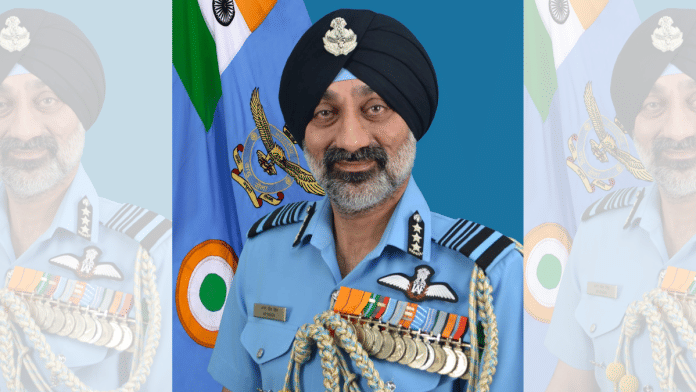

A military chief’s legacy lives in the force he leads and the people who remember his care. It is recorded in operations, decisions and preparations for the future. It also survives in a family’s memory of a visit, an injured air warrior’s experience of encouragement, and the reassurance offered to someone who has waited decades to be heard.
As Air Chief Marshal Amar Preet Singh prepares to retire on 31 October 2026, his tenure will be assessed through Operation Sindoor, combat readiness and the challenges of modernising the Indian Air Force. My perspective also comes from seeing how he responded to people whose lives had been shaped by service and its consequences.
He assumed command in September 2024 and led the IAF through Operation Sindoor, during which the force conducted precision strikes and helped counter Pakistani drone and missile attacks. Those operations depended on air warriors across disciplines and coordination between the services. Singh carried the responsibility of leading the Air Force through that confrontation.
Personal touch
He was also forthright about procurement delays. His demands for realistic timelines and timely delivery brought attention to an unresolved problem: the gap between plans for future capability and equipment available for present requirements. These challenges will outlast his tenure, but his willingness to discuss them publicly deserves recognition.
My own experience of him began while writing The Silent Warrior, the biography of Damayanti V. Tambay, wife of Flight Lieutenant VV Tambay, who went missing during the 1971 India-Pakistan war and is believed to have been taken prisoner.
When we first met, she told me that since her husband had left for war in December 1971 and never returned, she had not received a single phone call from the Indian Air Force. Her words stayed with me. Beneath them lay decades of waiting and the hurt of feeling forgotten. I felt a responsibility to tell her story and hoped that, in doing so, I could ease some of that pain.
The book took almost two years to complete. I then shared the manuscript with Air Chief Marshal Singh and requested a foreword. He wrote it and also launched the book. What touched me was the personal interest he took in the occasion. He stayed until the end, warmly receiving attendees, speaking with them and patiently accommodating requests for photographs and autographs.
For Mrs Tambay, that warmth felt like a balm on a wound that time had never quite healed. His care continued beyond the launch. More than a year later, Air Chief Marshal Singh continues to ensure that she is invited to major IAF events.
Those invitations could not answer her questions about her husband or undo the years of uncertainty. But they renewed her connection with the service to which he belonged. For a woman who had spent decades waiting, being remembered and welcomed back held a meaning of its own.
Mine was no isolated experience. Veterans, young people and others who have met the Air Chief Marshal often speak of the warmth with which he received them. He made them feel valued and at ease, as though they were meeting one of their own.
Also read: Lt General Vijay Oberoi proved that war can wound the body, not the spirit
One who supports, remembers and respects
In August 2025, Singh and wife Sarita Singh visited the family of Sergeant Surendra Kumar Moga, who had lost his life during Operation Sindoor. Besides paying tribute, he discussed practical concerns, including the battle casualty certificate and progress toward employment for the sergeant’s widow.
He also visited Corporal Varun Kumar at Pune’s Artificial Limb Centre during rehabilitation following an amputation after injuries sustained in the operation. He met other patients and acknowledged the medical staff supporting their recovery.
I also know of bereaved parents who met him and received a Chief of the Air Staff medallion. It was a personal gesture of recognition, meaningful to a family carrying the loss of their son.
Veteran Group Captain ML Bountra’s account offers another perspective. During a visit to present his book, Singh repeatedly addressed him as “Sir.” When Bountra objected, Singh acknowledged his seniority and his generation’s contribution to building the Air Force. The veteran described leaving with a renewed sense of belonging.
These encounters reveal an aspect of leadership that deserves attention: how serving personnel, veterans and families are treated.
Through my work with military families, I have seen how much continued contact matters. A meeting is welcome; being remembered afterwards often matters more. That is why Singh’s sustained engagement with Mrs Tambay remains, for me, the most telling example.
There is much unfinished work in Air Force modernisation, and Singh’s successor will inherit demanding responsibilities. Alongside that institutional assessment, there is room to acknowledge a Chief who gave time to people whose concerns could easily have remained outside the conversation.
As he prepares to retire, many in the military fraternity would welcome a fitting appointment where his experience, candour and understanding of military lives can continue to serve the nation. His contribution need not end with his tenure as Chief of the Air Staff.
Thank you for your service, Chief.
You will be missed.
Jai Hind.
Ambreen Zaidi is an award-winning military author and activist, honoured by the President of India, for her work on war widows and disabled soldiers. Views are personal.
(Edited by Ratan Priya)