






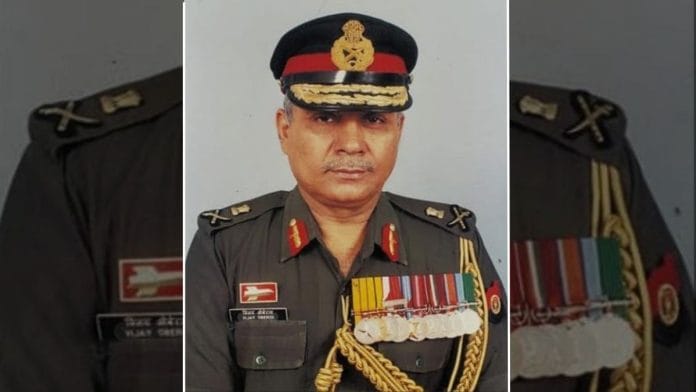


Lieutenant General Vijay Oberoi, the former Vice Chief of Army Staff, passed away on 14 June at the Chandigarh Army Hospital aged 84. With his passing, India has lost a decorated General and a soldier who redefined what it means to endure, to lead, and to serve. Commissioned into the Maratha Light Infantry in June 1961, Lt Gen Oberoi belonged to a generation for whom soldiering was a covenant of duty. It was not just a career for him.
War altered the course of his life in 1965. Serving in Jammu & Kashmir, he sustained injuries that resulted in the amputation of his right leg. For a young infantry officer, it could well have marked the end of a promising military career. Instead, Lt Gen Vijay Oberoi embarked on a journey that would come to inspire generations of soldiers. Refusing to let disability define either his identity or his contribution, he continued to serve with distinction, transforming personal adversity into a lifelong commitment to leadership and the welfare of fellow war-disabled veterans.
Over the years, Lt Gen Oberoi held some of the Indian Army’s most important appointments, including Director General Military Operations, General Officer Commanding-in-Chief Army Training Command, General Officer Commanding-in-Chief Western Command, and finally Vice Chief of Army Staff. He superannuated on 30 September 2001.
‘Erudite soul mate’
As Vice Chief of Army Staff during a critical period in the Army’s evolution, Lt Gen Oberoi played an important role in steering the implementation of post-Kargil reforms. Deeply conscious of the human cost of war, he remained committed to strengthening operational preparedness, refining training systems and ensuring that the hard-earned lessons of conflict translated into institutional change.
For him, honouring the sacrifices of soldiers also meant equipping future generations to fight better and smarter. He also served as Colonel of the Maratha Light Infantry Regiment, carrying its ethos not merely as words, but as a way of life.
There was also another aspect in his remarkable journey, his wife, Daulat Oberoi. Their daughter, Rashmi Oberoi, once described her as his “erudite soul-mate.” In one of the most poignant details of his life, Lt Gen Oberoi is said to have won Daulat’s heart while still on crutches after losing his leg in the 1965 war. Behind the General’s public courage stood a partnership of rare grace, one built on shared resilience, solid support and deep companionship. The story of a soldier, after all, is often also the story of the person who walks beside him through recovery, postings, command and a lifetime of service.
After retirement, Lt Gen Oberoi remained deeply committed to the welfare and dignity of India’s war-disabled soldiers. As founder-president of the War Wounded Foundation, he worked tirelessly to ensure that those who returned from war wounded but alive were not pushed to the margins of national memory. He knew their battles because he had lived one of his own. He believed that rehabilitation was not about charity, but about restoring independence and purpose.
Under his leadership, the Foundation focused on long-term rehabilitation, livelihood opportunities, education and support for war-disabled veterans and their families. He often reminded the nation that while the fallen are rightly remembered, those who survive with life-altering injuries deserve equal recognition and respect.
Also read: India’s nuclear doctrine was built for 2003. The logic of deterrence has changed by 2026
Extraordinary resilience
My own association with Lt Gen Oberoi began during the writing of my book, Soldiering On, which documented the real-life stories of India’s disabled soldiers. I had approached him seeking the perspective of someone who had not only risen to the highest echelons of military leadership, but had also experienced the realities of life after a battlefield injury. What followed was one of the greatest privileges of my journey as a military writer.
He guided me generously through the completion of the book, sharing his experiences, offering invaluable inputs, helping me understand the nuanced challenges faced by war-disabled soldiers, and ensuring that their stories were told with honesty, dignity and empathy. His wisdom came not from theory, but from a life that had witnessed both the brutality of war and the extraordinary resilience of the human spirit.
For me, Lt Gen Oberoi became the guiding light. His commitment towards ensuring that India’s disabled soldiers were seen, heard and remembered profoundly shaped my own understanding of courage and service.
A soldier-scholar, writer and institution-builder, he was also the founding Director of the Centre for Land Warfare Studies (CLAWS) and remained an important voice on national security, soldier welfare and the future of the Indian Army. He championed the idea of a “thinking Army” one that constantly studied warfare, adapted to changing realities and prepared itself for the conflicts of tomorrow.
Even age could not diminish his spirit.
At the age of 72, he ran the Mumbai Marathon on a prosthetic leg, a powerful reminder of the way he had chosen to live his life: undiminished, resolute and in service till the end. The marathon was a message to every war-disabled soldier that life after injury could still be one of purpose, achievement and dignity.
Lt Gen Oberoi leaves behind a legacy of courage, command, scholarship and lifelong commitment to India’s war-wounded soldiers. He showed, through the example of his own life, that while war may wound the body, it need not diminish the spirit.
As I bid farewell to him, I realise that the greatest lesson he left behind was not simply about overcoming disability. It was about refusing to allow adversity to diminish one’s sense of purpose. He transformed personal loss into service, pain into compassion, and experience into advocacy for those who followed in his footsteps.
For countless disabled soldiers and military families, he was not merely a former Vice Chief of Army Staff. He was proof that adversity could be transformed into service, loss into leadership, and personal suffering into a mission larger than oneself.
For me, he will remain the General who taught me that some of the bravest battles are fought long after the guns fall silent.
A General till the very end. India salutes him.
(Edited by Saptak Datta)