





An odd contradiction underlies India’s growing appetite for air power. The Army wants more access to it, the Navy wants more of it at sea, and political leaders have seen at Balakot and during Operation Sindoor the options it offers without committing to a prolonged campaign. Meanwhile, the Indian Air Force is down to 29 fighter squadrons against an authorised 42.5. As demand grows, the available strength is thinning, and claims upon it are multiplying.
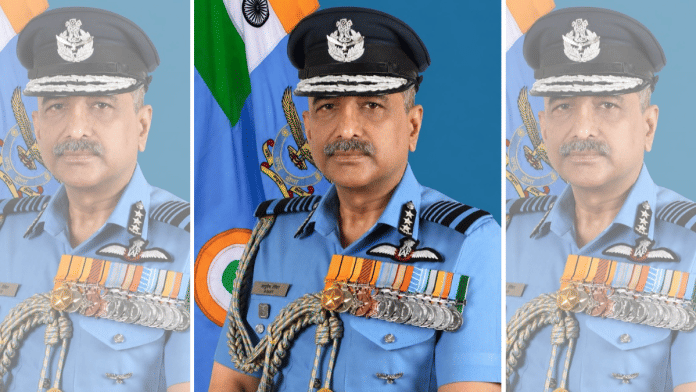
Air Marshal Ashutosh Dixit takes over on 31 October in these circumstances. He also follows a Chief whose manner was anything but conventional. Air Chief Marshal AP Singh spoke easily to the public, was comfortable with humour, and rarely disguised his views behind the formality of office. The incoming Chief will have his own style, but the visibility of the office and the expectations attached to it have changed.
The obvious part of Air Marshal Dixit’s inheritance is the aircraft shortage. Tejas Mk1A deliveries have slipped, while Tejas Mk2 and AMCA are years away from forming operational squadrons. Additional imported fighters may ease the shortage, but cannot remove the difficult choices between present readiness and long-term domestic capability. The Chief can argue for a balance. Money, industrial capacity, and the pace of national procurement will determine how much of it he gets.
A harder problem is less visible in the discussion of squadron numbers. The Indian Air Force (IAF) has remarkably few natural allies in the institutions whose decisions now shape or influence its future. This does not mean that other Services or industry are working against it. But each has legitimate interests that do not always coincide with what the Air Force considers necessary, and the differences have become unusually public.
Institutional isolation of the IAF
One source of tension predates theaterisation by decades. The Army and Navy have steadily sought greater air capabilities of their own. The Navy took over maritime reconnaissance from the IAF in 1976 and today operates its own carrier aviation, maritime patrol aircraft, and surveillance systems. The Army has expanded its aviation and ground-based air defence, and has 90 Prachand attack helicopters on order, compared with 66 for the IAF. Both Services also look to the Air Force for capabilities beyond their own inventories. These developments are natural, reflecting how important air power has become to operations. But they also create competing interests over resources, responsibilities, and control of the air domain.
Theaterisation presents a separate challenge. It concerns how the capabilities of all three Services should be commanded and employed in war, irrespective of who owns them. The IAF has legitimate concerns about dividing its limited fleet among geographical commands. Air power derives much of its strength from reach, speed, and the ability to concentrate force. Aircraft committed to one front may be needed elsewhere within hours, while a national air campaign may serve purposes far beyond the immediate needs of one theatre. Equally, a theatre commander must have dependable access to air support. The structures must reconcile these requirements rather than treating the division of aircraft as an answer in itself.
The two debates have different origins, but both contribute to the IAF’s institutional isolation. Its desire to retain flexibility in employing air assets can appear to other Services as reluctance to share control. At the same time, its concerns about theaterisation can be interpreted as resistance to integration. Neither is necessarily a fair reading of its position. Yet the differences are real, and reconciling them requires more than sound arguments. Air Marshal Dixit must build enough trust to move these discussions beyond competing institutional claims.
A similar tension exists with the country’s defence industrial establishment. Air Chief Marshal AP Singh did not mince words about HAL’s delayed Tejas deliveries, and he was right to insist that commitments mean something when squadron strength is falling. His candour gave a public voice to an operational problem that could not be wished away. The incoming Chief inherits the same problem and must pursue its resolution with equal determination.
At the same time, HAL and the wider indigenous aviation industry are indispensable to the IAF’s future. The relationship needs closer engagement, realistic commitments, and accountability. Experimental failure is part of building complex aircraft, but indefinite delivery slippage cannot become its accepted companion. Too often, the IAF’s insistence on operational capability is portrayed as a preference for imported equipment, as though support for indigenisation and concern about readiness were competing loyalties.
Also read: Marco Rubio’s visit shows US needs India—the ‘refining superpower’
A cultural challenge
Thus, on sharing and control of air assets, the IAF risks appearing territorial; on theaterisation, obstructionist; and on procurement, insufficiently committed to indigenisation. Together, they leave the Air Force spending considerable effort defending otherwise operationally justified positions. Rebuilding those relationships without compromising professional judgement will require considerable skill from the incoming Chief.
Another challenge comes from outside the defence establishment. Balakot and Operation Sindoor have drawn a much wider public, particularly younger Indians, into conversations about air power. The interest extends well beyond operations to aircraft, armament, engineering, infrastructure, and flight safety. Even an aircraft accident attracts intense scrutiny despite the considerable long-term improvement in the IAF’s flight-safety record. This wider attention calls for the Service to build a sustained ability to explain its work, its decisions, and its setbacks, while protecting operational information. For Air Marshal Dixit, making strategic communication an institutional strength is both an opportunity and an imperative.
Technology may be the most unsettling part of his inheritance. There is no reason to assume that combat aircraft are about to disappear, but there is every reason to question whether the manned fighter will retain its present share of military air power. Drones, loitering weapons, autonomous systems, electronic warfare, and networked sensors are taking over an increasing range of tasks. Air power may become more consequential, even as its familiar platforms lose some of their centrality. Air Marshal Dixit himself remarked earlier this year that unmanned systems were already replacing manned aircraft in a growing number of roles.
That calls for changes extending well beyond the purchase of new equipment. Traditional procurement processes are uncomfortable with technologies that must be tested, adapted, and upgraded repeatedly. Research establishments and industry need more room to experiment and learn from failure. The IAF, too, will need to alter some deeply established habits. A Service organised around flying, squadrons, and long equipment lifecycles will increasingly rely on software engineers, data specialists, electronic-warfare operators and those who can combine manned and unmanned systems.
This is a cultural challenge. Training, career progression, and the standing accorded to technical expertise will need to evolve. Technical judgement must quickly enter operational decisions. Commanders will have to become comfortable with systems that change continuously, and with experimentation that does not always succeed. Changing this culture will be harder but perhaps more consequential.
Air Marshal Dixit is well equipped to understand both the institutional and technical sides of the problem. He has flown the Tejas as an experimental test pilot and served as Chief of Integrated Defence Staff. His challenge will be to use that experience to bring the other Services, industry, and government into closer agreement, while making the necessary changes within the IAF itself. It is an unusually demanding inheritance for a Chief.
But if everyone wants more air power, it’s a good problem to have for the Air Force in some ways.
Anchit Gupta is a military aviation historian. His X handle is @anchitgupta9. Views are personal.
(Edited by Prasanna Bachchhav)