




Trade tensions have dominated the US-India relationship over the past year, but the headlines tell only part of the story. American firms continue pursuing production and technology partnerships in India, while Indian companies invest in US manufacturing. Even as Washington and New Delhi struggle to settle trade terms, businesses on both sides continue to bet on each other.
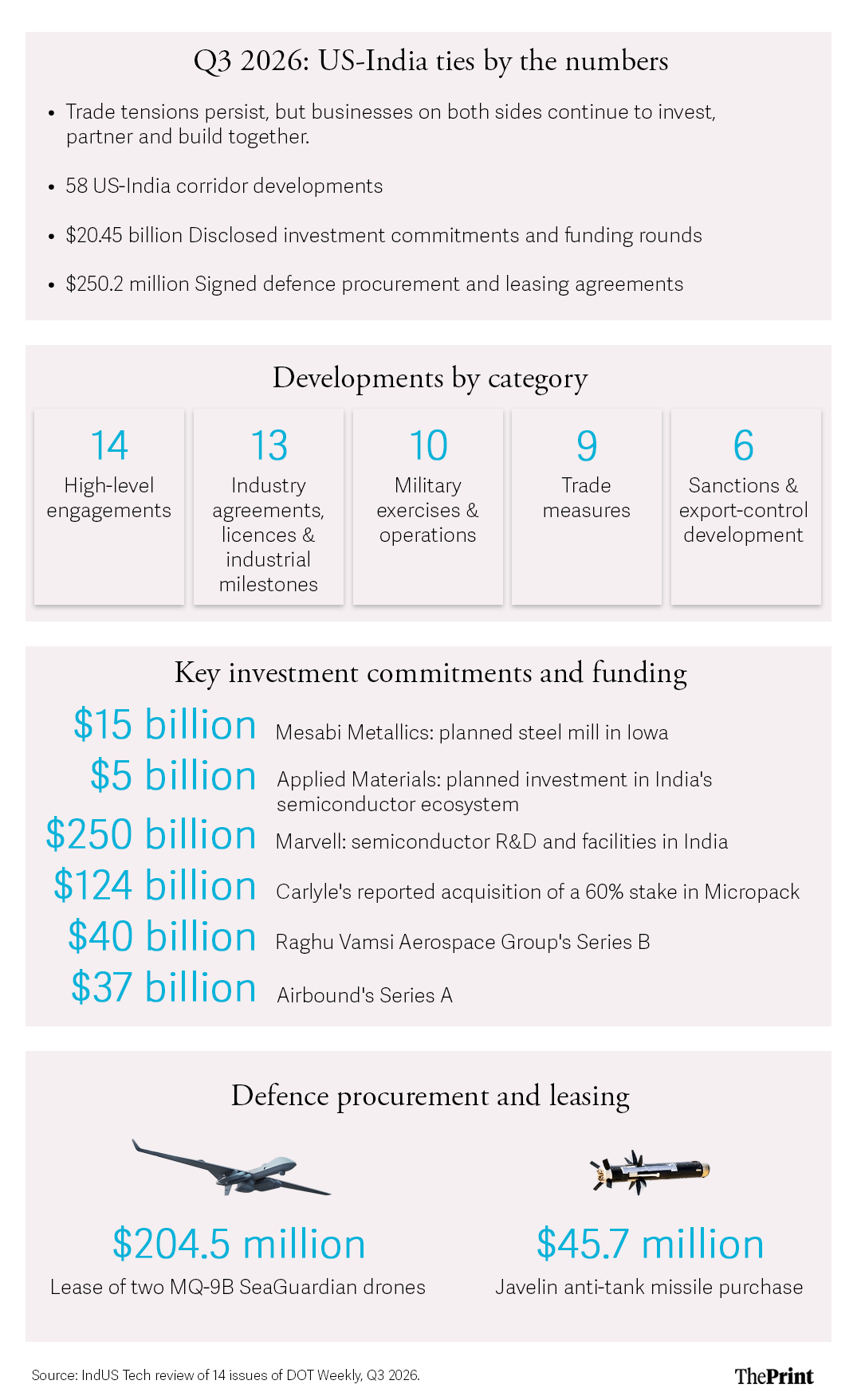
That contrast is evident in IndUS Tech’s review of 14 issues of DOT Weekly covering the third quarter of 2026. Of the 58 developments tracked, industry agreements and licenses formed the largest category with 13 entries. Trade friction has not stopped companies from making long-term industrial commitments and building together.
Building together
The tracker recorded 13 industry agreements and licenses, compared with four defense procurement and platform milestones. Only two of the latter were new contracts. India signed a $45.7 million Javelin anti-tank missile purchase and a $204.5 million lease of two MQ-9B SeaGuardian drones. Weeks after the Javelin purchase, Tata Advanced Systems and the Lockheed Martin-Raytheon Javelin Joint Venture signed an MoU to explore production in India.
HAL reported resolving technical issues surrounding the proposed co-production of 99 GE F414 engines, while Honeywell licensed GMR Aero Technic to maintain components on LEAP engines. In addition, Boeing Defence India partnered with Merlinhawk Aerospace to sustain sensors on Indian platforms, including the P-8I.
India’s procurement policies are shaping these arrangements. The Defence Acquisition Council’s September approvals envisaged sourcing roughly 98 percent of their value from Indian industry. Foreign manufacturers are competing for India’s transport aircraft requirement through Indian partners: Tata with Lockheed Martin’s C-130J and Mahindra with Embraer’s C-390.
Indian firms are also entering international supply chains. MIDHANI became the first Indian company to secure GE Aerospace’s S400 approval for materials testing. Sigma Advanced Systems secured a $104.9 million order from a North American customer for 147,000 extended-range 155mm ammunition shell bodies.
Semiconductors were another area of activity: Microchip Technology signed an agreement involving Kaynes Semicon and GridCrest Technologies on an India-based semiconductor initiative, while Silvaco agreed to provide design tools through C-DAC.
In space, a different collaboration model is emerging. On 2 October, four Indian startups reached orbit aboard SpaceX’s Transporter-18 mission. One of the satellites carries NVIDIA computing hardware that allows customers, including a US-based customer, to run AI models on imagery in orbit. Indian startups are bringing their own technology, payloads, and intellectual property while the US provides launch services, advanced computing, and access to commercial customers, helping these young companies validate their technology in orbit and turn it into viable businesses.
In civil nuclear energy, India issued the draft SHANTI rules which seek to address longstanding supplier-liability concerns that have hindered foreign reactor projects and US-India nuclear cooperation since the signing of the nuclear deal.
Capital flows
Disclosed investment commitments and funding rounds reached $20.45 billion, with capital moving in both directions. The largest came from Essar Group’s US subsidiary, Mesabi Metallics, which announced plans for a $15 billion steel mill in Iowa. In India, Applied Materials announced plans to invest $5 billion over a decade in semiconductor research, suppliers, infrastructure, and workforce development. Marvell committed another $250 million over three years to expand semiconductor R&D and facilities in Bengaluru and Hyderabad.
US investors also targeted Indian defense and aerospace companies. Carlyle agreed to acquire 60 percent of Micropack in a reported $124 million transaction. Norwest co-led Raghu Vamsi Aerospace Group’s $40 million Series B, while Greenoaks led drone maker Airbound’s $37 million Series A. Separately, Skyroot Aerospace was reportedly in advanced talks with US investors to raise capital, although no financing had been completed.
Mesabi Metallics and Applied Materials account for nearly 98 per cent of the disclosed total, and their commitments represent planned rather than completed investment. The smaller funding rounds, however, demonstrate investor interest in Indian aerospace manufacturing and autonomous systems.
The friction
The tracker also recorded nine trade measures, and six sanctions and export-control developments. On 13 July, India prohibited imports produced using forced labor. Washington subsequently imposed an additional 10 percent Section 301 tariff on Indian goods under its forced-labor investigation. India credited its engagement with securing a reduction from the proposed 12.5 percent rate and said approximately 45 percent of its exports to the US remained exempt.
India also changed UPI merchant charges, which the US Trade Representative had previously criticized. Indian officials denied that the change was made under US pressure. The rollout of the new merchant fee, initially scheduled for 15 October, was subsequently postponed until after Diwali. Meanwhile, new US drone tariffs excluded India from preferential rates, and three named Indian solar manufacturers and their primary international trading partner Kowa Company Ltd, a Japanese conglomerate, faced a 107.17 per cent cash-deposit rate following US trade investigations, pending a final injury ruling.
On the sanctions front, Washington removed four Indian firms from Russia-related sanctions lists and granted relief relevant to ONGC Videsh’s Venezuelan operations. It also sanctioned an Indian travel company for allegedly supporting Iran’s Mahan Air and later targeted four India-based companies and three Indian nationals over alleged Iran-linked petroleum trade.
The most critical development was a new bill passed with bipartisan support. On September 18, President Trump signed the Lindsey O. Graham Sanctioning Russia and Iran Act of 2026, authorizing tariffs of up to 100 per cent on major buyers of Russian oil and gas, subject to presidential waiver authority. India was not named but remained potentially exposed at the end of the quarter.
Negotiations nevertheless continued, with Commerce Minister Piyush Goyal meeting US Trade Representative Jamieson Greer toward the quarter’s close.
Channels stay open
Defense and diplomatic engagement remained active across bilateral and multilateral forums. Of ten military exercises and operations involving both countries, eight were multilateral. This includes two Quad activities – an Indo-Pacific logistics tabletop exercise in Tokyo and a coast guard ship-observer mission between Chennai and Perth.
Bilaterally, Yudh Abhyas spanned two theatres and included the first deployment of the US Army’s M-LIDS counter-drone system to India. At Tarang Shakti, US F-35s exercised with the Indian Air Force from Indian soil for the first time. The period also saw 14 high-level engagements, including two calls between Prime Minister Narendra Modi and US leaders and a bipartisan House delegation visiting New Delhi.
The trade relationship remains unsettled, and not every announced investment or industrial partnership will materialize. But the quarter’s evidence shows companies moving ahead with manufacturing, technology licensing, supplier qualification, and investment. While Washington and New Delhi negotiate the terms of trade, firms on both sides are not waiting for a deal to build together.
Editor’s note: This is a quarterly series tracking key developments in US-India trade, business, technology and defence ties. Read all the articles here.
Kriti Upadhyaya is the manager and founder of IndUS Tech JGJ Ventures LLC, an advisory firm in Washington, DC, and publisher of DOT Weekly. Subscribe to DOT Weekly: https://www.theindustech.com/contact-us. She tweets @upadhyaya_kriti. Views are personal.
(Edited by Prashant Dixit)