



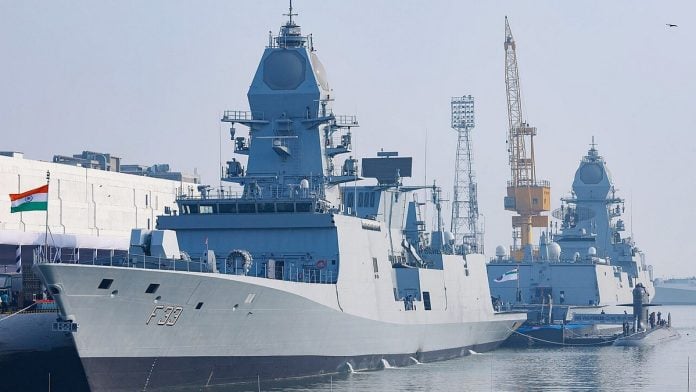
A major push in India’s naval indigenisation ambitions came on 7 September 2026, when the Defence Acquisition Council officially issued an Acceptance of Necessity for the domestic design, development and subsequent procurement of marine gas turbines for warship propulsion.
A marine gas turbine (MGT) is an engine that generates power, which is then transmitted through a gearbox to rotate the propeller. It can also produce electricity when connected to a generator. In June 2026, the Ministry of Defence (MoD) had placed orders for MGT generators to supply electricity onboard warships, but the September approval went a step beyond this. It is an especially important milestone, as it aims to reduce India’s dependence on foreign suppliers for warship propulsion.
While India has made substantial progress in building sophisticated warships, its record in the critical technology of propulsion is less than ideal. The majority of the Indian Navy’s propulsion systems remain imported.
Also Read: The war at the bottom of the sea is here. UK uncrewed vessel Excalibur shows its future
The need for indigenous marine propulsion
Before the Russia-Ukraine war of 2022, India was heavily dependent on the Ukrainian firm Zorya-Mashproekt for powering its frontline warships. However, following the crisis, India’s import of propulsion systems had to be diversified. Alongside Zorya, GE Aerospace emerged as a major supplier of gas turbines to the Indian Navy.
GE Aerospace LM2500 engines propel the P-17 Shivalik-class frigates, the P-17A Nilgiri-class frigates and India’s first indigenous aircraft carrier, INS Vikrant. Hindustan Aeronautics Limited (HAL) assembles the engines under licence. The LM2500 has also been selected for India’s Next Generation Missile Vessel (NGMV), intended for offensive anti-surface warfare and coastal/sea-denial missions.
On the indigenous front, though, progress was slow. In 2008, India tested a marine variant of the Kaveri gas turbine, designed by the Gas Turbine Research Establishment of the Defence Research and Development Organisation (DRDO). But it never became an operational propulsion engine, and New Delhi continued to rely on foreign suppliers.
Cut to 2026. With the complications arising from the Russia-Ukraine war and India’s push toward indigenisation in the defence industry, the MoD entered into a contract with Bharat Forge for an initial supply of 12 sets of marine gas turbine generators to provide onboard electrical power for the Navy’s Kolkata-class destroyers, scheduled to be completed over five years.
A private sector company, Bharat Forge has been actively shaping the landscape for marine gas turbine engines in India. On 19 May 2026, it announced a memorandum of understanding with the Government of Andhra Pradesh to establish a gas turbine repair and overhaul services complex in Visakhapatnam. While the complex is not yet operational, Bharat Forge intends to establish an MGT development and assembly hall, as well as a testing and development facility for indigenous MGTs.
Bharat Forge also has a Gas Turbine and Technology Development Centre in Bengaluru, known for building the Kalyani Gas Turbine 45 thrust engine used in Unmanned Aerial Vehicles (UAVs), target drones, and cruise missiles.
However, a supplier has not yet been selected for the 24-28 MW marine gas turbine propulsion engines.
Why MGTs are essential for warships
To sustain naval superiority, good propulsion is critical. Beyond propelling a ship, a robust propulsion system governs speed, acceleration, manoeuvrability and endurance, shaping how and where a warship can operate. It also reduces fuel consumption and limits dependence on fuel supply chains, allowing a warship to sustain its presence.
Additionally, a warship’s stealth can also depend on an effective propulsion system, as engine machinery can generate underwater acoustic signatures that reveal a vessel’s presence. Sophisticated propulsion systems like MGTs can offer an advantage by reducing machinery-induced underwater noise, increasing a warship’s stealth and endurance. A sturdy propulsion system can thus have a direct impact on a warship’s overall performance.
MGTs are particularly important for major surface combatants because their high power-to-weight ratio facilitates high speed, acceleration, and sustained operations at sea. They provide surface combatants with maximum power density and rapid startup capability. This makes them important for frigates and destroyers engaged in fleet defence and anti-submarine warfare.
However, developing an MGT is no easy task. It requires a sophisticated technological ecosystem and expertise in high-temperature materials, turbine blades, cooling, combustion and compressors, among others.
Foreign dependence and fleet readiness
India has dramatically expanded its domestic shipbuilding capacity in recent years. Since 2014, Indian shipyards have delivered over 40 indigenous warships and submarines to the Navy, with a new platform inducted every 40 days over the past year.
But the challenge for India extends beyond the ability to build warships. It must also keep them operational during periods of conflict, as excessive dependence on critical foreign technologies can expose its fleet to disruptions.
As has been highlighted, a good propulsion system is key to fleet readiness. So far, India has indigenously developed and operationalised steam turbines and nuclear propulsion technology, while its fuel-cell-based air-independent propulsion (AIP) technology is advancing towards integration into the fleet.
India has also established domestic manufacturing capabilities for marine diesel engines and already possesses indigenous technology for lower-capacity engines. But higher-capacity marine diesel engines are still largely imported, as reported by the MoD in April 2025. Hence, a project was subsequently sanctioned to Kirloskar Oil Engines to design and develop an indigenous medium-speed (6 MW) marine diesel engine with more than 50 per cent indigenous content.
Additionally, Rolls-Royce MTU diesel engines power several Indian Navy and Coast Guard vessels, with the latest additions being the Arnala-class INS Agray and the Nilgiri-class INS Dunagiri and INS Mahendragiri. The MTU brand engines represent over 80 per cent of India’s Coast Guard fleet. Currently, Rolls-Royce’s MTU Series 4000 engines are manufactured domestically in India under a licence agreement with Garden Reach Shipbuilders and Engineers (GRSE).
Yet these arrangements remain dependent on foreign technology, whether through licensed production and local assembly or direct imports.
The risks of this reliance on foreign propulsion technology became clear during the Russia-Ukraine war. Several frontline warships use gas turbines supplied by Ukraine’s Zorya-Mashproekt, including Russian-designed and built platforms. According to the DRDO, these Zorya turbines were installed on 34 Indian Navy warships, including Talwar-class frigates and Kolkata- and Delhi-class destroyers.
The 2022 war disrupted supplies of new turbines, spare parts and repair services, as complete turbine maintenance also required sending the units to Ukraine. As a result, two Russian-built frigates, INS Tushil and INS Tamal, were delayed by more than two years because their propulsion systems depended on Ukrainian gas turbines.
The same vulnerability was noted during the Russia-Ukraine conflict of 2014, which India mitigated by procuring turbines directly from Ukraine for Russian-built ships. This workaround was no longer feasible after 2022, highlighting the vulnerabilities that come with dependence on foreign propulsion systems.
Also Read: From red to green: 5-yr report card of DPSUs after India split up its old defence factories
From development to production
A turning point came in June 2026, when the MoD approved 12 sets of 1.25 MW MGT systems under a contract with Bharat Forge Limited, with a target of 60 per cent indigenous content. The approval was for MGTs attached to generators to supply electricity to combat systems, weapons and sensors. Just a few months on, in September, the MoD approved the local design, development, and procurement of MGTs for warship propulsion.
This development indicates India’s growing ambition to shift from merely manufacturing and assembling foreign-origin propulsion engines to developing its own technology.
What is important to note is that while India had already demonstrated its capability to indigenously develop an MGT in 2008 with the Kaveri MGT (which was tested to 12 MW; sufficient to meet the propulsion requirements of Rajput-class ships), it was not able to materialise the achievement into an operational, production-ready unit.
But as a sliver of assurance, India still has decades of experience in gas-turbine research and development (R&D) through DRDO’s Gas Turbine Research Establishment. Also, in February 2026, Defence Minister Rajnath Singh reviewed the status of ongoing projects to develop an indigenous gas turbine engine. He emphasised the need to attract more R&D from industry and academia, build a robust nationwide ecosystem and fast-track the development of an operational, production-ready system.
The challenge now for India is not just to further develop gas-turbine technology but to transform it into a reliable ecosystem capable of producing, testing, maintaining and providing life-cycle support. Only then can New Delhi significantly reduce its foreign dependence on one of the most critical technologies underpinning naval propulsion.
Anondeeta Chakraborty is currently researching an archival project examining India’s strategic culture during the Cold War, with The Centre for Applied Social Sciences. She holds a Master’s degree in international relations from Jawaharlal Nehru University, New Delhi. Views are personal.
(Edited by Asavari Singh)