




New Delhi: Five years after the government dismantled the century-old Ordnance Factory Board and divided its production network into seven separate Defence Public Sector Undertakings (DPSUs), the new companies have collectively stepped out of the red and into green, recording sharply higher revenues, profits and exports.
The seven companies are Munitions India Limited, Yantra India Limited, Armoured Vehicles Nigam Limited, Advanced Weapons & Equipment India Limited, Troop Comforts Limited, India Optel Limited and Gliders India Limited.
Their combined provisional revenue more than doubled to Rs 26,496 crore in 2025-26 from Rs 12,755 crore in 2019-20, the last financial year before the corporatisation of the Ordnance Factory Board, according to a 2026 Ministry of Defence report.
The financial turnaround has been striking. The seven companies together moved from a combined loss of Rs 2,844 crore in 2019-20 to a provisional combined profit of Rs 2,801 crore in 2025-26. Their exports leapt to Rs 4,561 crore in 2025, from Rs 81 crore in 2019-20, while cumulative exports since the companies were created stood at Rs 10,169 crore.
Four of the companies—Munitions India, Armoured Vehicles Nigam, India Optel and Yantra India—have also been granted Mini-Ratna Category-I status, a special recognition granted by the Government of India to profit-making Central Public Sector Enterprises (CPSEs), giving them greater financial autonomy without requiring prior government approval for certain decisions.
The restructuring was intended to separate the factories from the constraints of the old Ordnance Factory Board and allow them to operate more like commercial enterprises while continuing to serve the armed forces.
The companies have expanded production of ammunition, armoured vehicles, artillery, optical systems, military clothing and parachutes.
However, the figures paint a mixed picture across the seven companies.
While firms like MIL, Yantra India, AVNL, and India Optel are showing revenue and profit growth, Troop Comforts is still working through losses. Despite AWEIL’s overall profitability, its small-arms units face strain, as flagged in a Public Accounts Committee (PAC) report tabled in both houses of Parliament in August.
Munitions India: ammunition
Munitions India, headquartered in Pune, has perhaps the broadest role in the country’s ammunition industry.
Created in 2021, the company manufactures ammunition, explosives, rockets and bombs for India’s armed forces, foreign militaries and civilian customers. Its product range extends from small-calibre ammunition to large artillery rounds and air-to-ground weapons.
The government has increased investment in the company as part of a broader effort to modernise production capacity and build war reserves.
Its budget allocation rose from Rs 577 crore in 2023 to Rs 580 crore in 2024 and Rs 745.45 crore in 2025, the highest allocation among the seven new defence PSUs.
The money has been directed toward modernising equipment, increasing production capacity and establishing new manufacturing lines, including for 30 mm and 40 mm grenade-launcher ammunition.
Its products include the Pinaka multi-barrel rocket launching system, hand grenades, high-speed low-drag bombs, APFSDS ammunition, Shivalik multi-mode hand grenades, 155 mm high-explosive extended-range shells, naval mines, 1,000-pound air-to-ground bombs, 68 mm rockets and mortar bombs.
Armour-piercing fin-stabilized discarding sabot (APFSDS) is a long dart penetrator, or simply dart ammunition, a type of kinetic energy penetrator ammunition used by battle tanks.
One of its more ambitious programmes involves a 155 mm artillery shell using ramjet propulsion. The 2026 project, developed with IIT Madras and other research institutions, is intended to extend the range of conventional artillery without sacrificing lethality.
The technology is designed to increase the range of conventional shells by 30 to 50 percent and can be retrofitted to existing 155 mm artillery ammunition. Developmental testing at Pokhran and IIT Madras was reported to have been successful by December 2025.
The company has also built an export business. The United Arab Emirates (UAE) purchased 155 mm artillery ammunition from the company in 2017 and 2019, while Armenia has also been identified as a customer, according to their official website.
In 2024, Munitions India and its partner Nadrah Company signed a $225-million agreement to supply artillery ammunition to Saudi Arabia.
By March 2024, the company had export orders worth about Rs 6,000 crore, to be delivered through 2026-27, with the UAE, Vietnam and an undisclosed European country among its leading customers.
The company also exported 500 tonnes of explosives to Germany’s Rheinmetall in 2023 and early 2024. In 2023-24, exports accounted for about Rs 2,000 crore, or 28.5 percent, of Munitions India’s Rs 7,000 crore business.
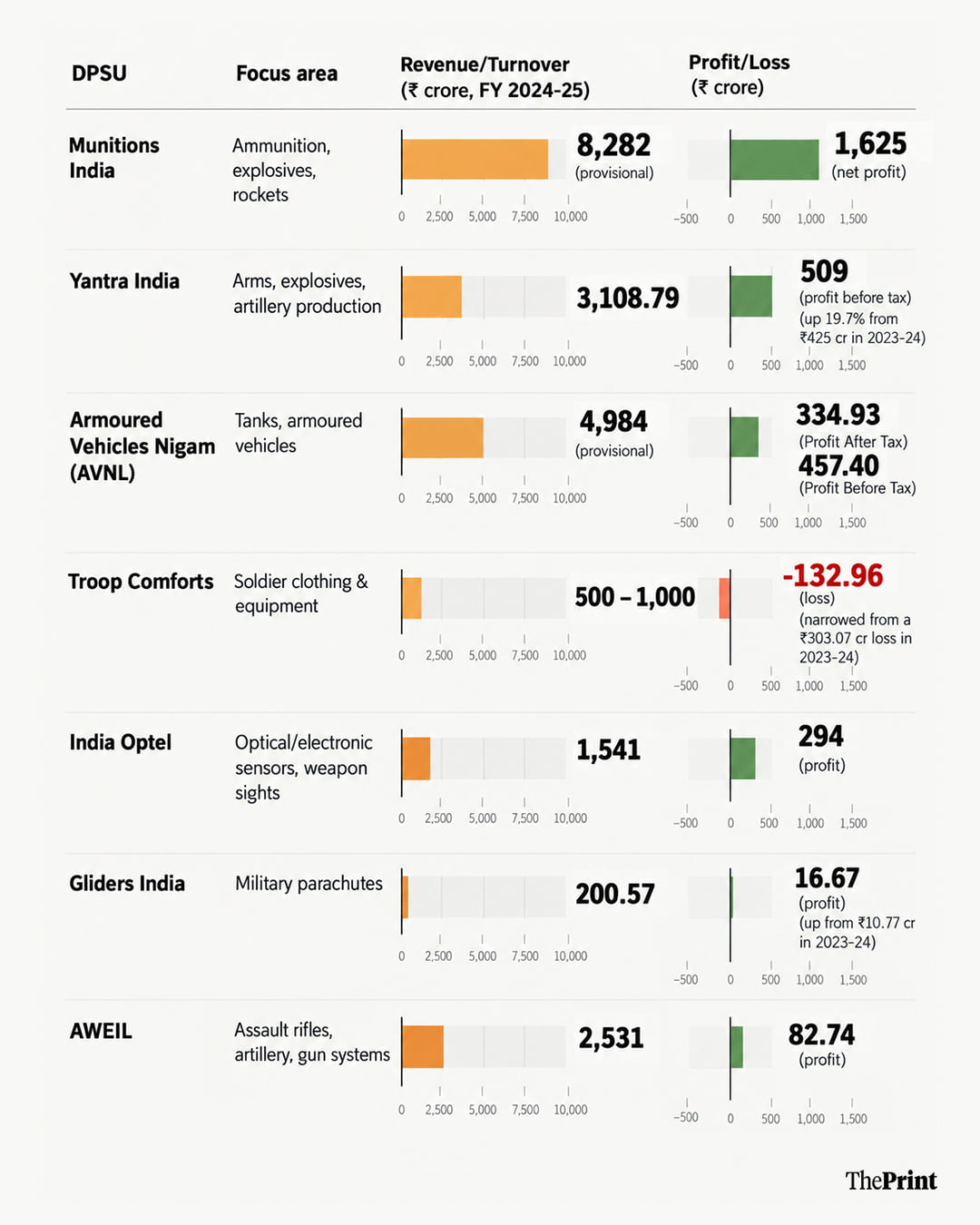
Munitions India posted a provisional turnover of Rs 8,282 crore in 2024-25, with exports climbing sharply to a provisional Rs 3,081 crore during the year, with no reported losses.
Yantra India: production
Yantra India Limited, headquartered in Nagpur, operates eight defence manufacturing units inherited from the Ordnance Factory Board. Its factories supply the armed forces with arms, explosives, artillery and ammunition.
The company is also involved in producing the Pinaka rocket used in the Pinaka launch system.
In 2025-26, Yantra India recorded its highest-ever revenue from operations, totalling Rs 3,522 crore. This represents a 13.3 percent increase over the previous year. The figure is provisional and unaudited.
Its expansion has also extended into long-term industrial partnerships. Yantra India signed a 10-year agreement with Hindustan Aeronautics for an interest-free advance of Rs 435 crore and 17,420 tonnes of supplies, alongside a separate agreement with Bharat Dynamics.
Yantra India recorded a profit before tax of Rs 509 crore in FY 2024-25, up 19.7 percent from Rs 425 crore the previous year, with no losses.
Armoured Vehicles Nigam: tanks, guns and battlefield vehicles
Armoured Vehicles Nigam (AVANI), headquartered at Avadi near Chennai, was created to manufacture armoured fighting vehicles, main battle tanks, military vehicles and their engines.
Its portfolio includes the Arjun tank, several variants and support vehicles, artillery systems and specialised armoured platforms.
AVANI’s other Arjun-based systems include the Arjun Catapult, a 130 mm self-propelled howitzer; a bridge-layer tank; the Arjun armoured recovery and repair vehicle; and the experimental Tank EX, which combines a T-72 chassis with an Arjun turret.
AVANI’s Jabalpur operations include the Aditya mine-protected vehicle, Sharang 155 mm artillery gun and Super Stallion military trucks. The Sharang is an upgraded 130 mm gun converted to 155 mm, increasing its range from 27 km to more than 36 km.
At Medak, AVANI produces specialised vehicles including the armoured ambulance tracked vehicle, armoured engineering reconnaissance vehicle, carrier mortar tracked vehicle, CRN-91 naval gun and NAMICA Nag missile carrier.
The company recorded its highest-ever revenue of Rs 6,093 crore in 2025-26, an increase of roughly 22 percent over the previous year. Its 2024-25 revenue was Rs 4,984 crore, while its order book was valued at approximately Rs 35,553 crore to Rs 36,662 crore.
AVANI has also established design and innovation centres at Avadi, Chennai and Medak, Telangana, reflecting a move beyond production toward in-house engineering and product development.
Armoured Vehicles Nigam reported a provisional turnover of approximately Rs 4,986 crore for the fiscal year 2024-25 with no losses reported.
Troop Comforts: clothing and equipment for soldiers
Not all the new companies make weapons. Troop Comforts, headquartered in Kanpur, produces the equipment soldiers need to operate in difficult environments.
Its products include clothing for various life cycles, extreme cold weather, mountaineering gear, supply-drop equipment, water-storage equipment and tents, for both the armed forces and civilian customers.
The company comprises four former Ordnance Factory Board facilities: the Ordnance Equipment Factory in Kanpur, the Ordnance Clothing Factory in Shahjahanpur, the Ordnance Clothing Factory in Avadi and the Ordnance Equipment Factory in Hazratpur.
Its operating revenue has been reported in the Rs 100 crore-Rs 500 crore range, with profitability varying across fiscal periods.
The company has also worked to replace imported equipment. It developed high-altitude gloves and rock pitons previously imported by the Army, with its samples reported as the only ones found satisfactory in Army Headquarters trials.
Troop Comforts narrowed its losses considerably to Rs 132.96 crore in 2024-25 from a Rs 303.07 crore loss in 2023-24. Profit in 2024-25 was Rs 19 crore.
The narrowing of losses came from a sharp rise in revenue, not from cost cuts. However, revenue from operations rose about 97.5 percent, from Rs 280.37 crore to Rs 553.81 crore. Total expenses of about Rs 819 crore exceeded total income of about Rs 633 crore.
India Optel: eyes and sensors
India Optel Limited, headquartered in Dehradun, focuses on optical and electronic systems that allow weapons and soldiers to identify and engage targets.
It manufactures electro-optical sensors, weapon sights and communications equipment for the Indian military and foreign customers. The company consists of three former Ordnance Factory Board facilities in Dehradun and Chandigarh.
In December 2025, India Optel signed a collaboration agreement with French Safran Electronics & Defense for the production of the Sigma 30N digital ring-laser-gyro inertial navigation system and the CM3-MR direct-firing sight.
Under the agreement, India Optel is responsible for production, final assembly, testing, quality control and life-cycle support. The systems are intended for applications including artillery, air defence systems, missiles, radars and anti-drone systems.
According to its annual report, India Optel closed the year with the highest ever turnover of Rs 1,541 crore and made a net profit (after tax) of Rs 294 crore in FY 2024-2025. Its 2025-26 report said the company delivered its best ever operational performance and achieved a record turnover of Rs 2,010.70 crore with a 30 percent growth in turnover over the previous financial year (FY 2024-25).
Gliders India: parachutes for India’s military
Gliders India, headquartered at the Ordnance Parachute Factory in Kanpur, manufactures military parachutes, parachutes for aerospace and emergency applications, and other related products. The company has sought to expand its international business under the Make in India and Atmanirbhar Bharat programmes.
Earlier this year, it secured a Rs 30-crore export contract from Vietnam to manufacture and supply twin-canopy brake parachutes and PSU-36 series pilot parachutes for Vietnam’s Su-30 fighter aircraft.
The deal followed a Rs 17 crore export order in 2023 and a related Rs 26-crore agreement covering 274 fighter-jet parachutes.
The company has said its products offer a reported 30 percent cost advantage over traditional suppliers and can be delivered in about two months, compared with the longer timelines associated with some Russian state exporters.
The company has also been positioned to pursue additional export opportunities, including discussions involving parachutes for Egypt’s MiG-29 fleet, supported by technology transfers from the DRDO.
Gliders India’s net profit rose from Rs 6.86 crore in 2022-23 to Rs 10.77 crore in 2023-24 and Rs 16.67 crore in 2024-25. Export revenue reached Rs 21 crore in 2023-24, or about 12 percent of total turnover. Its profit increased by more than 54 percent between 2023-24 and 2024-25.
Gliders India describes itself as India’s only DPSU dedicated to parachutes, inflatables and technical textiles. It has also developed equipment for Northern Command and begun an industry-academia research programme.
AWEIL: assault rifles
Advanced Weapons and Equipment India Limited (AWEIL) produces a wide range of military hardware including assault rifles, light machine guns, sniper and anti-materiel rifles, pistols, the Dhanush 155mm towed artillery gun, mortars, naval gun systems, and tank gun components for the T-90, T-72 and Arjun platforms.
It also overhauls existing gun systems and supplies ammunition, hardware and spares across calibres.
On the export front, AWEIL has secured 14 orders worth roughly Rs 581 crore from buyers in the Middle East, Europe, and Asia, a notable shift from the negligible export activity seen under the earlier Ordnance Factory Board structure.
The company is also positioning itself as an Indian Offset Partner, pursuing defence-cooperation opportunities through the Ministry of Defence.
AWEIL reported a net profit of Rs 82.74 crore in 2024-25. Despite this overall profitability, the PAC report flagged significant financial strain at three of AWEIL’s small-arms manufacturing units.
The panel found that these factories collectively lost Rs 234 crore between 2023-24 and Rs 2025-26. It attributed the losses largely to high overhead costs that inflated per-unit production expenses.
The legacy DPSUs
The seven new companies are part of a much larger state-owned defence-industrial network. They now operate alongside established defence manufacturers such as Hindustan Aeronautics Limited (HAL), Bharat Electronics, BEML, Bharat Dynamics, Garden Reach Shipbuilders & Engineers, Goa Shipyard, Hindustan Shipyard, Mazagon Dock and MIDHANI.
Among the older companies, Hindustan Aeronautics remains central to military aerospace. HAL received Maharatna status (highest financial recognition to CPSEs) in 2024 and operates 20 divisions and 10 research and development centres across seven states and 10 locations.
Its aircraft and helicopters account for 60-100 percent of fleet strength in particular segments of the armed forces, while the company supports about 75 percent of the overall fleet, according to government reports.
Its indigenous portfolio includes the Tejas Light Combat Aircraft, HTT-40 trainer, Prachand Light Combat Helicopter, Light Utility Helicopter and Dhruv Advanced Light Helicopter.
A third Tejas Mk1A production line at Nashik has taken HAL’s annual capacity to 24 aircraft. The first aircraft from the facility was flagged off in October 2025.
Bharat Electronics Limited (BEL), meanwhile, is expanding beyond conventional electronics into autonomous systems and precision weapons.
With the Navy’s Weapons and Electronic Systems Engineering Establishment, BEL developed software for autonomous unmanned surface vessels and signed a joint venture with France’s Safran for production in India of the HAMMER— Highly Agile Modular Munition Extended Range— precision-guided air-to-ground weapon.
BEL has also become the first DPSU to achieve RE100 status by transitioning to 100 percent renewable energy. This milestone reflects the company’s compliance with the RE100 initiative, a global corporate climate campaign led by international non-profits Climate Group and CDP.
In addition, it established a software centre in Indore focused on artificial intelligence and web-based quality inspection.
BEML, established in 1964, operates across the defence, mining, construction, rail, metro, marine, aerospace and space sectors. It reorganised its operations into 14 strategic business units and introduced energy-efficiency measures including IE3 motors, 770 LED luminaires and variable-frequency drives.
Bharat Dynamics Limited, which began in 1970 producing the SS11B1 anti-tank missile, now manufactures Konkurs-M, Milan-2T and Invar missiles as well as Akash surface-to-air missiles.
Its three units achieved 100 percent renewable-energy use. Trials of the Improved Akash system were completed at high altitude in Leh before bulk-production clearance in March 2026, according to the report.
India’s state-owned shipyards have also increased production. Garden Reach Shipbuilders & Engineers, based in Kolkata, has built 807 platforms, including 118 warships, and was constructing 39 vessels across nine projects. Its order book stood at Rs 15,324.13 crore in March 2026.
Goa Shipyard delivered more than 230 ships and more than 171 boats in 2025. Hindustan Shipyard, which underwent a financial and operational turnaround, received Mini-Ratna status and delivered INS Nistar, an indigenously designed diving-support vessel. In 2025, it docked and undocked 55 vessels and completed 19 refits on or ahead of schedule.
Mazagon Dock Shipbuilders remains India’s only shipyard with established capabilities to construct destroyers and two types of conventional submarines. In January 2025, it commissioned INS Surat, INS Nilgiri and INS Vaghsheer—a destroyer, a frigate and a submarine.
The company has also entered an agreement on Landing Platform Docks, signed a tripartite memorandum with the Indian and Brazilian navies on submarine maintenance, and acquired a 51 percent stake in Sri Lanka’s Colombo Dockyard for about $27 million, its first international venture.
Behind much of this production is MIDHANI, which manufactures superalloys, titanium alloys and special steels. Its Rohtak facility produces armour and protective equipment, while its metal bank with HAL, Bharat Dynamics, NSIL, Akanksha and DRDO is intended to secure six critical raw materials.
MIDHANI has also indigenised HY-80 and HY-100 submarine steels, which were previously imported from France.
(Edited by Sugita Katyal)
Also Read: Formed in 2021, 7 new defence PSUs to see steep decline in orders, finds Parliament panel