



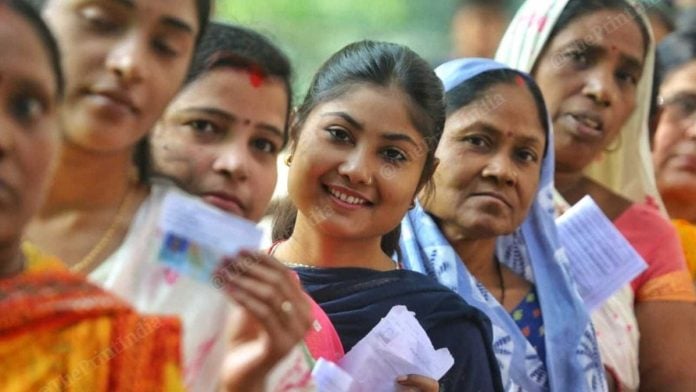
For faith in the democratic process to take root, it is necessary that the political system be fully open, transparent and responsive. It should create conditions whereby the masses feel that their security, dignity and livelihood are assured and that there is a perceptible improvement in the quality of life from election to election.
Any democracy worth the name must be participatory, as a non-participatory democracy is a contradiction in terms. In every true democratic set-up, the people are expected to take an active part in deciding what is good for the community as a whole and in implementing what is decided upon.
The implementation of decisions is followed by the next step of evaluating the results of those decisions and taking corrective measures where necessary. True, democracy is an ongoing process requiring continuous involvement on the part of the common citizens.
Unfortunately, in practice, it has come to mean casting a ballot periodically and suffering the consequences thereafter. Democracy has become a ritualised affair producing results that are banal, to put it mildly. What has gone wrong?
Basic components of democracy
In the first place, we must realise that a vibrant democracy presupposes certain vital inputs that we often take for granted. One such input is alertness. Unless the people are continually on the qui vive and are fully aware of their rights and responsibilities, the public issues at stake and the calibre of their so-called leaders and representatives, they are likely to be taken for a ride by the latter.
Another input is concern. By this, we mean a genuine feeling of belonging to the polity and of sharing in its weal and woe. One may be very well aware of what is going on but still be aloof, uninvolved and unconcerned. If the mass of people are thus disaffected, it is time to bid farewell to democracy.
A third requirement is sensitivity whereby one’s awareness and concern are fine-tuned to specific situations in which one descends from the general to the particular, and is ready to take part in concrete actions to uphold democratic norms.
A fourth requirement is openness to ways of thinking, feeling and acting that are different from one’s own, as we live in a plural society where people of different ethnic origins live side by side. For democracy to succeed, tolerance of and respect for behaviour patterns different from the ones that we are accustomed to are necessary.
A fifth requirement is honesty whereby there is consistency in what we think, speak and do. There is no double-think, double-speak and double-act, as this makes consensus and solidarity impossible to achieve and sustain.
A sixth requirement is courage to take a public stand that conforms to the norms and values we profess to hold in private. Many individuals are very categorical in asserting principles in private but fight shy of abiding by them in public. This dichotomy does not augur well for democracy.
The absence or weak presence of these six inputs or requirements constitutes what we perceive as impediments to participatory democracy. It is, therefore, necessary to reflect on the state of our Indian society today and draw some salutary lessons for toning up our democratic life in this Golden Jubilee Year of our Independence.
Awareness
To begin with the first requirement stated above, viz. alertness or awareness, we need to ask ourselves whether our people are sufficiently aware of their rights and responsibilities as citizens. Here the answer has, unfortunately, to be largely negative. Awareness of human rights generally, and of civic and political rights in particular, is quite nebulous. Thus, it is not surprising that abuse of these rights by the police, by the security forces, by vigilant groups, by riotous mobs, by militants and so on, is frequent and widespread. In the absence of quick and credible remedial action, there is a growing feeling of anomie and cynicism which are detrimental to democratic culture.
As for people’s awareness of the worth and performance of their leaders and representatives, one is relieved to note that while sycophancy is far from dead, people are less and less willing to tolerate corruption and arbitrariness on the part of the public authorities, and are coming out openly to demand greater accountability and efficiency from them. The common man might be illiterate, but he is no fool. This has been demonstrated time and again in local, state and national elections, when our citizens have shown their innate perspicacity and sound common sense. This trait augurs well for democracy and should be fostered assiduously.
Concern and sensitivity
As for concern and sensitivity, we find these in short supply in large sections of our national community. Loyalties tend to be parochial, based on language, caste and creed. There is little of a civic culture that expresses a sense of belonging to a wider society, transcending denominational barriers. Thus, there is no sense of outrage when injustices are perpetrated against women, tribals, dalits, minorities and other weaker sections, or when national monuments are vandalised, resources frittered away, environment ravaged or public trust abused. There is a pervasive sense of indifference to the social evils that jeopardise nationhood. Participatory democracy cannot be based on such shaky foundations.
A vigorous campaign needs to be launched at all levels and on all fronts, beginning with grassroots agents of socialisation, and liaising with those at higher levels, to ensure that masses of citizens are sensitised to the imperatives of social justice and harmony, without which there can be no participatory democracy worth the name.
Openness
In the highly plural society that is India today, openness to diverse moves and organisational patterns is a way of life that reinforces the democratic temper of acceptance and tolerance. Most of the time, most of our people know how to synthesise unity from diversity. But there are moments of aberration when, under instigation from vested interests and revanchist elements, entire sections can go berserk and turn on each other. There should be inbuilt safeguards against these atavistic throwbacks. A collective mindset imbued with human empathy and scientific objectivity needs to be fashioned, and this is the prime task facing all agents of socialisation.
Honesty
As for honesty being a vital input for participatory democracy, we find that notwithstanding the noble dictum that “truth alone prevails” (Satyameva Jayate), public probity is in increasing short supply in our land of Sanskriti (refinement) and Maryada (decorum). Public office is viewed not as a sacred trust to be held for the common good, but as a vehicle for self-aggrandisement and a spoils system. Public morality degenerates into rhetorical posturing and upstaging one’s rivals. No sanctity attaches to electoral promises or policy pronouncements. Public memory being proverbially short, many a volte-face can be executed with impunity. Values and norms are short-circuited to enable unscrupulous characters to survive and thrive, while honest people are sought to be sidelined, if not penalised. The net result is a travesty of government of the people, for the people and by the people. As the saying goes, honesty is the best policy. A major lacuna in our educational curriculum needs to be filled, and that is the absence of a substantial input of value education. Individual, social and professional ethics need to be inculcated in all citizens from the early and most impressionable years, or else habits of integrity will stand little chance of being ingrained.
Courage
Finally, turning to courage as a vital ingredient of participatory democracy, we find that this quality, while not totally absent, is not evident in abundant measure and needs to be cultivated from early schooling onwards. Discipline should not degenerate into unthinking conformism nor deference to subservience. Initiative and creative thinking, frankness no less than discretion when speaking one’s mind, steadfastness of purpose and willingness to give credit where it is due—all these aspects of courage need nurturing. They deepen, strengthen and enrich participatory democracy and greatly limit the scope of sycophancy and the personality cult which are the bane of any democratic polity. The ability to laugh at oneself, to call the bluff of the establishment and to admit one’s mistakes are also aspects of civic courage which nourish democratic culture.
Also read: A free economy needs controls, not a Control-Raj: MA Sreenivasan
Structural domain of democracy
Besides the above-mentioned impediments to participatory democracy which belong to the ‘psychological realm’, we need to identify other impediments belonging to the ‘structural realm’ with both national and international dimensions. The structural realm comprises both social formations and political institutions which mould and condition people’s ways of thinking, relating to each other and behaving generally. Both sets of structures need to be critically evaluated, reformed and restructured where necessary, simultaneously.
It follows that educational action in the psychological realm and socio-political action in the structural realm are required in close co-ordination so as to remove the impediments to participatory democracy. Psycho-sociological structures that have been in existence during centuries of feudalism and colonialism cannot be demolished in half a century of national independence. Mere recourse to external devices and instrumentalities such as periodic elections, parliamentary debates, government resolutions, statutory enactments and constitutional amendments without an ongoing ‘revolution of the spirit’ will not deliver the goods of participatory democracy. The outer trappings must not be mistaken for the real thing. Many of our public bodies are functioning in a merely ritualistic and stereotypical manner. They are either elite-friendly or mafia-friendly, but not people-friendly. The common man does not feel comfortable dealing with any branch of the government, whether executive, legislative or judicial, whether at local, state or national level. Social and political workers often develop their own networks of vested interests, and the common man is constrained to turn to them as a last resort. Thus, disillusionment with the political system sets in, and a chasm opens up between the rulers and the ruled. How can participatory democracy flourish in such an environment?
To sum up, for participatory democracy to be definitely established, attitudinal change is a must, no less than institutional reform.
Political authority needs to be demystified and viewed in a business-like, instrumental perspective. Political leaders must be cut down to size and not portrayed as larger than life. The voluntary sector needs to be strengthened, and less reliance placed on governmental agencies and political parties. The media spotlight must be turned on all aspects of public life and all forms of impropriety exposed relentlessly. The constructively critical voice of the people must be heard above the din of political battle. Pre-election and post-election voters’ committees should scrutinise the programmes of political parties and their performance when in office or in the opposition and should conduct an ongoing political audit of the elected representatives. These measures bid fair to revitalise our democracy and make it a fully participatory and vibrant affair.
This piece is excerpted from the booklet Freedom First with the title “The Relevance of Participatory Democracy”, which was published in March 1998. The original version can be accessed here.