






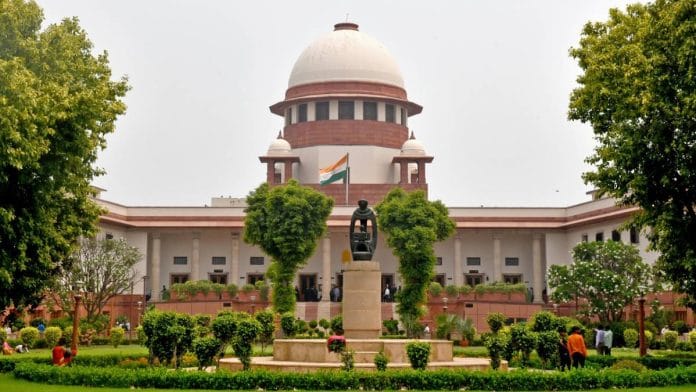


The Supreme Court dissolved a marriage earlier this month that had been over for 15 years. For the divorce to go through, the bench first had to label it “a dead relationship, which has already decayed and is decomposing day by day, creating foul sociological, psychological and mental hollowness in life.” Only then could the parting couple be allowed to sever ties.
In its judgment, the Supreme Court observed that the prolonged process was a “denial of a free and independent environment to flourish” and the court must release “the parties from a stale and frozen relationship.” The judgment itself relied on another case, Rakesh Raman vs Kavita, 2023 and held that “cruelty as a fault, may not be attributable to one party alone and hence despite irretrievable breakdown of marriage keeping the parties together amounts to cruelty on both sides.”
Most Indians, however, do not have the fortune or means to go to the Supreme Court to settle their divorce cases. They shouldn’t have to.
Section 13B of the Hindu Marriage Act allows divorce by mutual consent: Once both spouses sign on, the court mandates a six-month “cooling-off period”, and only after that is the marriage deemed over. However, the only other direction that the law offers is a fault-based or contested divorce, where the petitioning spouse has to establish a wrong, such as cruelty, desertion, adultery, mental disorder, or even conversion to another religion.
Backdated Indian laws
As this editorial in the Indian Express points out, “Where consent is unavailable, parties must establish, if not invent, a matrimonial wrong. In the process, ordinary discord acquires criminal colour and relationships that have simply become unworkable are recast as adversarial contests over fault.”
Most democratic countries have already recognised the reality of “unworkable relationships”. The UK legislated no-fault divorce in 2020 after years of campaigning by the legal community. It came into effect two years later. Australia did it in 1975. In 2010, New York became the last American state to bring in no-fault divorce, ending a 40-year-old process that began in California in 1970.
A marriage that has ended deserves a graceful exit – not a pointless battle over who killed it. India has come close to accepting this, but our laws are yet to keep up.
What the law has instead is a procedure that runs in the opposite direction. Section 9 of the Hindu Marriage Act allows a spouse to petition for restitution of conjugal rights when the other has “withdrawn from the society of the other without reasonable excuse.” While the provision is gender-neutral on paper, neither its origins nor its application is.
India adopted the remedy from the British ecclesiastical courts, where a wife was considered her husband’s property. At least 50 years before no-fault divorce, England abolished restitution of conjugal rights, a concept that India still holds on to.
In 1983, the Andhra Pradesh High Court held Section 9 unconstitutional in the case of T Sareetha vs T Venkata Subbaiah, where the young actress was being forced to return home. The decree noted that it denied “the woman her free choice whether, when and how her body is to become the vehicle for the procreation of another human being.”
That rare instance of an expansive understanding of human rights, however, was short-lived. The Delhi High Court overruled the reasoning a year later, and the Supreme Court, in another case, sided with Delhi. Sections 9 and 22 of the Special Marriage Act have been operational ever since, although students from Gujarat National Law University filed a PIL challenging the section’s constitutional validity in 2024.
Also read: Delhi HC’s order on the right to be forgotten isn’t very practical—the internet never forgets
‘Section 9 is used as a step before divorce’
Anindita Pujari, a senior advocate in Delhi, does not consider the provision indefensible in principle.
“Section 9 is not, in itself, an instrument of oppression,” she said. “It does not compel an individual to return to an abusive household.”
But what troubles her is how the provision is used now.
“On a daily basis, it is used as a step before divorce,” she said. “The spouse filing it is often using it to delay proceedings, to gain a strategic advantage in related matrimonial litigation, or to maintain the facade of a marriage that has, in fact, ended.”
“Husbands may sometimes invoke the provision in ways that draw upon existing social expectations surrounding marriage,” said Dr Pujari, “particularly where women who have left a marital home — whether because of incompatibility, neglect, or abuse — are portrayed as having failed to uphold the institution of marriage.” On the other hand, she said, wives who invoke the section often do so because they do not wish to be seen as the first to break the marriage and face the social judgment that may follow.
Whoever files Section 9, it’s the institution that comes out ahead.
Pujari described a recent case where the husband had filed for restitution of conjugal rights. The wife, raising a special needs child alone, could barely scrape together the money to travel for the proceedings. A provision designed to invite a spouse back to a marriage had been used as a precursor to divorce. “Couples realise that they cannot stay together, but in pleadings, they have to fight it out. It’s a big dilemma,” she said.
The dilemma worsens because sparring couples realise there are no respectful ways out – though it’s not for want of asking. Even as far back as 1978, the Law Commission of India had recommended that irretrievable breakdown of marriage be added as a ground for divorce.
Gayatri Dahiya, a lawyer practising in Delhi, recognises the pattern from her own practice. “There are marriages where it is apparent things have broken down beyond repair,” she said. “But the law drags the couple through the process.”
In 2006, in Naveen Kohli vs Neelu Kohli, the Supreme Court urged the Parliament to act when it said that “once the marriage has broken down beyond repair, it would be unrealistic for the law not to take notice of that fact.” In the last 48 years, the Marriage Laws (Amendment) Bill was introduced twice – in 2010 and 2013 – and has lapsed each time.
Also read: Supreme Court’s NCERT textbook order punishes the messenger, doesn’t answer the message
Beyond a simple relationship
This gap in the legislature has to be filled by the last court of appeal. Article 142 of the Constitution allows the Supreme Court to pass any decree necessary for “complete justice”. The article is often invoked to dissolve marriages, including the one it deemed “decomposing”, even if it has acknowledged the limits of that route explicitly. Article 142 confers no right to divorce, and under the Hindu Marriage Act, a marriage is “still considered as a sacred union, which can be declared irretrievable only by the highest court of the country.”
This effectively means that the Supreme Court of India, in Delhi, exercising extraordinary constitutional power at its own discretion, becomes the only viable exit for a couple whose marriage has ended but cannot be ended on fault, and where one spouse will not consent. It is almost a mercy petition, where the supplicants have to ask that the court find their suffering adequate.
Discretion cuts the other way, too. In Nirmal Singh Panesar vs Paramjit Kaur Panesar (2023), the Supreme Court refused to dissolve a marriage at the 89-year-old husband’s petition. Even though the couple had been separated for decades, the wife (82) said that she did not want to die carrying the “stigma” of being a divorcee. Marriage, the court observed, was “pious, spiritual, and an invaluable emotional life-net.”
Eventually, the preservation of the institution trumped the individuals inside it.
In May this year, the apex court overturned a lower-court verdict that had labelled a woman dentist “cruel” to her army officer husband for pursuing her profession, while living apart from him. The woman had to approach the SC to expunge the record. The bench had labelled the lower court’s reasoning “backward, feudalistic thinking.”
But the lower courts are not always the source of backward thinking. Sometimes, the statute is. “Any court, lower or higher, can only apply the law as it exists,” Dahiya said.
In 2011, when the Marriage Laws (Amendment) Bill was up for consideration, there was opposition from both ends of the political spectrum. Brinda Karat of the CPI(M) had held that the amendment would be misused against women in unequal relationships. Meanwhile, Arun Jaitley of the BJP had argued that the amendment “works in countries that have a well-established social security mechanism.” Both recommended that the bill should not be passed without first building a safety net that would catch a woman if she chose to leave a marriage. Even lawyers who personally support recognising irretrievable breakdown, like Dahiya, agree that the reform cannot be transplanted without guardrails.
Because marriage in India goes so far beyond a simple relationship. For so many Indian women, it also means housing, income, social safety, and a legal identity. Outside it, there is little that the state can provide. “The Indian state views marriage as a necessary capital patriarchal unit that it maintains at all costs,” Dahiya told me. “The family unit has to be maintained, the line of succession has to be maintained, the labour pools have to be maintained.”
To acknowledge the irretrievable breakdown of marriage, the state first has to acknowledge that the consequences of leaving have to be borne by something other than the marriage. Until then, Indian couples are at the Supreme Court’s mercy.
Karanjeet Kaur is a journalist, former editor of Arré, and a partner at TWO Design. She tweets @Kaju_Katri. Views are personal.
(Edited by Saptak Datta)
A stale marriage definitely needs a graceful exit. But there should be law to not allow remarriage for some period like 3 years after divorce so that they get ample time to cool off and most importantly not add to further social issues. Many times people divorce as they find others more suitable which in truth is an escape route decided when they are vulnerable and an easy remarriage can prove more fatal than the previous marriage.