







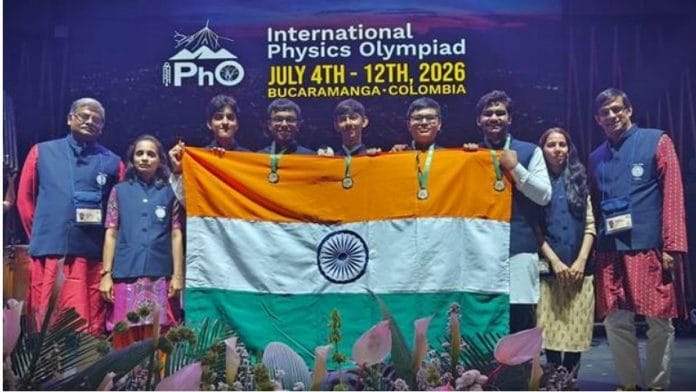


Last month, India achieved something extraordinary. For the second time in its history, all five members of the Indian team at the International Physics Olympiad won gold medals, placing India joint first in the world alongside China, South Korea, Kazakhstan, Russia and Taiwan. These students competed against 381 of the world’s brightest school students from 87 countries. Later, the Indian team also swept the gold medals in the International Chemistry Olympiad for the first time.
The achievement deserves celebration. It also deserves reflection—these students reveal something profound about Indian education. They are not products of a school system deliberately designed to nurture exceptional scientific talent. They emerged from an entirely different ecosystem that operates largely outside our schools.
The journey of the five medalists began with a national filtration process of astonishing rigour. More than 40,000 students write the National Standard Examination in Physics each year. Around 300 qualify for the Indian National Physics Olympiad. Roughly 35 then enter the Orientation-cum-Selection Camp at the Homi Bhabha Centre for Science Education (HBCSE), where they undergo weeks of intensive theoretical and experimental training under scientists and expert mentors. From this group, only five are selected to represent India at the International Physics Olympiad.
Most people assume the International Physics Olympiad is simply a harder version of the Class XII physics examination. It is not. The competition consists of a five-hour theoretical examination and a five-hour experimental examination. Students are expected to derive equations from first principles, analyse unfamiliar physical systems, design experiments, quantify uncertainty in measurements and integrate ideas from mechanics, electromagnetism, thermodynamics, optics and modern physics into entirely new situations. There are no familiar question patterns or memorised templates. Students are expected to think like physicists rather than merely reproduce physics.
Our schools are not built for this. It is therefore unsurprising that the real preparation happens elsewhere. Many Olympiad students spend evenings and weekends in mathematics circles, specialised coaching programmes, research camps and mentorship networks. Several of this year’s gold medalists trained extensively through Kota’s advanced coaching ecosystem before reaching HBCSE’s national camps.
Also read: Youth’s struggles won’t end with Dharmendra Pradhan’s resignation. Govt must decentralise education
A different kind of school
This is not an argument against schools. It is an argument for a different kind of school. Countries competing at the frontiers of science and technology have long understood this. Singapore identifies highly-gifted learners in primary school and provides differentiated educational pathways. Israel operates gifted education centres beginning in elementary school. South Korea established specialised science high schools decades ago. The United States supports specialised public schools, early college programmes and institutions dedicated entirely to profoundly-gifted learners.
India has no comparable ecosystem. Our educational philosophy has understandably prioritised equity. The assumption seems to be that treating every child identically is synonymous with fairness. It is not. A child with dyslexia requires specialised educational support because the standard classroom does not meet that child’s needs. A profoundly-gifted child faces the same problem for the opposite reason. Both require differentiated education. Equity means giving every child the education appropriate to his or her potential.
The age of artificial intelligence raises the stakes dramatically. The economics of talent has changed. The world’s leading AI companies, semiconductor firms and frontier technology laboratories are often driven by remarkably small groups of exceptional individuals. Their ideas become platforms upon which entire industries are built. Nations are increasingly competing not only through the average quality of their workforce but through the quality of their most exceptional minds.
India’s demographic dividend will matter far less if we fail to cultivate our cognitive dividend. This is why gifted schools should no longer be viewed as an educational luxury. They are strategic national infrastructure. Such schools would organise education differently. Students would progress by mastery rather than age. They would encounter university-level ideas while still in school, work alongside researchers, build original projects, spend time in laboratories rather than coaching classrooms, and learn in communities where intellectual curiosity is the norm rather than the exception.
Building such institutions, however, requires resources that conventional school economics rarely permit. World-class laboratories, AI computing infrastructure, outstanding faculty, research partnerships, international exposure and unusually low student-teacher ratios demand sustained investment.
This is where India should be willing to rethink regulation. Our school system continues to assume that education must largely operate through charitable institutions. That model has served important purposes. But it also limits the flow of entrepreneurial talent and patient risk capital into school education. Ironically, wherever regulation has permitted innovation, such as coaching, Olympiad academies and specialised learning programmes, private investment has created sophisticated ecosystems that schools themselves have struggled to build.
The twentieth century rewarded nations that built schools for everyone. The twenty-first century will reward nations that also build extraordinary schools for extraordinary minds. India has already shown the world that those minds exist. It is now time to build institutions worthy of them.
Suresh Prabhu is a former union minister and parliamentarian. Shobhit Mathur is the co-founder and vice-chancellor of Rishihood University. Views are personal.
(Edited by Theres Sudeep)