






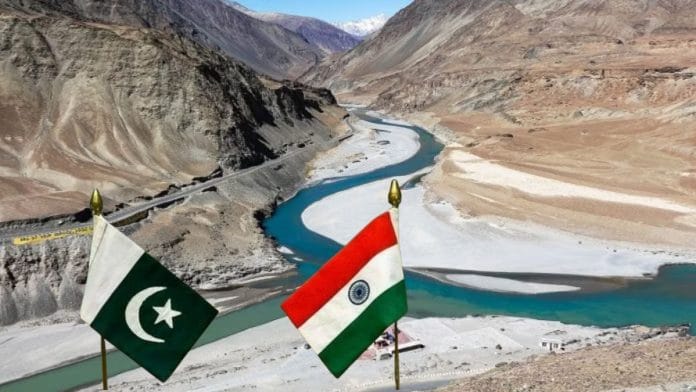

On 31 August, the Permanent Court of Arbitration in the Hague issued two determinations. The first held unanimously that India’s decision of 23 April 2025 to place the 1960 Indus Waters Treaty in abeyance was justified neither by the pact nor by general international law, and that India remains bound by it. The second barred specified concreting at the Ratle hydroelectric plant on the Chenab until 90 days after a neutral expert’s final determination, due around July 2027. By evening, India’s Ministry of External Affairs had rejected both, calling the court illegally constituted and without jurisdiction over India’s sovereign decisions.
Two facts are missing from most of the coverage of the development. The first is that India did not appear in the court. Since the World Bank constituted this court in October 2022, New Delhi has declined to file, plead, nominate or attend, including at the April 2026 hearings. The proceedings have been ex parte throughout, and the record was written by the only party in the room.
The second is that India is not boycotting the treaty’s machinery as such, but only one of two parallel tracks. Before the neutral expert, Michel Lino, appointed by the World Bank on India’s own request, India has filed, argued, and participated fully. India’s objection is not to adjudication but to simultaneous adjudication: the treaty lays down a ladder — commissioners, then the neutral expert, then Court of Arbitration. And a court cannot be seized of differences the neutral expert is already examining, because two forums on one set of facts can produce irreconcilable answers. We have spent four years declining to make that argument where it counted.
The word that is not in the treaty
Open the text of the 1960 Indus Waters Treaty and look for “abeyance.” It is not there. The treaty provides for continuation, and for termination by a duly ratified treaty between the two governments. It does not provide for a middle condition in which one party pauses performance while the instrument survives. We invented that condition after the Pahalgam massacre of 22 April 2025, and it was a necessary act of self-preservation at the time. It is also where an adjudicator finds purchase. A state that declares a treaty ended, and gives its legal basis, makes a claim capable of defence. A state that says the treaty exists but will not be performed has described a breach and given it a gentler name.
Nor can the court restore what it has certified. Exchange of flow and storage data has stopped, design notifications are not filed, objections are not entertained, inspections do not happen. A tribunal can direct a party. It cannot convene a commission that a party will not attend. The treaty is in a coma, maintained on paper at The Hague, generating all the liabilities of a live obligation and none of its benefits.
India did try the bilateral route
One objection deserves meeting head-on: if a treaty dispute is to be settled between the parties, how do we defend having acted alone?
The record answers it. On 25 January 2023, India served a formal notice on Pakistan, seeking modification under the treaty’s own Article XII(3). A second followed on 30 August 2024, citing changed demographics, clean energy needs, and cross-border terrorism. Behind both lay five meetings of the Permanent Indus Commission between 2017 and 2022 at which Pakistan declined to discuss Kishanganga and Ratle; the commission last met in May 2022. Islamabad says it replied in April 2023 and found India’s notice vague; we say no substantive engagement followed. Either way, India sought renegotiation through the treaty’s own machinery, and Pakistan went to a third-party forum. Unilateralism looks different when it follows two unanswered notices.
The Article 370 route
The remedy is one that this Parliament has used once already. On 5 August 2019, the abrogation of Article 370 was not left to an executive notification. It went through both Houses, a Presidential Order, and thereafter the Supreme Court, where a Constitution Bench upheld it in December 2023. India argued that case before no external forum and needed none. The whole of Jammu and Kashmir, including the territory under Pakistani occupation, has been an integral part of India since the Instrument of Accession, and what a sovereign republic does to its own Constitution in respect of its own territory answers to its own courts and nobody else’s. Islamabad’s response was a diplomatic downgrade — an expelled High Commissioner, an emergency session of its legislature, a letter to the Security Council, and the recitation of the resolutions of 1948 and 1949 on a plebiscite that is never going to be held. Seven years on, none of it has changed anything on the ground or in law.
Apply that logic to the western rivers. A Cabinet decision conveyed by letter can be undone by another letter, and no ministry sanctions two years of tunnelling and storage works on that footing. In July, I drafted and released for discussion the Indus Waters Treaty (Abrogation) and Western Rivers Development Authority Bill, 2026, with a companion Constitution Amendment Bill. It converts abeyance into statutory abrogation for the Indus, the Jhelum, and the Chenab alone, leaves the Ravi, Beas and Sutlej untouched, and creates an authority to put the water to use, with drinking water as the first charge. A constitutional amendment, if the Seventh Schedule requires one, is a fair price for permanence.
Also read: If Bangladesh joins the Mecca pact, India will have more to worry about
Statutes do not irrigate anything
The part that should trouble us most has nothing to do with Pakistan. Annulling a treaty we cannot act upon is rhetoric. The test is whether water reaches a field in Malwa or a tap in Kathua.
Consider the Ravi, one hundred per cent ours since 1960 and unencumbered by any objection Islamabad could raise. The Shahpurkandi Dam Project, sanctioned in 1995, spent nearly 30 years in inter-state cost disputes. The Ujh Multipurpose Project still awaits land acquisition and financial closure. For six decades, we let our own entitlement run across the border unused, and no arbitral award had anything to do with it. If we cannot tame a river indisputably ours, the case for confidence on the Chenab, where gradients are steeper and works far larger, is thin.
The legislation must therefore be paired with execution. Every scheme on the western rivers should be declared a national project — centrally funded and centrally executed, with statutory timelines, single-window clearance, and land acquisition treated as the critical path it always is. The Chenab-Beas link, a bore of some 10 to 12 km through the ridge, discharges into a grid Punjab already knows how to operate: the Upper Bari Doab off the Ravi, the Sirhind system off the Sutlej, a century of canal engineering waiting for water. The narrow valleys of Jammu, Kashmir, and Ladakh cannot absorb western-river water at scale. Punjab is where it becomes usable.
Even then we would draw a small fraction of the roughly 80 of every 100 acre-feet of Indus-system water still flowing past us into Pakistan. Nobody proposes to reverse the arithmetic of 1960, only to touch a corner of it lawfully and finish what we start.
Sixteen months of rejections have not moved a cubic metre. Pass the Bill, and then pour the concrete.
KBS Sidhu is a retired IAS officer who superannuated as Special Chief Secretary, Government of Punjab. He is the Founder-Editor of The KBS Chronicle. Views are personal.
(Edited by Aamaan Alam Khan)