



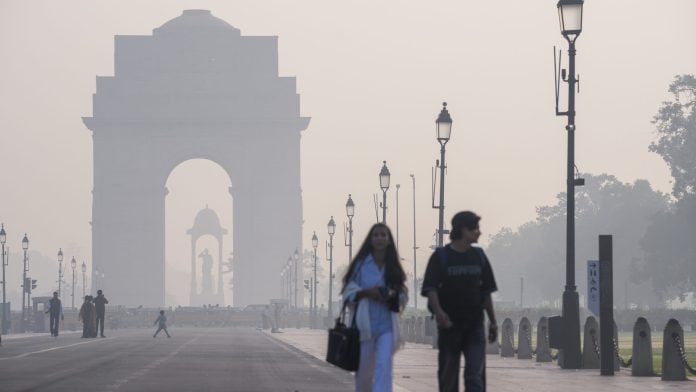
As the air thickens with the onset of winter, India and Pakistan struggle with hazardous levels of air pollution, with cities from both countries topping the rankings of the world’s most polluted urban centres. Winter in the subcontinent is witness to two kinds of smog: one that blankets Delhi and Lahore, and a second fog of the blame game that follows.
Some voices from the two countries propose ‘smog diplomacy’ or ‘climate diplomacy’ to get New Delhi and Islamabad to the table and find solutions for the toxic air they share. Despite the majority of the world’s most polluted cities between 2017 and 2025 being in India and Pakistan, smog has not acted as a catalyst for dialogue. This is even when it presents a less political, low-hanging fruit for cooperation and lasting benefits for citizens on both sides of the border.
Two Punjabs, one problem
A day after Diwali, the environment minister of Pakistan’s Punjab province attributed Lahore’s pollution to air carried in from India. The pattern recurs every year. In 2024, the chief minister of Pakistan’s Punjab, Maryam Nawaz, had expressed her desire to speak to her counterpart in India about the smog issue. She sought to visit India and extend an invitation for Punjab CM Bhagwat Mann to visit Pakistan.
“This matter has to be resolved diplomatically with India. I am considering writing a letter to Indian Punjab’s chief minister. This is not a political issue, it is a humanitarian one,” she said.
A key driver of winter pollution in the two Punjabs is the practice of stubble burning. Early in the season, farmers burn agricultural waste to clear fields for the next harvest season. Though crop residue burning (CRB) is not quite legal in both countries, with existing bans and fines, it remains the fastest and cheapest option available. Adding to this is a toxic mix of gases from vehicular emissions, industrial pollutants, and construction activities, compounded by winter meteorological conditions that prevent the dispersal of polluted air.
While Pakistan pins the blame on India, a study by the RAND Corporation finds that neither country is entirely responsible for transboundary pollution. During early winters or the post-monsoon burning season, when pollution peaks, most of the smoke is caused by CRB in India’s, rather than Pakistan’s, Punjab region. But this smoke largely sweeps away from Pakistan and into the Indo-Gangetic Plain, where it affects Indian cities. Should burning increase in Pakistan during this season, it could have implications for transboundary pollution transport. In the pre-monsoon burning season, pollution is typically lower, and the magnitude of burning between each country is more comparable, suggesting that pollution from each source region contributes to pollution at home and across the border.
Pakistan’s leading daily, Dawn, launched an investigation into this as early as 2019 by analysing regional fires and thermal anomalies. It concluded that not only is the claim of CRB in India causing smog in Lahore statistically false, with a “very small correlation coefficient”, but that such claims breed discord and do the opposite of creating a conducive environment requisite for a transboundary effort between both Punjabs to tackle air pollution.
There is evidence to support that the winter smog in Pakistan today is mainly locally generated. According to the Pakistan Air Quality Initiative (PAQI), satellite data from 1 October to 9 November recorded 18,825 fire detections across its Punjab region, of which approximately 16,714 were classified as likely crop-residue fires.
The two countries certainly share the problem. But does one cause the other’s pollution, as Pakistan’s accusations imply? The evidence points to a plethora of factors. Nonetheless, the drivers and effects of CRB are similar in the Punjab regions of both countries, and a coordinated response to mitigate the issue is yet to emerge.
Also read: When America starts behaving like an emerging market, India ends up paying part of the bill
Clearing the air
The human cost of air pollution is well established. As per a Lancet report, the deaths of roughly 17,18,000 Indians were attributable to anthropogenic air pollution in 2022. On Pakistan’s part, a report by the PAQI reveals that air pollution contributed to over 1,28,000 premature deaths annually, with prolonged exposure to polluted air cutting life expectancy in Pakistan by an estimated 3.9 years nationwide and by up to seven years in Lahore. This is even as both countries have constitutional provisions for the right to clean air and environment: India under its Article 21, and Pakistan under Article 9A.
With dialogue frozen between India and Pakistan, smog diplomacy offers a less contentious ground to break. It does not carry huge political costs, but will require political will on both sides, given the entrenchment of hawks who oppose any engagement. Cooperation could be facilitated under regional agreements, or even under the aegis of the World Bank. The Malé Declaration, for instance, signed in 1998 by eight South Asian nations, offers a precedent and can be revived to this end.
While a purely bilateral framework for discussing air quality has merit, initiating a regional dialogue could also serve as a means to the end. The latter would perhaps spare India and Pakistan the bilateral discomfort and risks. This is especially so since many South Asian nations share interconnected “airsheds”.
An airshed can be defined as a region that shares a common flow of air. The World Bank identified six major airsheds within South Asia in a report. One among them, titled the ‘West/Central Indo-Gangetic Plain’, spans a few Indian states and Pakistan’s Punjab. The Bank accordingly recommended transboundary coordination, as no single city, state, or country can achieve steep reductions in pollution levels on its own, least of all cost-effectively.
The timing is also opportune. Pakistan’s climate change minister will be in New Delhi for the Shanghai Cooperation Organisation (SCO) Civilisational Dialogue from 20 to 22 November. He could use his visit to broach the poor state of bilateral climate, quite literally, and to make the case for technical cooperation on smog, as a recent Dawn editorial has recommended. In fact, bilateral deadlock has historically been broken on the sidelines of multilateral gatherings, where India and Pakistan have at times reached agreements and at others, simply agreed to talk.
The first step should be a joint study of how pollution originating in one country affects the other, especially during winter. The two sides could share each other’s best practices to curb CRB and its effects, and encourage respective farming communities to adopt alternative agricultural practices. Other areas for cooperation include sharing satellite data on crop fires and issuing timely public health warnings and forecasts. Involving scientists and policy experts, not just politicians, would expedite an environmental policy dialogue.
This issue-specific cooperation does not necessarily have to lead to a thaw between the two. But if both rivals could work on air pollution without letting mutual antagonism get in the way of the greater good, it could serve as a template for engagement elsewhere. There is a certain irony in India and Pakistan sharing the fate of breathing the same toxic air. As Maryam Nawaz said in 2024, “Winds don’t know there is a line [border] in between.”
Bantirani Patro is a Staff Writer at ThePrint. She tweets @bantirani_patro. Views are personal.
(Edited by Prasanna Bachchhav)
Time to start ALL shades of diplomacy. Exchange of high commissioners. Very liberal grant of visas to all who pose no security risk. More trade. And then to address the knotty issues – Cross border terrorism for India, Kashmir for Pakistan. Nothing so unique in the India – Pakistan differences – viewed against the backdrop of Ukraine and Iran – that slams the door shu on diplomacy.
Bantirani badi sayani! Nice article.
But one thing I have noticed is that increasingly you too are getting fixated on Pakistan and Indo-Pak relations. The company of Shekhar Gupta seems to be rubbing off on you.
It’s a hellhole and nothing good ever comes out of it. It’s just like Hotel California – you can get in but cannot get out.
Avoid falling into this trap and getting caught in this.