




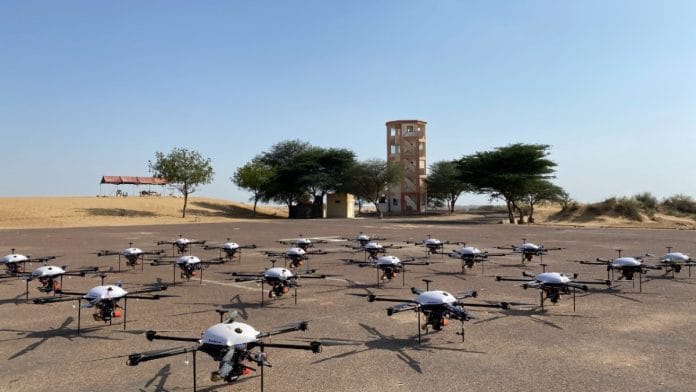

At the NDTV World Summit, General David Petraeus delivered a critical mandate for military professionals: modern militaries must undergo an urgent, revolutionary institutional transformation to survive. The primary catalyst for this shift is the rapid, real-time evolution of technology, particularly artificial intelligence and autonomous systems. Because contemporary warfare is changing far faster than rigid military institutions can adapt, incremental upgrades are no longer sufficient. Militaries must fundamentally overhaul their overarching concepts of warfare, training pipelines, procurement schedules and organisational structures within a one-year horizon, rather than the traditional five-year planning cycle.
India must heed this warning; there is no doubt about the urgency. But we must exercise equal care in deciding what to adopt and how. Ongoing conflicts are an important laboratory for contemporary warfare, but the lessons they offer need to be interpreted correctly in the context of India’s military transformation. The concern, therefore, lies in sweeping interpretations that turn observations from one conflict into prescriptions for every battlefield. In addition, true AI-driven transformation demands absolute technological sovereignty. India therefore needs a ground-up approach to AI development, a capability that exists within its start-up ecosystem and must be harnessed.
The following analysis examines these issues in India’s strategic and operational context, where lessons from recent conflicts and General Petraeus’s remarks require careful interpretation.
Strategic landscape
The ongoing conflicts in Ukraine and the Middle East provide profound insights into the mechanics of modern military transformation. In both cases, campaigns initiated by traditionally dominant powers have stalled, leaving the conflicts unresolved without clear military or political closure. The defining lesson for contemporary modernisation is that asymmetric actors such as Ukraine and Iran have successfully neutralised conventional military superiority by developing tailored, indigenous solutions that seamlessly integrate emerging technologies with their specific operational realities. Even major military powers, including the United States, are learning from these experiences.
For India, the strategic imperative is similarly clear: it must innovate by merging technological sovereignty with locally tailored operational doctrines. To build a robust, enduring deterrent, India’s defence architecture must be organically designed and indigenously sustained, moving decisively away from foreign dependencies and off-the-shelf procurement.
What drives Indian AI transformation
India’s military AI transformation must be anchored strictly in its unique operational realities rather than in the imitation of foreign paradigms. The United States develops its force logic around an expeditionary model, prioritising standoff weapons, long-range power projection and fully autonomous systems. In contrast, India’s strategic posture demands a fundamentally different architecture. India’s continental and regional realities shape its defence priorities, which include credible deterrence, proactive retaliation if required, deterring cross-border aggression, defending highly contested boundaries and securing a critical maritime neighbourhood.
Consequently, India does not require an AI framework built for distant intervention. It needs localised, data-centric capabilities that maintain a credible, persistent peacetime presence, deny sudden territorial seizures and provide the nation with rapid and flexible response options.
Geography dictates technology
India’s unique geography, stretching across high-altitude glaciers, arid deserts, dense jungles and vast maritime approaches, defies universal hardware solutions. Mountainous terrain and rarefied air degrade drone aerodynamics, disrupt communications and complicate sensor networks. Consequently, technologies proven in foreign battles cannot be presumed to work on India’s frontiers. Every drone, sensor and weapon system must survive stringent operational trials under actual Indian deployment conditions before induction.
Also read: China is preparing for a full-spectrum AI war. India is still 15 years behind
Affordable and scalable sovereignty
Unlike other nations operating without legacy forces on the same scale, India maintains a large, continuously deployed military that has always delivered results. Transformation must remain fiscally sustainable, ensuring that affordability, reliability and ease of repair guide procurement. True strategic autonomy requires bridging the gap between legacy platforms and emerging systems. By cultivating domestic industrial capacity to manufacture, maintain and upgrade critical systems, India will enhance its war-fighting resilience and eliminate foreign dependencies that could compromise its freedom of action during a crisis.
Cultural transformation and ownership
Integrating AI into national defence is not merely about introducing a new weapon class or updating a tactical doctrine; it demands a profound organisational shift. This transformation requires an attitudinal evolution among military leaders, updated institutional training and a deep conceptual understanding of algorithmic warfare. Because these systems depend on hyper secure, proprietary data, military AI capabilities cannot simply be reverse-engineered, imported or procured off the shelf from foreign suppliers. Developing them requires an uncompromising, ground-up indigenous effort involving all stakeholders, particularly the users themselves. The military hierarchy must take ownership of this process.
Sovereign AI as the foundation
Absolute technological sovereignty is an imperative for military AI transformation. India’s immediate priority must be the development of sovereign foundational models that operate independently of foreign frontier platforms, cloud dependencies or the open internet. Whether developed through secure, sandboxed architectures or adapted from existing models during the transition until domestic frontier models mature, India’s AI infrastructure must remain entirely self-reliant.
Crucially, military operational data must be processed and housed within secure, indigenously designed vector databases, such as the ShaktiDB ecosystem developed by IITM Pravartak, to ensure that sensitive data remains insulated from external access.
Leveraging unrivalled combat data
The bedrock of powerful artificial intelligence is high-quality, real-world data. The Indian Armed Forces possess an unparalleled repository of operational experience as one of the world’s most combat tested, professional militaries. India’s historical and ongoing operational experience spans decades of warfare across every conceivable terrain, from extreme high-altitude glaciers and arid deserts to dense jungles, riverine plains and complex littoral zones. This experience, combined with thousands of kilometres of active border management, complex internal security operations and high-risk United Nations peacekeeping missions, provides a foundation for developing context-specific AI, which would be unmatched.
The immediate strategic challenge is to curate, structure and synthesise this immense, multidomain combat data into specialised artificial intelligence models. By transforming this raw operational expertise into secure, edge-native models, India can field an intelligent deterrent precisely tailored to the nuances of the Indian strategic environment.
Also read: Design, develop & deploy: Sarvam signs 5-year MoU with MoD to build AI for Army, Navy, IAF
Empowering Indian startups
The landscape of deep-tech innovation in India is thriving at premier academic institutions, such as the Indian Institutes of Technology (IITs), alongside a burgeoning ecosystem of agile start-ups. These ventures possess the talent, vision and technical capability required to solve complex, real-world problems. However, to translate this potential into national self-reliance, these institutions and early-stage companies must be given a genuine, structured opportunity to prove their capabilities. There is no dearth of talent; what is needed is an ecosystem and an institutional framework that allow it to flourish.
The case for SLMs
In modern defence, security and enterprise infrastructure, mainstream reliance on massive, cloud-dependent Large Language Models (LLMs) is a fundamentally flawed idea. LLMs are prohibitively expensive, demand enormous computational infrastructure and pose significant data sovereignty risks due to their reliance on centralised, often foreign-hosted, servers.
For localised, real-time and high-security operational requirements, massive LLMs are entirely unviable. The future belongs to Small Language Models (SLMs) deployed directly at the network edge. By moving away from massive architectures and focusing on hyper efficient, domain-specific SLMs, developers can achieve high accuracy with minimal computing overhead.
The strategic blueprint
To build a self-reliant deterrent, India does not need a single monolithic AI system. Instead, it needs a highly integrated, modular system composed of specialised sub-models. By leveraging a “mosaic-style” architecture similar to a Mixture of Experts (MoE) system or a network of specialised, interconnected models, different domain-specific models can collaborate seamlessly.
Under this framework, independent modules would handle diverse streams of intelligence, such as text, image, and signal processing, combining their outputs to deliver unified situational awareness. This modular approach allows for cost-effective scaling, rapid updates, and the seamless integration of localised innovation.
By backing indigenous start-ups and academic teams to build this tailored, edge-native architecture, India can secure complete technological sovereignty with a deterrent built from the ground up, rather than relying on software imported or adapted from foreign, off-the-shelf products.
Vulnerability is not obsolescence
The rise of drone threats exposes tactical weaknesses but does not make traditional assets like tanks, ships, or infantry obsolete. The true test of any platform is its ability to accomplish essential missions within an integrated, multidomain force at an acceptable risk. Modern warfare is not a contest between tanks and drones; it is about combining mobility, protection, and sensor networks. Drones alone cannot hold territory, and tanks cannot survive without electronic warfare and counter-drone defences.
Also read: Gaza, Ukraine being fought on techno-battlefields. Indian military is 3 decades behind
Conclusion: Proactive preparation over reactive adaptation
Ultimately, India must exploit the current period to build, test and validate its multidomain capabilities before the shock of conflict forces a rushed, reactive adaptation. True deterrence does not rest on foreign templates or off-the-shelf procurement; it requires translating institutional urgency into an independent, indigenously sustained concept of warfare. By committing to accelerated procurement, rigorous adversarial testing and realistic multiterrain exercises, India will establish sovereign foundations in cyber defence, resilient edge communications and intelligent logistics necessary to secure its borders and dominate the modern battlespace.
Lt Gen Karanbir Singh Brar (Retd), PVSM, AVSM is a Distinguished Strategic Advisor at the IITM Pravartak Technologies Foundation located at the IIT Madras Research Park.
Gaurav Raina is a professor of electrical engineering at IIT Madras and Chief Scientist, Centre for Human Centric Artificial Intelligence (CHAI) at IITM Pravartak.
Views are personal.
(Edited by Prashant Dixit)