


On 28 August 2013, the Indian rupee depreciated by 3.7 per cent in a single day, reaching a record low of 68.85 against the US dollar. During that summer, Morgan Stanley grouped India among the “Fragile Five”, along with Brazil, Indonesia, South Africa and Turkey. These economies were characterised by their excessive reliance on volatile foreign capital to finance their spending. The catalyst was a signal from the US Federal Reserve that it might scale back its bond purchases, which pushed American 10-year yields toward 3 per cent and prompted investors to withdraw from emerging markets. At that time, India faced a current account deficit of 4.8 per cent of GDP, coupled with an average oil import basket price nearing $108 per barrel, making it particularly vulnerable.
Thirteen years later, both of these factors have re-emerged with greater intensity. In October, India’s crude oil basket averaged nearly $120 per barrel, marking a 14-year high, although it has since eased to the low $90s. Meanwhile, the US 10-year yield has pushed past 5 per cent as American inflation refuses to cool. Under the 2013 framework, India could have been in hot water. Yet the country is no longer “fragile”—and this is largely due to contributions from a software engineer in Bengaluru and a nurse in Dubai.
The same storm, a different ship
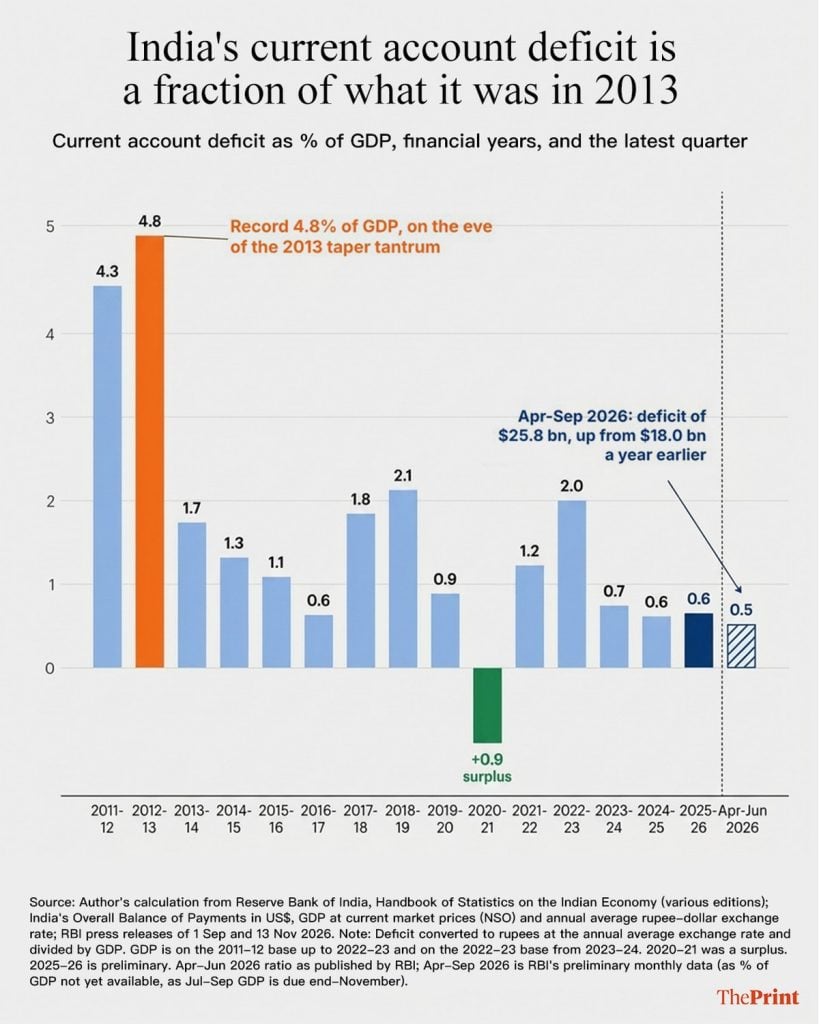
Let’s begin with the figure that significantly impacted India in 2013: the current account deficit, which represents the disparity between the nation’s earnings from and expenditures to the rest of the world. It amounted to $88 billion in the fiscal year 2012-13. By 2025-26, this deficit had decreased to $25 billion, constituting approximately 0.6 per cent of GDP. From April to June 2026, the deficit further decreased to 0.5 per cent of GDP.
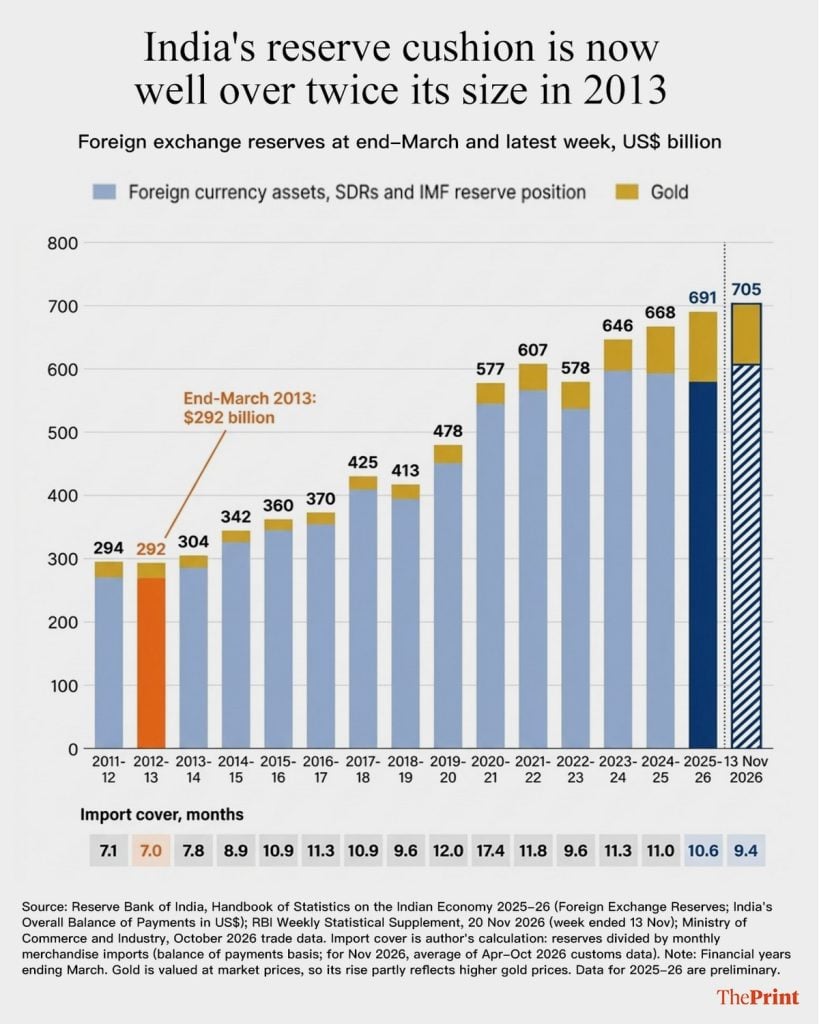
India’s foreign exchange reserves have significantly increased. At the end of March 2013, reserves amounted to $292 billion, enough to cover about seven months of imports. By March 2026, this figure had risen to $691 billion, and in mid-November it stood at $705 billion, still well over twice its 2013 level and enough to cover more than nine months of imports.
India had much less leeway in July 2013. During that period, as the rupee depreciated, the Reserve Bank of India was compelled to substantially raise short-term borrowing costs to stabilise the currency, despite an already slowing economy. This situation exemplified the trilemma articulated by Robert Mundell and Marcus Fleming in the early 1960s: a nation cannot simultaneously stabilise its currency, control its interest rates, and allow free capital movement. While reserves do not negate this principle, they give a central bank time and flexibility, enabling it to mitigate currency depreciation without resorting to panic-driven measures.
Paying for oil with software and remittances
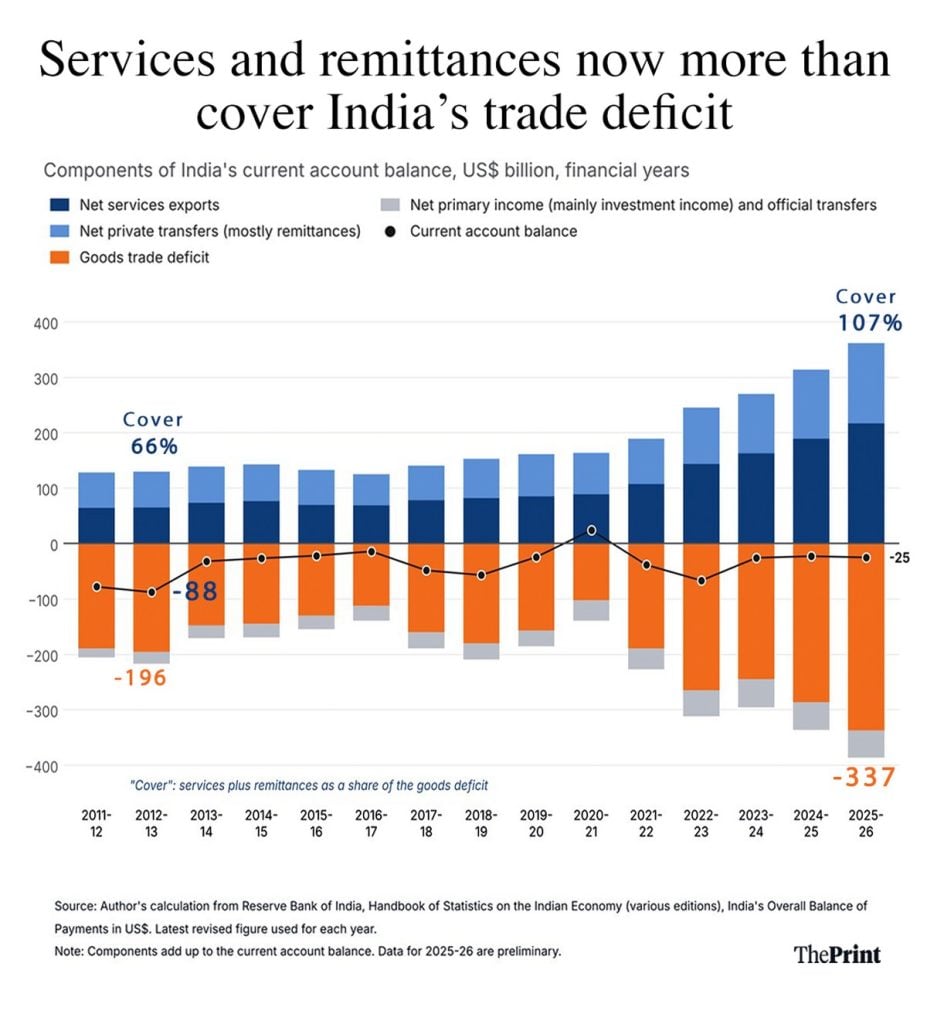
India’s merchandise trade deficit has widened, reaching a record $337 billion in 2025-26, far exceeding the $196 billion recorded in 2012-13.
However, notable changes have occurred in other areas. Net exports of services, particularly in software and business services, increased from $65 billion to $217 billion during the same period. Additionally, net remittances from Indians working abroad rose from $64 billion to $145 billion. In 2012-13, these two financial flows accounted for only about two-thirds of the goods deficit. By 2025-26, they not only covered the entire deficit but also exceeded it.
Households have also contributed. In October, while the crude oil import bill increased by approximately $8 billion compared to the previous year, India imported around $9 billion less in gold. The drop in gold imports is also so large because of the festive-buying surge in October 2025. Nonetheless, India’s external account is now supported by multiple sectors, including software engineers in Bengaluru, nurses in Dubai, and occasionally, families that choose to delay gold purchases.
Also read: Fast money is leaving, patient money is arriving—and RBI quietly rewrites the rules
What could still go wrong
The data above do not mean we can be complacent. There are three significant warnings.
Firstly, the deficit is expanding once more. From April to September, it reached $25.8 billion, up from $18 billion in the same period a year earlier, as higher oil prices hiked the import bill.
Secondly, the remaining deficit is no longer primarily related to trade. A net $32.4 billion went out between April and September, mainly in interest, dividends and profits to foreign investors and lenders, up from $25.8 billion a year earlier. This is the cost of the capital India has attracted, and it quietly increases with each dollar borrowed or invested.
Thirdly, the financial cushion is less robust than it appears. Last year, as foreign portfolio investments exited, the RBI discreetly expended dollars. Total reserves have risen since March largely because the gold India holds became more valuable, and in the week to 13 November alone they fell by $14 billion, partly as gold prices slipped. Import cover has fallen from 10.6 months in March to about 9.4.
Economist Rudiger Dornbusch cautioned that crises take longer to materialise than anticipated, yet unfold more rapidly than expected. India experienced the latter part of this lesson in 2013. Since then, it has used the intervening years to build an economy that finances its oil imports through software, services, and the earnings of its citizens abroad, rather than relying on the goodwill of foreign investors. The “Fragile Five” designation is no longer applicable. Yet resilience should be viewed as an ongoing practice rather than a final goal. Trade with the US remains uncertain, for one— Commerce Minister Piyush Goyal said on 15 November that Indian goods will get preferential access to the American market, but it’s not a signed agreement yet.
The next challenge, whether a prolonged oil shock or further tightening by the Federal Reserve, will be overcome only if India continues to bolster the financial cushion it currently has.
Bidisha Bhattacharya is ThePrint Consulting Editor (Economics) and an Associate Fellow, Chintan Research Foundation. She tweets @Bidishabh. Views are personal.
(Edited by Asavari Singh)