






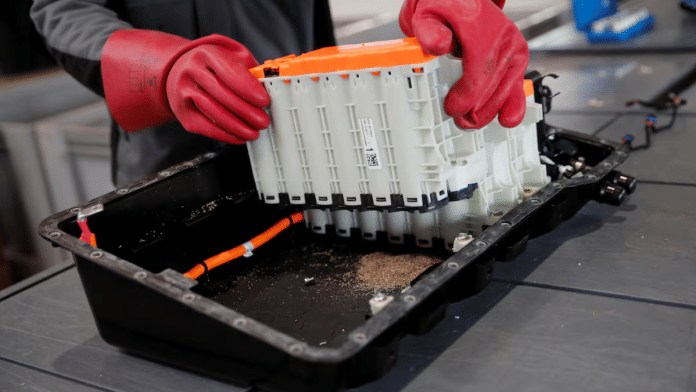


If you go by the relentless stream of headline events and claims, India under the Narendra Modi government seems all set to become self-sufficient in lithium-ion batteries, breaking free of China’s shackles and taking its rightful place in the battery-electric-vehicle revolution. But the reality is so underwhelming you’d be justified in reaching for a lithium pill to ward off depression.
The Productivity Linked Incentive (PLI) scheme, aimed at making India Atmanirbhar in advanced battery storage, has achieved less than 3 per cent of its target after five years, according to a study. In part, the gap exists because a chunk of the money was allotted to a gold exporter tainted by an alleged scam, rather than an actual battery maker. There have been zero bidders for the supposedly record-breaking lithium deposit found in Jammu and Kashmir, and no evident benefits from a slew of international agreements signed with fanfare by the Modi government.
The result: India’s lithium-ion battery imports jumped 57 per cent to $4.7 billion in 2025-26, most of it from China. The dependency increased ninefold since 2018, and it is only going to grow.
Why are we here?
First, outright policy failure. One reason the battery PLI failed is that one of the winners was Rajesh Exports, which is allegedly linked to Gautam Adani and has failed to produce a single watt-hour in five years. The gold firm has since been accused of a Rs 15.5 lakh crore fraud. Meanwhile, experienced battery makers like Exide Industries and Amara Raja failed to win any government subsidies, although they are much further along in their lithium-ion battery plans – clear evidence of poor policy choices by the Modi government.
Second, premature celebration. Recall how the Modi government tom-tommed the Reasi (J&K) lithium deposit as a discovery that would make India the world’s seventh largest lithium source. Yet it has failed to find a single bidder in two rounds of auctions. There are many reasons — the 5.9 million tonne deposit estimate is ‘inferred’ and hence preliminary, the mineral lies in difficult-to-mine clay, and persistent shortcomings in mining regulations. Moreover, there is only a single lithium refiner in India; exporting lithium ore mined in India to China for processing would hardly assure mineral independence for us.
Third, photo ops over delivery. Despite the hullabaloo, India has yet to reap any serious benefit from initiatives like the US-led Minerals Security Partnership (aimed at financing critical mineral projects) and the Indo-Pacific Economic Framework – the exception being a bilateral agreement with Australia that appears to have some concrete deliverables. India’s public sector Khanij Bidesh India Ltd (KABIL) has also made progress and is currently exploring for lithium in Argentina, for example. However, the pipeline of domestic and overseas Indian projects remains thin.
This is problematic because a secure lithium supply chain will matter more and more for India. India is aiming for battery electric vehicles to comprise at least 30 per cent of all new passenger vehicles sold by 2030, with even higher proportions of two and three-wheelers and commercial vehicles. The government has pledged to reach 500 GW of non-fossil fuel capacity by the next three and a half years. Add to this a growing market for battery storage of electricity linked to India’s renewable energy push, and you have a recipe for complete dependence on China if things don’t change.
Also read: Modi govt vs Delhi Gymkhana Club is not class war. It’s a distraction from Billionaire Raj
The groundwork needed
What if part of the answer lies in something distinctly unglamorous: recycling, or what some call ‘urban mining’? This is the recovery and processing of minerals (including lithium) from discarded electronics and batteries. India is the third-largest generator of e-waste worldwide. Some studies project that battery recycling could supply 30-40 per cent of India’s lithium demand by 2030. In fact, India’s sole lithium-refining firm Lohum uses recycled lithium rather than ore.
It’s not as if the government doesn’t get it. Ministry of Environment, Forest and Climate Change formalised battery waste management rules for critical minerals and announced a Rs 700 crore incentive for battery recycling plants. But the current policy is already in need of an update given how expensive it is to build a recycling plant, plus the crash in lithium prices driven by Chinese overcapacity, which reduces the incentive to invest.
The point about India having a single lithium refinery is germane here. Global conversations and policies tend to focus on mineral supply, but China’s stranglehold actually comes from control over the processing or refining of raw ores into usable products. China processes over two-thirds of global lithium. Until Indian firms begin investing in lithium refineries, the raw material will continue to be exported to China for processing, which does not solve the political problem of over-dependence on China.
There is much to do here, and some of the groundwork is admittedly being done. But as long as the Modi government continues to value pronouncement over action, photo ops over delivery, and, last but not least, cronies over makers, India is anything but Atmanirbhar in this strategic industry.
Amitabh Dubey is a Congress member. He tweets @dubeyamitabh. Views are personal.
(Edited by Ratan Priya)
The reasons given are ridiculous.
You are talking about Exide and Amararaja not getting contract, but ignore the fact that they were in JVs with Chinese battery makers.
Rajesh exports did not present any such issue. And how the hell are you linking a random company with Adani, that you have arbitrarily declared as evil for political reasons? Congress state govts, themselves give projects to Adani. Why are you doing that?
And talking about mining, you ignore the new Mining rules modification, where existing miners would be allowed to process rare earths from sands in existing mines.
Secondly, if lithium mines are actually excavated, Congress would start putting hurdles in land acquisition and prevent private sector participation.
We know your hypocrisy.
Ola Electric designed a battery without rare earths