




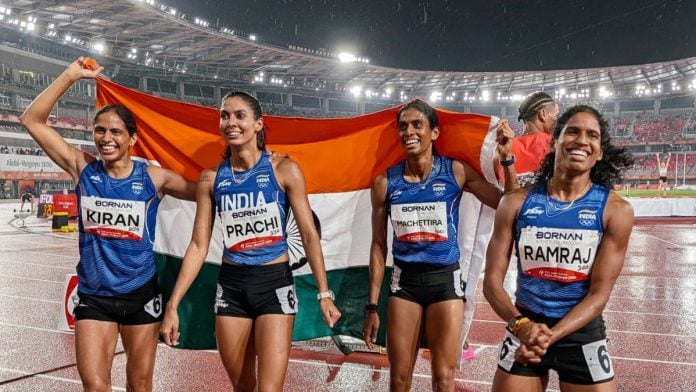

Under a soft drizzle at the Nagoya City Mizuho Park Athletic Stadium, on 29 September, the 20th Asian Games athletics programme reached a dramatic end. In the penultimate event of the night, Kiran Pahal, MR Poovamma, Prachi Choudhary and Vithya Ramraj shattered the tension with a blistering 3:29.69 in the women’s 4x400m relay.
That electric dash delivered India its sole athletics gold of the Games, preserving a proud podium legacy dating back to 1982 and reclaiming the relay crown India had last won at Jakarta in 2018, after finishing second behind Bahrain at Hangzhou in 2023.
It was the crowning moment of a five-medal final day, preceded by hard-fought bronze medals from the men’s 4x400m team and a national-record-breaking mixed 4x100m relay squad, as well as bronze medals for Gulveer Singh in the 5,000m and Pooja Singh in the high jump.
As the stadium lights finally flickered off, India’s athletics campaign closed with a hard-earned total of 24 medals: 1 gold, 9 silvers, and 14 bronzes.
Yet, as the dust settles on Nagoya, the overriding question remains: Did we succeed or fail?
To answer that requires looking past the mesmerising glint of gold or the stark lack of it and digging into the complex, messy, and deeply human realities of elite sport.
The gold drought
There is no denying that finishing an Asian Games athletics campaign with just a single gold medal feels jarring. In the theatre of international sports, gold is the currency that carries disproportionate weight in the medal table and in perceptions of performance, dictates funding, and validates four years of breathless hype. When the Indian athletics contingent landed in Nagoya, the bets were justified. They came off a stellar domestic season, with considerable optimism around the team.
As days dragged on, silvers and bronzes stacked up with agonizing frequency. The lack of gold became worrisome, reinforcing the traditional Indian sports psyche where success is measured almost entirely by the top step of the podium.
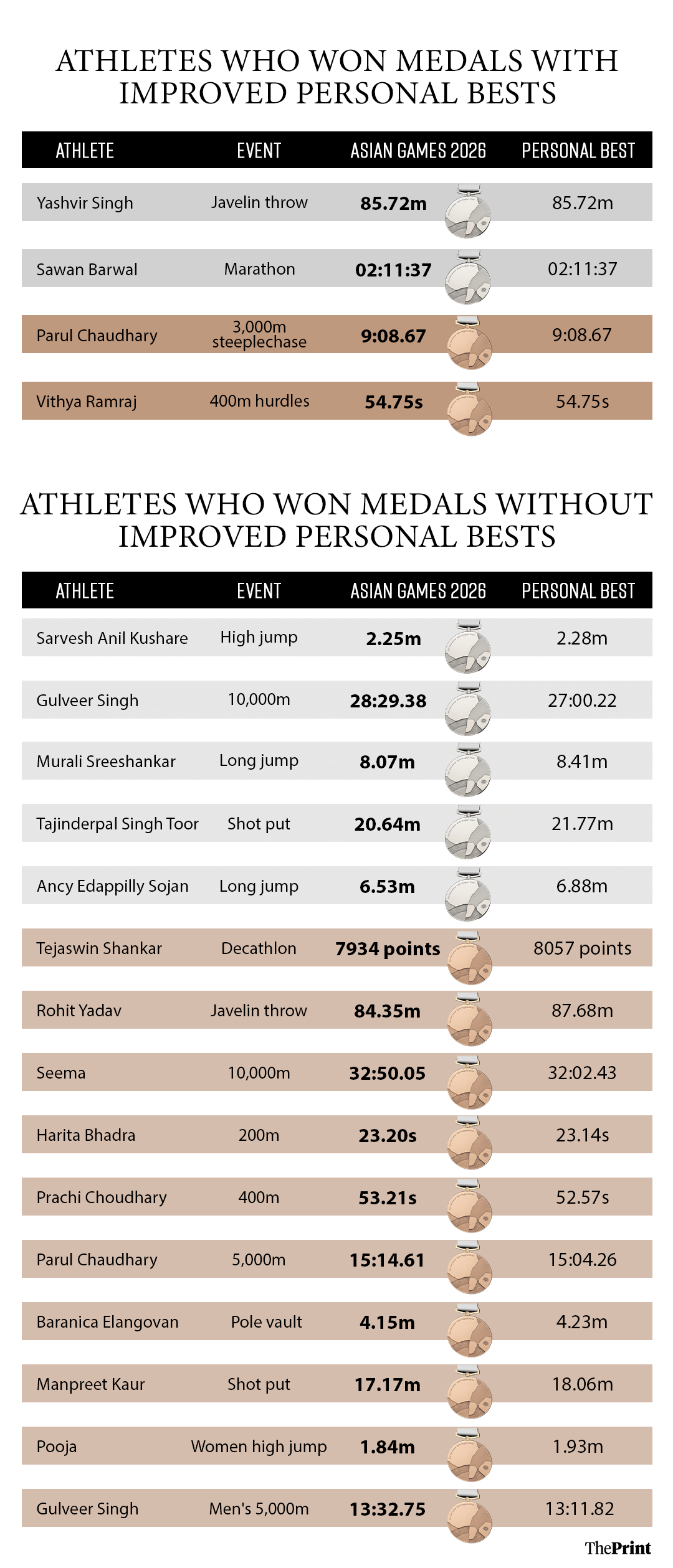
However, calling this campaign an unmitigated “failure” is too simplistic. Beneath the surface, the numbers tell a different story. India claimed 24 medals across 23 events, its third-highest tally in Asian Games athletics history, trailing only Delhi 1951 (34) and Hangzhou 2023 (29). In Nagoya, 12 Games records fell, five of which saw Indians take silver. Athletes also delivered seven fourth-place finishes (three with lifetime bests), five national records, 12 personal bests, and 51 top eight finishes from 67 individual entries and five relays.
An all-time cumulative count that crossed 300 with the Nagoya haul proves that India is consistently present at the sharp end of continental competition. But sheer volume cannot entirely mask the performances that fell flat.
Also read: How athletics drove India’s record performance in Asian Games — 29 medals in 2023 from 12 in 2010
Pain and disappointment
Athletes get hot, then cold; they get lucky, then unlucky. The Nagoya campaign saw its share of heartbreaking setbacks, injuries, and missed opportunities that left fans wondering what could have been.
Fitness certificates became a talking point, after the Athletics Federation of India had cleared several athletes who were returning from injury — giving off the troubling scent of systemic mismanagement. Jyothi Yarraji withdrew from the heats as a precaution after feeling pain in her knee stress during her warm-up. Yashas Palaksha pulled up midway through his 400m hurdles heats with a hamstring injury, and Praveen Chithravel withdrew from the triple jump after an injury during competition.
And then there was Avinash Sable, the defending Asian Games champion. His 3000m steeplechase fourth-place finish and subsequent decision not to start the 5000m remain among the Games’ biggest disappointments, a stark reminder of how thin the line is between redemption and heartbreak when an athlete isn’t fully fit.
Utterly disappointing, too, were the instances where performances didn’t match an athlete’s stature or preparation, whether it was Priyanka Goswami, who was disqualified from the marathon race walk after receiving four red cards or Pooja Olla, who finished seventh in the 800m final. In such cases, it is difficult to know how much of an athlete’s “true capability” was left unfulfilled, so the results are better treated as missed opportunities rather than definitive evidence of underperformance.
The silver linings: Youth and resilience
Yet, looking at the campaign solely through the lens of missed gold overlooks the profound paradigm shift happening beneath the surface.
The most memorable moments of the Games were not just skill based but were examples of resilience. Take Gulveer Singh, the undisputed giant of the campaign. Finishing third in the 5000m in 13:32.75 behind Balew and Yamaguchi, he became the first Indian man to win three individual medals at a single Asian Games in athletics — silver in the 10,000m, silver in the 1,500m, and bronze in the 5000m, across five gruelling days, with a 1,500m heat thrown in the middle. “How did you do it,” he was asked. “I do what my coach (Scott Simmons) asks me to. I just follow his instructions,” was Gulveer’s analysis.
Scott, on his part, said: “I judge Indian distance running at the Asian Games as having proven as high a level as historically top countries like Japan and the Gulf states, Bahrain and Qatar. India will always be looked to for medals now.”
Sarvesh Kushare claimed a silver in the high jump that could easily have been gold, matching the winning height of 2.25m but losing on countback because he needed an extra jump. Ancy Sojan led the long jump until China’s Huang Yingying pulled out a 6.55m clutch leap on her sixth and final attempt to snatch gold.
Consider Pooja, the 19-year-old national-record holder. Clearing 1.84m for bronze behind Uzbekistan’s Sayfullaeva and Kazakhstan’s Ovchinnikova, she secured the first Indian women’s high jump medal since Bobby Aloysius won silver in 2002, ending a 24-year wait.
Look at Sawan Barwal shining in the marathon, winning silver and ending India’s 44-year wait for a men’s marathon medal at the Asian Games, or veterans like MR Poovamma, 36, claiming her sixth Asian Games medal and fourth relay gold, and Vithya Ramraj, who also finished with six Asian Games medals across the 2023 and 2026 editions.
Silvers give hope because they show we are right on the doorstep of absolute dominance. Bronzes make us understand where we stand and how much more structural and physical work is required. More importantly, an influx of hungry young athletes has stepped onto the continental stage, handled the pressure, and delivered. This generational transition could lay the bedrock for a much better medal-conversion rate in future global and continental championships.
Also read: Maharashtra’s Parbhani is training athletes without govt support. They dream of Olympic gold
Nagoya vs Hangzhou: A measured comparison
When comparing Nagoya to the historic heights of Hangzhou 2023, the differences are palpable. Hangzhou felt like a watershed moment where multiple events clicked into gold-winning gears simultaneously. Nagoya felt more grinding, defined by attrition, injury management, and tactical podium finishes.
While Hangzhou yielded a higher total medal count (29), Nagoya proved that India’s presence across events (24 medals in 23 events) is remarkably stable. The depth chart has increased: athletes are no longer winning by absolute freak accidents of talent, but through a broader pipeline. However, the conversion bottleneck of turning silvers into golds remains our most stubborn ceiling.
To view Nagoya in a vacuum is to miss the shift happening in Asian athletics, where standards are rising at a ferocious pace. While India boasts impressive numerical depth, regional rivals are also developing highly specialised programmes. China continues to dominate many technical and field events through state-of-the-art sports science pipelines, while nations such as Bahrain and Qatar leverage targeted talent structures. Thailand has successfully realised its deliberate, long-term ambition of becoming a regional sprint hub — epitomised in Nagoya by 20-year-old trailblazer Puripol “Bew” Boonson capturing gold in both the 100m (9.9s) and the 200m (19.88s), the latter matching the Asian record.
For India to cross the bridge from regional volume-medallists to ruthless global contenders at World Championships and the Olympics, its athletic ecosystem must evolve beyond participation and match the science-backed specialisation seen across its neighbouring countries.
The real change needed at the top
Perhaps the most important takeaway from Nagoya is not found on the track, but in the corridors of administration.
We as a nation execute a fresh start every four years. Athletes change, new records get broken, veterans retire, and fresh faces take over. But the space where real change is desperately needed at the top remains frustratingly static. Beyond archaic bureaucratic selection procedures, a quieter reality now shapes the ecosystem: the mounting influence of corporate sports giants like Reliance, JSW, and other major stakeholders.
To their immense credit, these entities are injecting the capital, building elite infrastructure, and bringing in the scientific support that public federations historically lacked. Yet, this dynamic introduces a complex grey area. When private multi-conglomerates fund, house, and manage elite athletes and high-performance hubs, they inevitably secure a foot in the door regarding national selection conversations and the operational futures of “their” rosters. Balancing corporate patronage with absolute administrative transparency and conflict-of-interest management is the next major hurdle Indian sports administration must clear to ensure selections remain strictly meritocratic rather than influenced by corporate lobbying.
Also read: 1 gold, 4 women, 44 years—India’s Asian Games athletics streak lives on
So, did we succeed or fail?
The Indian athletics team was never as bad as a single-gold tally might make them look, nor were they as invincible as pre-Games hype suggested. Their overall record right now — the good, the bad, and the gritty jammed together — tells us who they really are and who they’ve actually been all along: a rising athletic powerhouse caught in the painful transition from regional contenders to consistent global contenders.
Hope is beautiful; it’s an addiction. And if Indian athletics can learn to match its raw, undeniable youthful talent with transparent selection, superior injury management, and institutional accountability, those near-misses in Nagoya could open up gold mines tomorrow.
One way or another, Indian athletics needs to make those moments count.
Sundeep Mishra is an author and the editor of Athletics India. Views are personal.
(Edited by Prashant Dixit)