




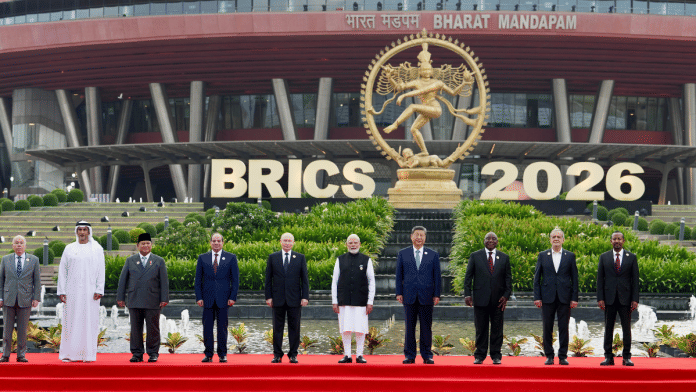

As a founding member of BRICS that had already hosted a summit in 2013 and navigated various geopolitical tangles, hosting the 18th BRICS Summit should have been an easy affair for India. It was not. There were three important reasons for this, besides several logistical issues.
The first is that this summit came at a time when the world is witnessing major conflict in West Asia and an unending war between Russia and Ukraine. Trade and supply chains have also been disrupted by fractured relations between major contestants for political and economic power, with the US weaponising trade and tariffs. It was at this critical juncture that Xi Jinping, Vladimir Putin, the President of Iran, the Crown Prince of Abu Dhabi, the presidents of Vietnam and the Philippines and several other heads of state rubbed shoulders with each other. This summit proved that countries with conflicting interests and differing views on global politics can set aside their differences and congregate for a commonly agreeable agenda — a common minimum programme that benefits the Global South — despite deep regional rivalries.
Secondly, unlike earlier summits attended by the initial founding members, the 18th BRICS Summit provided a platform for a larger, more diverse group, including new BRICS members such as Iran and the United Arab Emirates, and countries sharply divided in their views on the West, especially the US. This summit was a test for India: to steer BRICS away from the ‘Kazan spirit’ of making it an anti-West platform and focus instead on advocating and strengthening multilateralism, which it did with elan.
Thirdly, this summit was held close on the heels of the recent Shanghai Cooperation Organisation (SCO) meeting in Bishkek, Kyrgyzstan. The SCO declaration had condemned military strikes on Iranian territory that caused civilian casualties and economic damage, describing them as violations of international law and the UN Charter. Against that backdrop, the BRICS summit unanimously adopted the 140-paragraph New Delhi Declaration. It was the longest so far at any BRICS summit, but did not name specific countries involved in the ongoing West Asia and Russia-Ukraine conflicts, adopting calibrated diplomatic language so as to avoid splitting the expanded group.
But India’s BRICS Summit success is just the start. Thorny challenges lie ahead.
Also Read: Viksit Bharat cannot be built on crumbling buildings. We need to plan our cities better
‘Humanity First’ vs anti-West
India gave a new meaning and purpose to the G20 after holding a highly successful presidency summit in New Delhi. This time as BRICS chair, India has given the grouping a new purpose, agenda and acronym — Building for Resilience, Innovation, Cooperation and Sustainability — with a determination to advance a people-centric approach and the spirit of ‘Humanity First’.
The current membership structure of BRICS reflects a complex three-tier method of engagement: full members, dialogue partners and partner countries. This stratified approach addresses the fundamental issues of inclusivity and efficacy, allowing members and non-members sufficient flexibility to seek different levels of engagement while managing institutional growth. Yet, this tiered structure could also create serious limitations that constrain operational efficacy and pose coordination challenges. After all, stakeholder countries have varying degrees of commitment to collective initiatives and differing interests in group decisions.
The successful hosting of the 18th BRICS Summit, forging consensus among countries in a diverse group, advocating the interests of the Global South and making progress on economic and payments cooperation are certainly significant diplomatic achievements for India. But the harder phase begins after the summit. Institutionalising these gains, converting India’s Global South leadership into concrete economic and strategic outcomes, and preventing BRICS from becoming either China-dominated or anti-West should now be India’s focus.
Also Read: The real BRICS story is what China, Russia want & India wishes
The China paradox
After eighteen summits since 2009, several rounds of ministerial talks and an expansion of membership, one thing that still eludes BRICS is clarity, determination and speed in implementing its objectives. These include strengthening trade, investment and economic partnership among members to leverage their rapidly expanding markets and reform West-controlled (read US) global institutions, especially economic ones like the World Bank and the International Monetary Fund. Reform and expansion of the United Nations was also among its prime objectives.
BRICS will have to make a sincere assessment of how much of these objectives it has even attempted to meet collectively, much less achieved.
As for India, its foreign policy roadmap and options cannot — rather, should not — be anchored only in the present policies and future direction of BRICS. From its emphasis on reforming global financial and geopolitical systems to challenging the supremacy of the US dollar at the Kazan Summit, BRICS has gradually turned into an anti-US forum.
Needless to say, the international trade and foreign policies pursued by the Trump administration are no less responsible for dividing the world into pro- and anti-America camps, pulling India also into the vortex of this schism.
While India has refrained from joining the “anti-dollar” bandwagon, it has affirmed its stand on the need for a cross-border trade settlement system that provides an alternative to the present dollar-dominated system.
With China as chair of BRICS in 2027, managing the China paradox, reducing the trade imbalance and insulating BRICS from becoming China-centric, a platform for the China-Russia axis or an anti-US forum are some of the challenges that New Delhi will have to prepare for.
Seshadri Chari is the former editor of ‘Organiser’. He tweets @seshadrichari. Views are personal.
(Edited by Asavari Singh)