






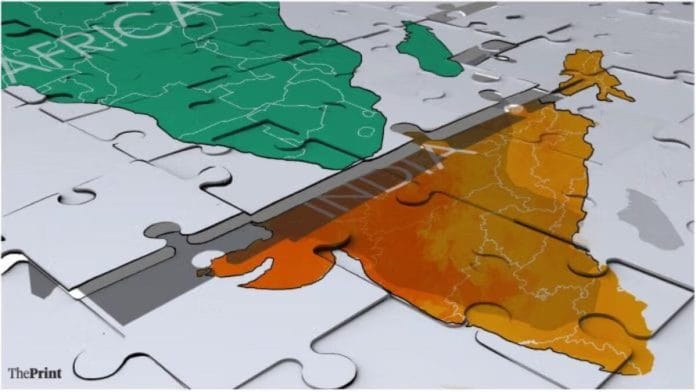


The postponement of the fourth India-Africa Forum Summit should not be viewed as a commotion in the bilateral relations. It is a temporary pause that offers an important opportunity to rethink, recalibrate, and strengthen the future framework of India-Africa partnership. Strategic partnerships are not sustained only through summit diplomacy; they are carried forward through continuous intellectual engagement, institutional dialogue, policy deliberation, and people-to-people connections.
Over the last month, I had the opportunity to participate in and observe a remarkable series of conferences, roundtables, diplomatic dialogues, and policy discussions focused on India-Africa relations. In many ways, this momentum began with the two-day International Conference on “Africa in the Digital Age: Emerging Trends, Global Realignments, and India-Africa Partnerships” organised by the Department of African Studies, University of Delhi. The conference brought together diplomats, policymakers, scholars, researchers, and strategic thinkers at a critical moment ahead of the fourth India-Africa Forum Summit (IAFS-IV).
What is particularly encouraging, many important institutions continued the momentum through serious engagements on Africa. Organisations such as the Indian Council of World Affairs (ICWA), think tanks like Vivekananda International Foundation (VIF), Chintan Research Foundation (CRF), Observer Research Foundation (ORF), Centre for Social and Economic Progress (CSEP), India International Centre (IIC), Manohar Parrikar Institute for Defence Studies and Analyses (MP-IDSA), India Habitat Centre (IHC), Confederation of Indian Industry (CII), Federation of Indian Chambers of Commerce and Industry (FICCI) and several diplomatic missions and ministries actively organised dialogues, Track-1.5 and Track-2 discussions, and policy consultations on the future of India-Africa cooperation. Track 1.5 and Track 2 refer to informal and semi-formal diplomatic channels used to supplement official, government-to-government negotiations.
Institutions such as the University of Delhi and Jawaharlal Nehru University, along with embassies, research scholars, investors, and strategic communities, have continued to engage with Africa beyond diplomacy.
This moment is important because sometimes summit postponements create a risk of losing continuity, attention, and implementation momentum. Instead, this period should be used constructively to revisit ideas that were left unimplemented, identify gaps in engagement, and build stronger institutional mechanisms for long-term cooperation. India-Africa relations must move beyond episodic diplomacy and become a sustained strategic conversation.
A few major ideas can be meaningfully strengthened during this period.
Africa Day celebration
At a time when the IAFS-IV stands postponed, Africa Day becomes even more relevant. It offers an opportunity to reinforce the long-term framework of the India-Africa partnership. Africa Day is ultimately a celebration of the possibility of a continent that continues to redefine itself with confidence, creativity, and resilience, and of partnerships that must evolve with mutual respect, shared interests, and a common vision for the Global South.
Observed every year on 25 May, Africa Day commemorates the formation of the Organisation of African Unity (OAU) in 1963, which later evolved into the African Union (AU). It represents the continuing vision of an integrated, prosperous, and peaceful Africa driven by its own people and institutions.
This year’s Africa Day gains greater significance in the context of Agenda 2063 “The Africa We Want”—the African Union’s long-term developmental blueprint aimed at economic transformation, continental integration, technological advancement, peacebuilding, and cultural renaissance. The 2026 AU Theme of the Year, “Assuring Sustainable Water Availability and Safe Sanitation Systems to Achieve the Goals of Agenda 2063,” reflects Africa’s growing focus on sustainability, climate resilience, public health, and human security.
Africa Day should be celebrated with full spirit and commitment to keep the momentum of India-Africa friendship and cooperation alive.
Also read: Myanmar wants to distance from China. India offers a relationship without domination
Continuous virtual engagement
Continuous virtual engagement is important to keep the momentum of India-Africa relations active. During the postponement, regular online meetings, scholar interactions, policy discussions, and expert consultations can be organised. These platforms can help maintain dialogue and strengthen mutual understanding.
Ministries and institutions should also share updates through newspapers, digital platforms, and social media so that public interest remains active. A short concept paper may be circulated publicly to invite suggestions from diplomats, scholars, defence experts, civil society, and young researchers. This will ensure wider participation and help India and Africa build a stronger and long-term partnership.
One useful suggestion is to start an India-Africa Forum Summit Continuing Dialogue Series during this continuity phase. This could help maintain momentum before IAFS-IV through monthly discussions organised region-wise with African regional organisations such as the Economic Community of West African States (ECOWAS), Southern African Development Community (SADC), East African Community (EAC), Common Market for Eastern and Southern Africa (COMESA), and others.
These discussions could target countries based on regional organisation. The initiative could produce regular” monthly report papers” that would support summit preparations. It would also give African partners an opportunity to directly raise their ideas and suggestions, making future India–Africa cooperation happening.
Heritage preservation matters greatly in India–Africa relations because it acknowledges the historical contribution of Africans in shaping India’s political, military, maritime, and cultural history. African communities in India, particularly in Gujarat, Karnataka, and Maharashtra, built important cultural spaces and developed unique Afro-Indian identities over centuries. Recognising and preserving this shared heritage revives historical agency for African people whose role has often remained neglected in mainstream historical narratives.
The history of Afro-Indians also strengthens the multicultural identity of India and reflects centuries of intercultural adaptation. During this continuity phase in India-Africa engagement, greater attention can be given to African heritage sites and communities in India. Such efforts can become a powerful cultural bridge connecting India and Africa beyond diplomacy and economics, through shared history, memory, and people-to-people relations.
Also read: From Kolkata to Quad, Marco Rubio’s India visit sparks anxiety and mockery in China
Need for a joint archive
A fifth important way to maintain momentum during this continuity phase is the development of a collaborative India-Africa regional archive and open-access knowledge platform. This initiative can bring together primary sources, oral histories, diplomatic records, photographs, cultural materials, and historical documents related to India-Africa relations.
Such a joint archive would help researchers, students, diplomats, and policymakers better understand the shared historical experiences between India and Africa. It would also encourage decolonial scholarship and promote academic collaboration during the period. More importantly, this platform can preserve neglected Afro-Indian histories and strengthen long-term intellectual and cultural connections between India and Africa.
The postponement of IAFS-IV, therefore, is not the end of momentum. Rather, it is a reminder that the strength of India-Africa relations lies in the continuous efforts of institutions, scholars, diplomats, ministries, think tanks, and civil society actors who keep this partnership intellectually alive and strategically relevant.
Manish Karmwar is a research professor and faculty member, Department of African Studies, University of Delhi. Views are personal.
(Edited by Saptak Datta)