



For over a decade, Hindutva bigots have systematically attacked Muslims across India, sometimes for simply existing. Many of us in Hyderabad watched these incidents as mute spectators thinking, “It only happens in the north; it’ll never happen in the south, especially not in Hyderabad.”
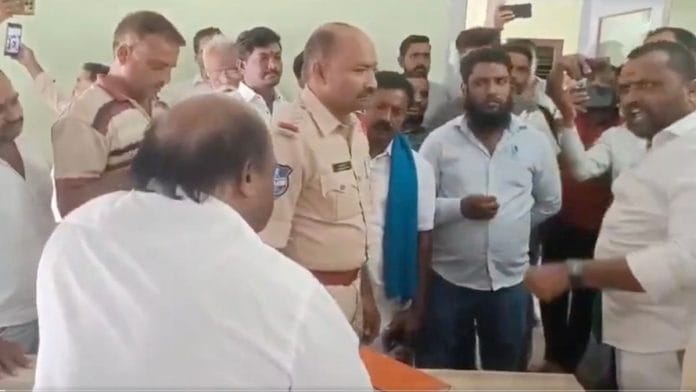
A recent incident, however, should serve as a wake-up call for all those who assumed they were insulated from such violence. A Muslim school principal was assaulted, in police presence, by BJP’s Armoor president Vandula Balu, over allegations of teaching Urdu to non-Muslim students in a school in Telangana’s Nizamabad district. The principal later explained that the non-Muslim students were merely seated there due to ongoing construction in another class.
This incident is a terrible sign of things to come. More troubling is the silence of Telangana CM A Revanth Reddy and other Congress leaders on the growing communalism in the state. It’s like there is a silent acceptance of communalism, which is only emboldening the right-wing.
But the incident is shocking also because Urdu is the second official language of Telangana. Not only is the language intrinsic to the very being of Hyderabad, but it also traces its origins back to Delhi. And even though Urdu is associated with Muslims today, some of the most notable Urdu poets have in fact been Hindus.
Then why should anyone take issue with Urdu being taught in a school?
Urdu was the official language of the erstwhile Hyderabad state under the Nizams from the late 1880s to 1956, after which Hyderabad was carved out on a linguistic basis.
Grandparents of many Hyderabadis still share pleasant memories of studying in Urdu. Although Urdu has seen a gradual decline in Telangana after Telugu became the official state language and medium of instruction along with English, it continues to be relevant. The language still serves as a medium of communication for lakhs of people in the state.
Urdu newspapers continue to be published and read while events are often held to celebrate Urdu literature.
Also read: Hyderabad is conservative at its core. It isn’t quite the modern global city others view it as
History of Urdu in Hyderabad
Both Urdu and Dakhni (the spoken language in Hyderabad and the Deccan even now) come from Dehalvi, the language spoken in Delhi in the 13th century. While Dakhni developed in the Deccan in the 1400s, Urdu developed gradually in northern India.
It is important to note that the literature in the 1500s and 1600s in Hyderabad was in Dakhni and not Urdu, which travelled to the Deccan only through Mughal conquests.
During Aurangzeb’s rule, Hyderabad became the capital of the Deccan in the 1760s, even as Persian remained the official language of the state. The shift to Urdu began around the 1700s when Wali Dakhni, a 17th-century poet widely regarded as the ‘father of Urdu’, visited Delhi.
As Urdu gained prominence, it became the medium of instruction in the Mughal courts in the 1830s. However, Persian was still considered superior. It was in the 1880s that Urdu was formally adopted as the official language of the Hyderabad state, which was assimilated into the British empire as a princely state after the collapse of the Mughal Sultanate in 1857.
After the revolt of 1857, Urdu started losing relevance and poets lost their patronage in Delhi after the 1857 war of independence. It is then that Hyderabad’s role becomes crucial. Hyderabad’s Nizams not only gave them patronage but also a space for Urdu to thrive.
Also read: Hindutva groups targeting Muslims will never understand what makes biryani Indian
Urdu isn’t a language of Muslims in Hyderabad
Urdu became a language for everyone in Hyderabad, not just Muslims. Some of the most notable Urdu poets were in fact Hindus who formed a core part of the Nizams’ administration.
Remember the famous Urdu poet ‘Shad’? His actual name is Maharaja Kishen Pershad, who belonged to a noble family and served as Prime Minister under the sixth Nizam Mahbub Ali Khan. Similarly, one of the state’s most popular communist leaders and former MP Raj Bahadur Gaur was a champion of Urdu literature, and served as the president of the All India Anjuman-Taraqqi-e-Urdu, an organisation established in 1903 to promote Urdu language. Gaur’s cousin Oudesh Rani Bawa is one of Hyderabad’s most well-known personalities for her scholarly work on Urdu.
The list is long, but the point here is that Urdu was certainly not a ‘Muslim language,’ and nobody had a problem with it. The BJP’s narrative of treating it as an alien language is not just wrong, but also unacceptable.
I can only hope this does not get normalised.
Yunus Lasania is a Hyderabad-based journalist whose work primarily focuses on politics, history and culture. He posts on X @YunusLasania. Views are personal.
(Edited by Aakriti Handa)
I’m not against any language and dont support violence but Stop this hyper secularism. Urdu or persian was imposed right from bahaminis till Nizams rule in deccan. osmania uni in 1918 had urdu as medium, there was no telugu medium. Why should telugu or kannada or marathi people speak and learn urdu? Shouldnt muslims who live in TG should adopt telugu ? Why still many are not fluent in telugu in old city?
The incident reveals so many problems: impotent police, assault wthout consequences, bigotry of the highest order, no one speaking up. Learning a language is a good thing. The language stays alive, it helps appreciate literature and culture, and can help keep cognitive decline at bay. The people who want to ban languages are cognitively chimps; they are beyond help.
Nothing can and should justify violence but the premise is laughable. Anyone who knows even a smattering of Urdu would know that the language is deeply immersed in Islamic culture and a worldview that is invariably Islamic.
Right from greeting someone ‘peace’ under submission to Allah (salam, etymologically tied to Islam; the full greeting means ‘peace, mercy, and blessings of Allah unto you’) to making a ‘dua’ (Islamic supplication) for their ‘khairiyat’ (well-being by Allah’s decree), to parting with ‘Allah keep you safe/in his protection’ (Allah hafiz/fi Amanullah) – and that’s just the everyday examples.
Examine the lexicon and idioms of Urdu. Talk of 7 heavens, theological concepts like qurbani, sadqa, sajda, iman, ibadat, qibla, wahiyy, and so much more. I’m not advocating that this is reason to despise the language, but it’s a profound ignorance to think it is not a language that evolved in an Islamic cultural milieu and evolved to express its ideas and reflect its thought paradigms.
And only as a final footnote do I bring in, one, the overwhelming body of literature from the classics to contemporary popular writings that are often explicitly didactic in nature and Islamic in character.
My second point is deeply connected to the history and evolution of the language, but I’d consider it a footnote because it is merely one small (if significant) way in which the Islamic character of Urdu becomes manifest – its metaphors and epithets allude to Islamic lands – Arabia, Iran, or at best Khorasan (rarely) – and folklore figures/legends far removed from Bharatiya geographies and local cultures. Even the Islamic doctrine of the kafir makes a cameo – kufr, sanam, but being frequent negative metaphors.
There is one exception – some idioms refer to munh mein Rama, or pujari, or mandir/devata. But these exceptions only prove the rule – munh mein Rama [mispronounced Ram in Urdu], baghal mein churi ; shaitani taqaton k pujari ; shehwat ka mandir / devata. As much as my lizard brain accustomed to rustic, lowly, uncultured Bharatiya languages wants to save myself from a 295 A or an STSJ crowd, I ask because someone must ask – why not munh mein Allah / Muhammad ; shaitani taqaton ka aabid/molvi ; shehwat ka masjid / khuda?
Oh yes I’m sorry, I know why not – Urdu is not a Muslim language.
Mr. Yunus L,
You put zero effort into checking the facts of this school incident. You watched a viral video, took the principal’s excuse about “construction” at face value, and stopped reporting. You didn’t ask the basic questions: What was actually being taught in that room? Did the parents consent? Was Urdu part of the approved curriculum? You skipped these details because answering them would completely destroy the simple story you wanted to tell.
Instead, your writing reflects consistent anti-Hindu bias. You look at a legitimate, high-friction local dispute over curriculum and parental consent, and immediately use it as an opportunity to attack Hindu society, labeling valid parental concerns as mere bigotry. You invoke three Hindu poets across centuries to claim Urdu was never a Muslim language, but the official historical record you conveniently buried tells a completely different story.
The Census of India records—specifically the 1941 Hyderabad State Census Report and the 1931 Imperial Tables archived by the Government of India—show the raw demographic reality: Telugu speakers made up nearly 50% of Hyderabad State. Native Urdu speakers accounted for barely 9% to 10%. Yet, under the 1884 diktat of the 6th Nizam, Urdu was enforced as the sole official language of administration and courts. The 7th Nizam pushed it heavily into education, founding Osmania University in 1918 with Urdu as the mandatory medium of instruction, entirely bypassing Telugu despite it being the native language of the overwhelming majority.
This wasn’t organic cultural patronage. It was systematic, top-down institutional suppression. The Nizam imposed the language of the capital’s elite 10% minority onto the 90% of the population that spoke Telugu, Marathi, and Kannada, creating conditions for educational and economic disparities for the native Hindu population. You intentionally confuse Hyderabad City’s Urdu-dominant nobility with the broader, Telugu-dominant Hyderabad State just to make your argument work.
A violent assault happened, and that is indefensible. But you are using that violence as a shield to shut down legitimate questions about curriculum transparency. The token Hindu poets, the weaponized nostalgia, and the erased history of linguistic coercion all collapse when confronted with documented demographic data. You aren’t defending a language; you are romanticizing elite imposition to run cover for historical linguistic coercion and current misrepresentation of Urdu’s actual role in state administration. Do some actual reporting next time
Agreed. Urdu needs to be delinked from religion.