



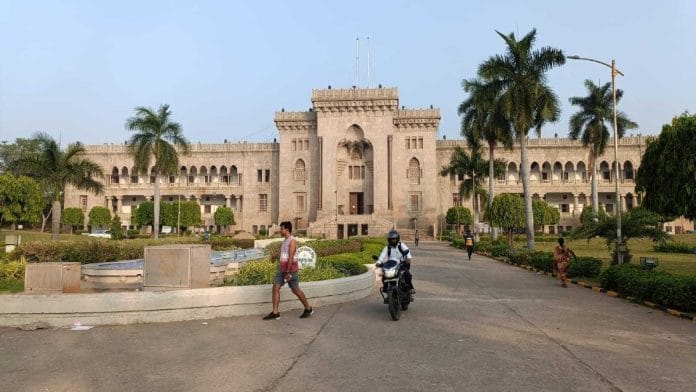
Osmania University, as everyone knows, was the hub of the Telangana statehood movement of 2009-14, and even before that.
Until the formation of Telangana on 2 June 2014, there were protests on campus almost every day. Many, including myself, thought the protests would stop after that, but they never did—and they didn’t have to. The very foundations of OU lay in the power students have held historically in terms of political influence.
This is precisely why OU’s absence from the nationwide youth protests over NEET paper leaks is rather unfortunate. Despite being one of the most politically charged forces in the country, OU and its students are nowhere to be seen in the current movement.
The university administration’s one-year-old memo banning protests on campus is much to blame. There is no question that sometimes, academics may have suffered due to demonstrations and disturbances. However, as a person who studied there, I couldn’t have been prouder of the institution—it embodied dissent.
Since the formation of Telangana, successive governments have clamped down on student groups, banning protests in OU in a bid to curb dissent. In March 2025, under the Congress government, the OU administration’s memo banning protests caused significant umbrage among students.
But such a clampdown did not start in March 2025. Under the previous Bharat Rashtra Samithi (BRS), former chief minister and party supremo K Chandrasekhar Rao (KCR) faced the ire of protesting students on more than one occasion. Although it was KCR who spearheaded the Telangana statehood movement, students did hold rallies against him.
In fact, KCR chose not to deliver an inaugural address in 2017 during the university’s centenary celebrations. The process of slowly killing student dissent in OU began under the BRS. However, the administration’s formal circular sped up the procedure.
In 2017, the BRS clamped down on student groups and the Telangana Joint Action Committee (headed by professor M Kodandaram) over protests against lack of jobs and other unfulfilled promises.
Also read: Would we be nicer without X? Social media is designed to make users lash out
A radical history
Osmania University was established in 1917-18 via a farman (order) issued by its founder and the last Nizam of Hyderabad, Mir Osman Ali Khan.
The university was a hub of excellence and progressive thought, which naturally made it a hub of dissenters. Makhdoom Mohiuddin, one of the leaders of the Telangana Peasant Rebellion or Telangana Armed Struggle, completed his master’s degree from OU and had his political awakening at the university.
OU was also where the ‘Vande Mataram’ movement took place in 1938 after the Nizam’s government reportedly rusticated some students for singing it. Dissent is in the DNA of OU.
Perhaps the administration is only keen on improving the quality of education. But a university, especially OU, is where students learn not just about their subjects but also about real-world politics. It’s where free thinking develops.
OU thrived at a time when Left-oriented politics was in vogue. It was a bastion of Leftist groups even after Independence. This is one reason why protest and dissent are at the core of the university’s culture.
So, it is rather sad to see that when the entire country is coming together to make its voice heard against the current administration, one of the most powerful voices and spaces in Telangana has its voice stifled.
Yunus Lasania is a Hyderabad-based journalist whose work primarily focuses on politics, history and culture. He posts on X @YunusLasania. Views are personal.
(Edited by Prasanna Bachchhav)
Oh My…Another Darbaari media rabble rousing agent, and his perpetual victimhood machinery is back with WhatAboutery.