





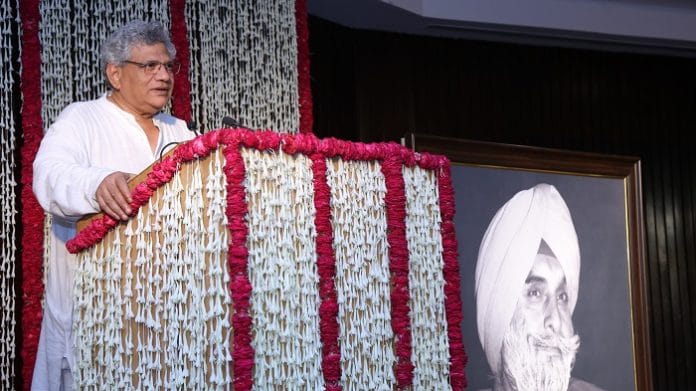


I find it very difficult to pay my homage to Mr. Gill, because there’s a very peculiar contradiction. It’s not very often that communists pay homage to police officers, but we are always often seen to be on the opposite sides of the fence, which I think is an unfortunate perception, because it’s not correct, because what was referred to us is what my perception of Mr. Gill has always been, as we say in our Hindustani, a naik insaan, I mean, like the naik insaan who searched to lay the shilanyas for the Golden Temple, and Mian Pir was found to do that, a Muslim Pir. Mr. Gill was one of those who stands out as a very, very unique police officer, and I wish he was around today to give, in his own inimitable style, a bit of advice to those in uniform who keep making political statements unsolicited today, and he would tell them, because I’d never seen him ever make any political statement while he was in uniform, or even otherwise while he was serving, except through his messages for his own comrades who were killed in the battle, in the fight against terrorism.
Mr Arun Shourie was talking about Mr Anand in Tarn Taran district. My association with Gill Sahib begins then, when I was a youth, part of the youth movement in the country. One of our youth leaders, Roor Singh Gill, was one of the first of the victims in Tarn Taran, who was shot down, I mean, in open daylight in front of many people, as a measure of defiance that the terrorists wanted to establish in Punjab, saying that nobody can stop them.
And when Roor Singh Gill died, Tarn Taran was exactly like what Mr Arun Shourie was describing, that it was about to go, if it went, the cluster of districts would have gone, and if that went, Punjab wouldn’t be part of India today. And God forbid, I mean, what else would have followed after that? But he was the first of our comrades who died, I mean, the first among the 200-odd of the CPM people who were killed in the battle. So, these were the comrades who were fighting, as Gill Sahib used to say, you are fighting without the uniform, we are fighting with the uniform.
And that association went on for a long time, I mean, I can go on giving so many instances. Go to a conference, Gill Sahib would not communicate with me naturally, I mean, I was a young man, but he would only keep sending messages to Comrade Surjeet, to say that you tell your comrades to not go there, or do this or do that. We were having a youth conference, I got a message from my party, General Secretary Singh, don’t go there.
I said, how can I not, because it’s all been done, and it was a good conference. But Secretary, he came to the station to see me off, and we used to have 303 rifles, and you used to have the extremists with AK-47s. Only advantage of the 303, like Gill Sahib used to explain, is that its range was longer than the AK-47.
So, he says the terrorist is a little afraid, if you see somebody with a 303, that he’ll be able to get him before his bullets can reach you. Well, that about, the Secretary came to see me off at the station, he went back home, by the time I reached Delhi, get a message that he was shot dead on the way back. Those were the days.
And that was the sign of terror, which very few today can actually imagine, unless you live through that period. And then he would have, and I think he was the first one to have started this, that a car, a pilot with a huge antenna in front of him, that’ll give him the radio signal, if there was something that was lying around. And I said, does this really help? He says it doesn’t really help, in an honest way, like many said, Gill Sahib was a very basic human being.
He said, of course it doesn’t help, but it frightens the enemy, you see, he thinks that there’s something wrong, and there’s a huge antenna, et cetera, and then he says, that is how the battle won, if you can disarm the enemy. But it’s about his personal qualities, like many, I mean, everybody who knows him knows that. And I remember what the instance that was referred to, about the Punjab police and the people who left deserted and abandoned, and I think Mr. Shourie also was talking about the Calcutta incident.
And that was one of those peculiar things about the Indian law, that a police from one state cannot enter the other state without informing the police of the other state. And if you’re part of a terrorist operation, I mean, there’s not much time for such bureaucratic, you know, file transfers to move through. So some of them were caught in Bengal, then, which had our government.
And because they transgressed, so they were jailed, and they were kept in jail. And suddenly one evening, this was about 15 years ago, 10 years ago, the case had reached the stage. I was returning home, only to find I still live there, a small DDA flat in Vasant Kunj.
And I suddenly found the way was littered with policemen all over the place, and there were these black dogs sniffing around. On the way, I mean, through the other houses, I said, kya ho raha hai? (what’s happening?). He said, Gill Sahab aaye wey hain (Gill Sahab has come). I said, kahaan pe aaye wey hain? (where has he arrived?) I didn’t think he came to, normally he would have picked up the phone and, you know, talked to me.
So, he said, nahi, woh ghar aaye hain. I said, Gill Sahab ghar aaye hain toh matlab kuch khaas hai, matlab, (if Gill Sahab has come home, there must be something important) so that you wanted to. And he said, no, I didn’t want to talk to you on the phone, nor for you to come to any other official place.
I wouldn’t tell you. And then he explained the case. I don’t think I should give the details here, but he explained the case, and then five policemen’s lives were in danger.
I mean, they would have been executed for having fought terrorism. Fortunately, when I said, agar aap batayenge toh zaroor (if you tell me, then definitely), I mean, I’ll take up the case, Gill Sahab, because I don’t think you have any ulterior motive. And he said, nahi yaar, bechare bachche hain mere, unki jaan ka sawal hai, unke bachchon ka sawal hai (they are my innocent children, their lives are at stake, it’s about their children).
And today I’m glad that I was in Punjab only two months ago to see one of them has come to the rank of a DG now, one of these five, and all five of them are doing very well. So that was our humble contribution to the entire struggle that he put up. But there are certain qualities which I wish sometimes, I mean, this is not the occasion to really analyze them and really dissect them and talk about them.
But I think this somewhere, sometimes has to be documented. And I would really like somebody like, you know, Mr. Shourie, Mark, Shekhar, many people who have worked with him to actually document this for the future of our own services, how they have to be built and nurtured. And this is important, both in terms of the command structure that Gill Sahab followed, the intelligence gathering that he followed, which was not really through the official circles alone, which is the most important thing in gathering intelligence, not to rely only on your sources.
And the ruthless manner at one level, he was a perfect human, I mean, a very fine human being, but he was completely ruthless when it had to be, something had to be executed. And that was the quality. I mean, if you want to sum up, it’s a rare combination, that you have to have a level headed, I mean, a head on your shoulders.
You had to have a warm heart, but you had to have a firm hand to execute the order. That can never waver. And that with Mr. Gill, never wavered.
And I think it’s been a very fine officer in the evenings. I mean, even through the height of terrorist things, I would be there with Mr. Surjeet in one of these programmes and we’d be taken off to some isolated guest house, you know, somewhere there and kept there. And I, because of my habit then of smoking, et cetera, and you know what it means in Punjab and particularly during terrorism to smoke and with Surjeet Sahab and Gill Sahab.
So, I had to find my escape routes, going outside to do that. And the way he one day scolded me, saying that, ek cigarette ke liye jaan de dega tu, kaisa communist hai tu? (You’ll give your life for a cigarette? What kind of a communist are you?) So then, I mean, then by the time he’s out of his uniform, he’s a different man altogether, completely, completely human, very warm and very good. And that’s why I think I can only go on for, I mean, on many, many other thoughts.
But I don’t think this is the occasion that we’ll, I hope we’ll have a time when we can all compile all our experiences. But in the end, I can only say one thing. And he was very fond of shero shayari, he had a wonderful memory of all the English poetry that he read.
And he could always, you know, with a drop of a hat, tell you, I mean, recollect a sher and tell you. But the only sher that I think is befitting for him would be like somebody said: Ye na poocho zindagi mein kitne pal hain. Ye na poocho zindagi mein kitne pal hain. Ye poocho, har pal mein kitni zindagi hai.
And that is what I think his life was, full of life in every moment. That’s how he lived it.
And I wish that we’ll have more such people for our country and for our future. Thank you.
This is part of ThePrint’s Great Speeches series. It features speeches and debates that shaped modern India.