






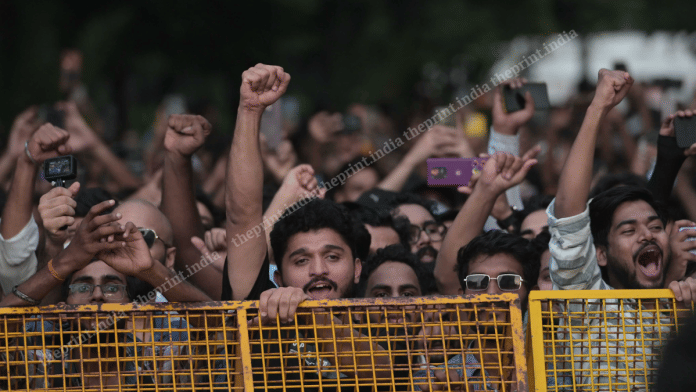


By letting Dharmendra Pradhan go, albeit reluctantly, the Modi government may have bought itself some time to recoup political capital and rework its political calculations. But the time it has bought may be weeks, not months. For, once triggered, the chances are every major citizen’s dissatisfaction will now be aired in public. Some could also lead to Jantar Mantar. Already there is an E20 Janta Party in the making, comprising vehicle owners miffed about what E20 – ethanol mixed petrol – may be doing to their vehicles. Soon you could have farmers and other groups vying to get into the action.
The Prime Minister, realising that the Jantar Mantar protests were driven by Gen Z – those in the 15-29 age group – and their instagram posts, has himself gone on Instagram. While there is no harm in this, he should not assume that his presence on this platform will change perceptions about this government. Reason: the Prime Minister is himself showing his age, and putting his own age on view for the younger generation repeatedly may not work with Gen Z.
So, what exactly should the government be doing?
One, and most important, it must choose engagement with the youth over just action driven by the top. The Gen Z grouse is not about any specific issue, but about those in power not listening to what they are thinking, what they want out of life, and which things must be prioritised. Of course, future careers are a big issue in our country, but it will not end with that. It wants to be listened to. Having tasted blood in its first coming out party, Gen Z is not going to go back to its studies.
The problem with the Modi government is that well-meaning decisions driven from the top may not seem as good on the ground. In the younger crowd, which is not used to listening to authority, it may even be seen as an imposition rather than a solution to a problem. The government has to develop the habit of listening to the youth and other social groups and then coming to decisions, rather than assuming that its own good intent is enough to justify a decision – as is the case with E20. At the very least, it must offer alternatives to E20, even if 100 percent petrol is priced higher. While ordinary vehicle owners are not going to create a “chakka jam” at Jantar Mantar, fleet operators and taxi owners might well do so. So, this is one trouble the government should see coming right now, and choose to engage with those raising concerns about E20. It is, of course, true that offering two options of fuel may take time to implement, but being heard is the important thing here.
Two, this is also a kind of taxpayer revolt. While the vast majority of citizens do not pay any income tax, they do pay indirectly through the goods and services tax. They also pay “private taxes” in the form of bribes to various officials at the state or municipal levels, whether it is for traffic violations or obtaining birth and death certificates, or hospital and other subsidised services. Our definition of the tax-paying middle class needs to change from defining them by income groups to a broader definition that looks at the middle class mindset: anyone seeking to write competitive exams and higher education, or consuming packaged foods, for example, should be considered middle class. The emerging consuming classes are the larger middle class, even if their income levels do not always indicate their membership of this group.
Three, as Santosh Desai argues in his Times of India column today (27 July 2026), for Gen Z the only government they have known is the Modi government, not least because it has been seen everywhere, and is also seen to be winning many elections. So, it will demand maximum accountability from the Modi government, even if most of their problems are not created by the Central government. The Modi government would do well to start the process of devolving power to state governments and ask the latter to further devolve power to the local bodies, for this is where citizens most interact with the state. The state governments will start feeling the heat soon enough. The message is not merely to the Modi government, but all state governments and municipal authorities, none of whom is actually delivering good quality citizen services. They will all be vulnerable, but as the party which dominates Indian politics both at Centre and many states, the BJP will face searing heat. The very fact that the Cockroach Janata Party (BJP) has Janta in its name, and the E20 protests too have Janta in their organisational name, tells you a lot about who the political target is. The BJP too has Janata as its middle name.
Four, the CJP protests did not have any overt caste undertones, but many of the students protesting the NEET mess-up – and the larger problem of lack of career opportunities – were also worried about the creeping nature of educational and job reservations. But anyone who tries to interfere with reservations as they currently exist will inevitably face a political backlash – which could well set off a caste war. This is precisely what will sink the BJP’s boat, for it is dependent on a Hindu vote consolidation that subsumes caste. If we end up with caste-based conflict, 2029 will be an uphill battle for the BJP, especially since minority consolidation against it is a reality..
Five, all political parties now need to heed the call for better governance and citizen services. Till now, thanks to the government’s ability to offer freebies using the Jan Dhan-Aadhaar-Mobile facility, politicians have been busy emptying the exchequer to win elections. While no one can discount the probability of a well-aimed freebie bringing in the incremental vote, future elections will be about freebie-plus. Not just freebies. If NEET can cause a political convulsion, why not garbage and traffic jams and poor health services?
Six, the judiciary and the news media should not consider themselves free from large scale scrutiny. At the Jantar Mantar protests, many journalists were given abusive treatment, sometimes even with physical jostling. The judiciary has not yet been a direct target, but the students on the prowl at Jantar Mantar did not have much reverence for the judiciary either. In fact, the term “cockroach” itself is, courtesy, a casual remark made by the Chief Justice of India.
So, to repeat, what should the Modi government, or any government at any level, do?
1: It should consider initiating huge reforms by consulting, among others, Gen Z representatives, apart from experts. This does not mean only the CJP, but many more youth leaders and organisations who understand the pulse of this cohort. Other political parties and citizen groups should also be kept in the loop.
2: There should be committees and consultations for reforms in agriculture, education, health, skilling, bureaucracy, judiciary and – most important – political reforms. The last is the biggest cause of corruption. The judiciary should know that while the executive will be held accountable for its lapses, the judiciary itself is one of the worst-performing arms of the state. So too is the bureaucracy. These reforms will not happen in a day, but if Modi is smart, he will use the opportunity to drive change in the judiciary and bureaucracy too.
3: The Modi cabinet could do with a huge amount of spring cleaning. It clearly needs fresh blood, young blood, and this must be visible. Some performing ministers – like Ashwini Vaishnaw – are clearly overburdened, and some others seem compromised. Nitin Gadkari is one of the performers, but he was seen to be insensitive to the concerns of vehicle owners on E20. He does not need to resign, but he could, along with petroleum minister Hardeep Puri, consider setting up a panel with the aggrieved parties to take a relook at the whole E20 plan, including the possibility of gradually separating E20 from 100 percent petrol paid for at a higher level. Consultation is key to forward movement.
Already, even after Pradhan’s exit, the Modi government has missed two opportunities. First, it announced the formation of a committee headed by Nandan Nilekani for fixing the exam system and its infirmities. But it could have done this in consultation with some Gen Z people. Second, it named Pralhad Joshi as the new HRD minister. But he does not represent change. A younger face in the ministry, even as the Minister of State level, would have been better.
The CJP movement is ultimately not about NEET or Dharmendra Pradhan. It is about demanding a higher quality of governance and performance from all arms of the state. The Modi government is on probation, but so is the system itself. How Narendra Modi navigates these challenges over the next few years will determine whether he gets to influence the 2029 elections or gets pushed aside by a rising tide of dissent. India is again at the threshold of a million mutinies.
But, this is not just a threat. If Modi navigates this successfully, his legacy will not only survive, but thrive. The important thing is to change the government’s DNA from rulership to consultation.
R Jagannathan is an editor and the former editorial director at Swarajya magazine. He tweets @TheJaggi. Views are personal.
This article has been republished from the author’s personal blog. Read the original article here.
“In the younger crowd, which is not used to listening to authority, it may even be seen as an imposition rather than a solution to a problem.”
In India, we have been raised with the belief that government has authority over us and we are subjects, not citizens. Well done to the CJP and the young protesters for changing that perception: people who work in public offices are there to serve people who put them in a position of responsibility and accountability, not rule over them.
The organic and genuine nature of the protest seems to have wokrn up supporters of the party/government to the real issues facing the people and the country. The author is finally talking about things that really matter: economy, jobs, infrastructure, education, not wasting money on freebies, devolution of power, not harping on caste and religion and so on. I don’t think this is because of a genuine change of heart but simply because of what the future voter base cares about. One can only thank the GenZ protesters. Go ahead folks, you are the future. Sorry from a millenial for having not done better.
Could a Gen Z-led uprising, similar to India’s “Cockroach” movement, happen in the United States? The question grows more relevant as Americans face worsening social division, economic inequality, corporate corruption, youth unemployment, and persistent inflationary pressures. Should we learn any lessons from it?
Gen Z is not alone. The opposition, which normally represents more than 50% of the popular vote, feels the same way. Not to talk of ordinary citizens.