



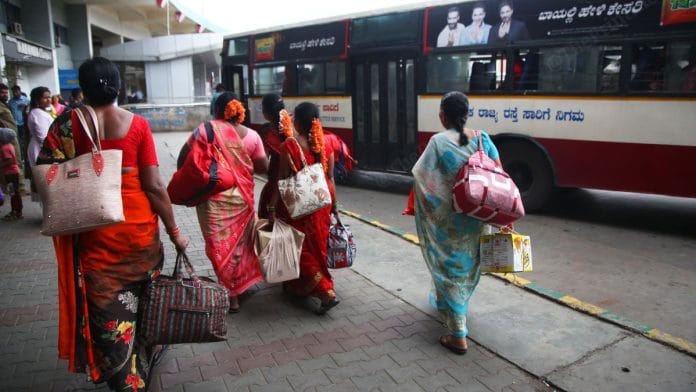
Free bus travel for women is easy to announce. Keeping the buses running is the harder part.
When a state government waives fares, the first pressure falls on the state transport undertakings. The woman boarding the bus may not have to pay, but the costs behind that journey remain. Diesel vendors have to be paid. Tyres have to be replaced. Depot mechanics, drivers, conductors, cleaners, and administrative staff still expect salaries on time. A free ticket does not make the bus free.
This does not make the policy wrong. In states where such schemes are active, the benefits are real. Free or subsidised travel can widen the area in which women look for work, help students continue college, reduce daily dependence on family members for travel money, and leave a little more cash inside the household.
For a woman travelling every day from a peri-urban village to a town or city, saving Rs 40 may pay for vegetables, a phone recharge, an electricity bill, medicine, or a notebook for a child. It may also mean one less question at home about why she needs money to travel.
In Tiruppur, Madurai and Nagapattinam, studies cited by Tamil Nadu’s Transport Department put the average saving at about Rs 888 a month for a woman travelling under the scheme. Though that number tells us how much room the policy creates in a household budget, its effect on women’s job options depends on where the buses go and when they run.
The trouble starts when governments treat these schemes as welfare announcements and not as paid public services.
Also Read: India is betting big on electric buses. Infrastructure, finances could hit the brakes
When free fares weaken public transport
A state transport undertaking cannot run on an unfunded mandate. If the state decides that a particular group of passengers should travel free, the state must become the paying customer. Every waived fare has to be counted. The trip has to be audited. The amount due has to be reimbursed on time.
Without that mechanism, the cost does not disappear. It sits inside the transport corporation’s accounts.
Karnataka’s Shakti scheme shows where the strain begins. The problem is not the idea of free travel, but launching a high-frequency public entitlement without a ring-fenced and predictable payment system behind it.
In August 2026, Karnataka’s transport minister reported in a written response that Rs 5,650.95 crore was outstanding to the four road transport corporations under Shakti. A corporation can record the reimbursement as money earned and still have too little cash to buy fuel that week.
Depot work follows its own calendar. Buses leave every morning whether or not files have moved in the Secretariat. Fuel requires upfront payment. Wage settlements cannot be postponed indefinitely. A worn tyre cannot wait for a revised estimate.
When reimbursements are delayed, or when they are calculated using outdated cost assumptions, the transport undertaking absorbs the first shock. Routine maintenance gets pushed back. Spare parts are taken from grounded buses. Route frequency falls. Overcrowding rises. In the end, the women the policy was meant to support may find themselves waiting longer at poorly lit bus stops.
A welfare scheme meant to expand mobility can slowly weaken the very system that provides that mobility.
Tamil Nadu has handled this with more steadiness because it treats fare concessions as a continuing Public Service Obligation. The state recognises that it is buying a service on behalf of passengers. Physical proof of travel, including zero-fare tickets and ticketing records, helps convert the political promise into a budgeted claim.
Calculating the costs
A free ticket for the passenger should not become an unpaid invoice for the bus corporation.
For states such as Kerala or West Bengal, both of which launched free bus travel for women in June, the reimbursement framework should not leave any chinks.
Electronic Ticketing Machines can help, but only if they are used for more than counting passengers. Each issued ticket or token should become a verified record of service. The transport department and treasury should know how many eligible passengers travelled, on which routes, during which period, and what amount is payable to the operator. Payments should be made on a fixed monthly schedule, based on realistic operating costs.
Ticket records tell only part of the story at a crowded stop. At eleven in the morning, a woman going to the district hospital may occupy an empty seat on a bus already making the journey. At eight, a nurse on the same route may watch a full bus pass her stop. Both women qualify for the fare waiver, but getting the nurse to work on time may take another bus and crew. A conductor can count the passengers who board. Someone at the stop must also count those left behind.
A depot could use those counts to agree a timetable and a price with the state. The treasury could advance the monthly cost of the agreed service, then settle the difference against trips actually run, tickets issued and fares collected. If a few entries are disputed, the rest of the bill can still be paid. That gives the depot manager a cash figure to plan around.
This is not about calling welfare a freebie. Public service has a cost. A serious state should count that cost honestly and pay it on time.
Bus stands can earn too
The second part of the model is revenue beyond the fare box. Many major bus terminals sit on valuable urban land and handle thousands of passengers every day, but they are still managed like waiting sheds.
A busy bus terminal can support pharmacies, small food counters, parcel counters, ATMs, banking kiosks, women’s help desks, clean paid toilets, digital information boards, and local retail. These services also improve the passenger experience. A woman waiting for a delayed bus should not have to stand in a dark, badly maintained terminal with no toilet or safe place to sit.
Consider the parcel counter. On an off-peak intercity service with spare luggage space, a trader might pay to send a small consignment to the next town. The depot keeps whatever is left of the fee after handling, insurance and claims. If loading parcels makes passengers miss their connection, the contract has cost more than the counter receipts suggest. The timetable should determine which consignments the depot accepts.
This does not mean selling public land or turning every bus stand into a mall. It means using public assets properly. If a terminal earns money from shops, parking, advertising, or service counters, a share of that income should stay with the transport corporation for maintenance, safety, and fleet improvement. It should not disappear into the general treasury.
Advertising is another source of income, if handled properly. A major bus terminal has known footfall, known routes, and known timings. That has value. Digital screens and station advertising can generate income, provided they are regulated and do not make the terminal more chaotic for passengers.
The French city of Lyon tried a version of this idea in 1964, when Jean-Claude Decaux offered the city bus shelters financed by the advertising displayed on them. The city received a maintained shelter, and the advertiser bought a visible location. Six decades later, JCDecaux reported €262.6 million in group net income for 2025 across its businesses. An Indian depot can borrow the original idea at modest scale. Before buying a single digital screen, offer local businesses four weeks on existing panels. A second month’s booking, at a price that covers upkeep, would give the depot a reason to invest.
Transit-Oriented Development may be considered in larger stations, especially in cities and industrial corridors. Office space, co-working areas, last-mile mobility points, and public service counters can be built into future terminal planning. But this must be done carefully. Public transport land must remain public in purpose.
Employers can fund routes
Companies also have a role. Industrial areas, IT parks, hospitals, manufacturing clusters, and large campuses depend every day on public transport bringing workers to their gates. This includes factory workers, security staff, cleaners, contract workers, nurses, technicians, and facility staff.
State policy should allow transport undertakings to create transparent corporate transit partnerships. Through CSR or infrastructure co-investment, industrial associations can support route-specific operations, better shelters, lighting, safety systems, fleet expansion, and terminal upgrades along worker corridors.
This does not require privatising the route. The state remains the regulator. The transport corporation remains the operator. The company helps fund the public infrastructure that keeps its own workforce moving.
For a factory whose shift starts at seven, a bus that reaches the gate at 6.45 every morning is worth paying for. Several employers could jointly guarantee the cost of that departure, with the route and seats open to everyone. At renewal, the depot can show how often the bus arrived on time and the employers can check how many shifts began fully staffed. A service worth buying every year gives the route a firmer footing than a one-time donation.
Consider the accounts of a single corridor. Suppose it costs Rs 60 lakh a year to operate, including its share of maintenance, depreciation and interest. Ordinary fares bring in Rs 18 lakh and commercial activities contribute Rs 6 lakh after their own costs. The state must pay Rs 36 lakh for the corridor to break even. Across two lakh eligible boardings, that works out to Rs 18 a journey. If an employer then pays Rs 8 lakh for an additional departure that costs Rs 3 lakh to provide, the corridor earns a Rs 5 lakh pre-tax surplus, provided the existing state payment continues and the agreement lets the depot retain the gain.
The margin is narrow. If crowding raises annual costs to Rs 72 lakh and ordinary fares fall to Rs 16 lakh, the original Rs 36 lakh state payment and Rs 6 lakh commercial contribution leave a Rs 14 lakh shortfall. These figures are illustrative. They explain why a board should see the cost of the next departure alongside the revenue from the last one.
Public transit subsidies are necessary in a developing economy. But it must be asked whether they are properly funded, audited, and supported by other income.
For the nation, the calculation reaches beyond the depot. A fare saved by a woman who already took the bus is valuable household relief. Counting that saving again as new national income would overstate the gain. A woman who can now reach a clinic in one morning instead of losing a day makes a different gain. So does a worker who can keep a job because the last bus home runs after her shift. A 2024 multi-state study of free bus travel for women found lower bus expenditure and no overall short-run increase in employment.
A credible assessment should record the time, access and independence women gain, and test employment effects where the service changes their options.
A state could test what the subsidy buys over a year on three routes serving different needs. One might bring workers to a factory gate, another carry passengers across town, and a third link villages to a hospital or college. Keep the fare entitlement in place. Introduce extra departures in stages, compare waiting times with similar routes, and ask passengers which journeys have become possible. Publish those results alongside cash collected, bills overdue and the cost of each added trip. A rural service may attract few advertisers and still be the best use of the next rupee if it gets patients to appointments they would otherwise miss.
A fare-free transit policy should be managed like a service contract. The passenger need not pay. But the journey must be recorded, priced, and paid for by the state on time.
If the accounts are handled casually, the policy will not fail first in speeches or budget documents. It will fail on the depot floor: in delayed repairs, older buses, fewer services, and longer waits.
Harilal Bhaskar is Chief Operating Officer and National Coordinator of I-STEM, under the Office of the Principal Scientific Adviser to the Government of India. Views are personal.