




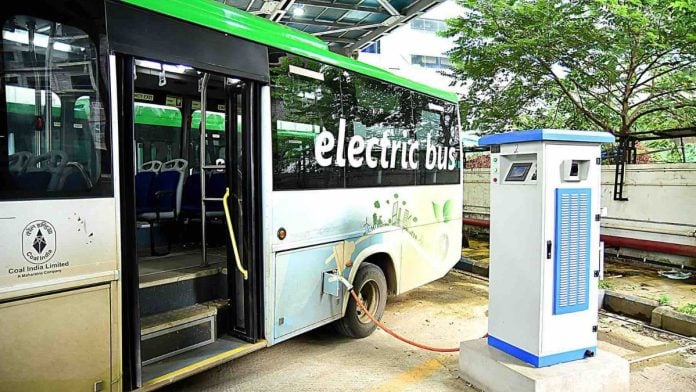

I am extremely fortunate to be able to travel across India. Seeing different parts of the country and the rapid transformation of infrastructure does fill me with a bit of pride. One change that I have been noticing over the past few years, particularly after the Covid-19 pandemic, has been the dramatic change in India’s buses, particularly intra-city urban public transport.
One could argue that India is currently executing one of the most ambitious public transport decarbonization experiments in global history, after China. The scale is unprecedented. The Prime Minister E-DRIVE scheme mandates the rollout of over 14,000 electric buses across India’s nine mega-cities, and the PM eBus Sewa expands that to Tier-2 and Tier-3 cities with an additional 10,000 vehicles.
The strange part is that the central and state governments have achieved this despite the debt-ridden nature of many state roadways transport undertakings (SRTU). A report last year by the Ministry of Road Transport and Highways (MoRTH) estimated that SRTUs across states held a combined debt of Rs 30,000 crore with only Chandigarh and Uttar Pradesh running in the black (turning a profit). Ill-thought out free transport schemes have made matters worse.
So how has this been done? Central Government subsidies combined with ‘Gross Cost Contract’, a type of public-private partnership (PPP) model most commonly used in public transport, allowed a whole new category of manufacturers to enter the sector. The GCC fixes the upfront and operating costs including drivers on the company winning the contract, with the SRTU paying on a per-kilometer basis while also providing the charging infrastructure and physical space for a depot.
This has allowed relatively new players such as Pune-based EKA Mobility to enter the sector. At an event in Pune recently, the company was recognised as a Champion Original Equipment Manufacturer (OEM) by the Government’s Performance-Linked Incentive (PLI) scheme. It recently deployed 675 buses across eight cities in Rajasthan.
Also read: Forget diesel, think hybrid: Renault’s new Duster makes a strong case for fuel economy
Electric buses make geopolitical sense too
Speaking to me at a recent event in Pune, Sudhir Mehta, the founder and Chief Executive of the company said that electric buses make sense from a simple operating cost point-of-view.
“It costs almost Rs 25 of diesel every kilometer a bus operates, on electricity that cost is under Rs 8. And when you get to the difficulties that we have had, given the crisis in West Asia and the chokehold on global diesel supplies, running electric buses doesn’t just make economic and environmental sense, but also geopolitical sense,” Mehta told me.
At a function where EKA announced the opening of six new facilities across the country, Maharashtra Chief Minister Devendra Fadnavis also announced how the state was going to help in the establishment of new chargers with simplified land acquisition. He said they would ensure that a majority of the electricity used to charge electric vehicles comes from solar power.
At the event EKA showcased India’s first 18-meter long electric articulated bus with a capacity of 130 passengers, capable of drawing power from overhead pantographs. Another bus was a mock-up of a long-distance inter-city electric bus laid out in multiple formats — business-class, economy seats and sleepers. Left unsaid were the recent incidents of intercity buses across India catching fire, claiming over a hundred lives.
“Our buses employ a far safer advanced monocoque construction that is inherently safer than older bus bodies”, Mehta told me.
But challenges for buses and even electric trucks remain. Sumit Mittal, Chief Executive Officer, JSW Greentech, the Sajjan Jindal-led conglomerate venture in electric buses and trucks, told me that some basic infrastructural problems still remain. The company just deployed their first hundred electric tractor trailers for JSW Cement that will operate on a 300-kilometer loop between Nandyal and Vijayanagar.
“It has not been about the availability of electricity but electrical infrastructure”, Mittal told me recently. “To facilitate electric mobility for inter-city travel, the government has to establish substations and electrical transformers at or near major stops on highways. The problem is when you need to draw a line even a few kilometers from a substation to a highway, the process could take over six months with land acquisition involved. As it is, there is a global crunch on the availability of equipment like transformers. So it just makes sense that we are building major new expressways, we plan the electrical infrastructure during the planning process itself.”
Another major challenge for urban electric buses is that infrastructure improvements are much needed around bus depots in several cities. JSW recently won contracts to operate a hundred electric buses in Gurugram and Faridabad but as Mittal jokes, that is just a drop in the ocean.
“Look at comparable countries like Brazil. There are 3800 buses per million population. We just have 1200 buses per million. Just to get to a comparable amount, we will need to make hundreds of thousands of buses every year for the next decade”, Mittal said.
Challenges remain. The pitiful finances of SRTUs might come back to haunt the industry if not addressed soon despite the safeguards in place. While free bus transportation for women and students might be praised by some, it impacts the already crippled SRTU finances further, and raising bus fares seems to be anathema to most state governments. Is the model going to be sustainable when the subsidies stop?
Kushan Mitra is an automotive journalist based in New Delhi. He tweets @kushanmitra. Views are personal.
(Edited By Janaki Pande)