





It’s been a chaotic week, with so much happening in India—protests, the road to anarchy, and even an earthquake. On the international front, the Houthis have again attacked Saudi airports, raising concerns about a possible escalation of the war in the Middle East.
As Mahalaya Amavasya heralded the end of Pitru Paksh shradda and the new moon entered Libra on Saturday, some Vedic astrologers predicted the inauspicious period would end, whilst others warned the turmoil would continue until the end of the month. A silent majority across the globe wants these wars to end and positivity to prevail.
Meanwhile, as a celebration of Prime Minister Narendra Modi’s 25 years of public service, the Ministry of Youth Affairs organised a month-long nationwide public participation and youth-led campaign called the Sewa Sankalp Abhiyan. The idea was to push the country’s youth into a mass movement that would contribute to nation-building in different ways. Outside some colleges, there have been hoardings of the ‘Clean the Yamuna’ programme, and there have been many initiatives, especially about Swachh Bharat.
It is truly disheartening to see that the opposition thinks it is cool to encourage and instigate the youth to indulge in anarchy and break down law and order rather than engage in a nation-building exercise. The leaders of the Opposition have forgotten that one doesn’t indulge in “non-cooperation” with our own people, unlike against the British, who were foreign colonisers.
The Opposition’s role in protest would have been more commendable had it pushed the youth for a massive cleanup sewa, rather than allowing them to be manipulated by political puppeteers and used to serve partisan interests instead of the country.
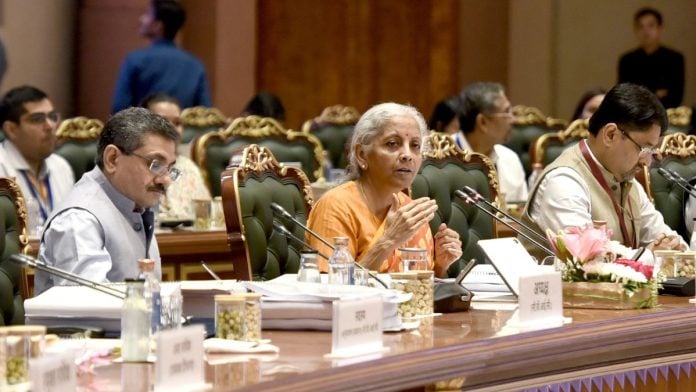
Amid all this chaos, a quiet and relevant direction has almost slipped into oblivion. On 8 October, the GST Council announced major compliance and enforcement reforms at their 57th General Meeting. In layman’s terms, tax authorities can no longer arrest anybody.
GST curbs tax officials’ powers
Under the Central Goods and Services Tax (CGST) Act, 2017, Sections 69 and 132 together governed the power to arrest, authorising the Commissioner to order an arrest if there were reasons to believe that a person had committed specified GST-related offences, subject to statutory conditions.
As recently as March 2025, the Supreme Court, in its judgment in Radhika Agarwal vs Union of India, upheld the constitutional validity of these powers, whilst emphasising safeguards, including the need to record and communicate the grounds for arrest and prevent tax officials from coercing taxpayers into making payments under the threat of arrest.
Even though this arrest provision was likely the bread and butter for some legal professionals, its application had to be assessed against the constitutional guarantees of Article 21, Right to Life and Personal Liberty, Article 22, protection against arbitrary arrest, and Article 14, Right to equality under Law, as well as the interests of commercial enterprises.
The major change announced by the GST Council is a recommendation to remove the powers of GST officers to arrest taxpayers at the pre-prosecution stage. Further, the Council has also recommended raising the threshold for prosecution from Rs 1 crore to Rs 5 crore and reducing the maximum general penalty from Rs 26,000 to Rs 10,000. The stated objective is to distinguish ordinary tax compliance failures from criminal conduct and reduce the scope for coercive enforcement. These changes are being proposed as a measure of corrective compliance procedures.
Also read: Why IRDAI should not back off now from its fight against insurance commissions
GST replaced more than 40 different taxes
Anything this government does is up for criticism regardless. And that’s why the PM calls this entire lot dimaagi Naxals. Criticise just for the sake of criticising. GST, when it was rolled out in 2017, was criticised relentlessly. Notwithstanding the fact that it replaced more than 40 different taxes—17 different indirect taxes and subsumed 23 other cesses. Some of the major taxes subsumed under GST were Central taxes that included Central Excise Duty, Service Tax, Additional Customs Duty (CVD), Special Additional Duty of Customs (SAD), Central Sales Tax and certain excise taxes. The state taxes that GST replaced included State VAT (in some cases different states had different taxes), Purchase Tax, Entry Tax, Luxury Tax, Entertainment Tax, state Sales Tax and the list continues.
Then there was education cess, higher education cess, Octroi, etc. The paperwork involving these taxes and cesses and the compliances required were often a nightmare for small business owners, and even for large businesses. A recent discussion around the education and higher education cess had me undertaking some research.
India’s two per cent education cess was introduced by the UPA government in 2004 under then PM Manmohan Singh, and under Union Finance Minister P. Chidambaram. It was intended to mobilise additional funds for universal elementary education, particularly the Sarva Shiksha Abhiyan and the Mid-Day Meal Scheme. The proceeds were credited to a dedicated fund, the Prarambhik Shiksha Kosh. The one per cent secondary and higher education cess was introduced in 2007 also by the UPA government. The combined education cess reached 3 per cent on various taxes.
The stated objectives were to supplement government education spending and widen access to schooling and higher education. However, there is no evidence to state that the proceeds were allocated ultimately for the purpose for which they were levied. A 2016 government reply noted that one per cent secondary and higher education Cess was not credited to a separate fund till that time, making it difficult to track its specific utilisation.
But I digress. The GST definitely improved ease of doing business by removing all these random cesses and bringing all such taxation under one head. The state GST was given a uniform rate, and there was no question of any confusion.
Nearly a decade after its rollout, GST remains a significant structural reform in India’s economic journey. By bringing a multitude of central and state indirect taxes under one framework, it helped create a more integrated national market, reduce the cascading effect of taxation, improve tax compliance and strengthen the digital tax infrastructure. Like any major reform, it continues to require refinement, simplification and a fair balance between revenue collection and ease of doing business.
It is a process of continual improvement, and the notification on 8 October is a step in the right direction. But the underlying idea of One Nation One Tax remains valuable, and a major achievement and success story of this government. A more transparent system which is predictable and unified is a step in the direction of Visit Bharat 2047.
This single reform during Modi’s Sankalp Yatra of 25 years has gone a long way in improving the quality of work done and enabling economic growth.
Meenakshi Lekhi is a BJP leader and lawyer. Her X handle is @M_Lekhi. Views are personal.
(Edited by Saptak Datta)