









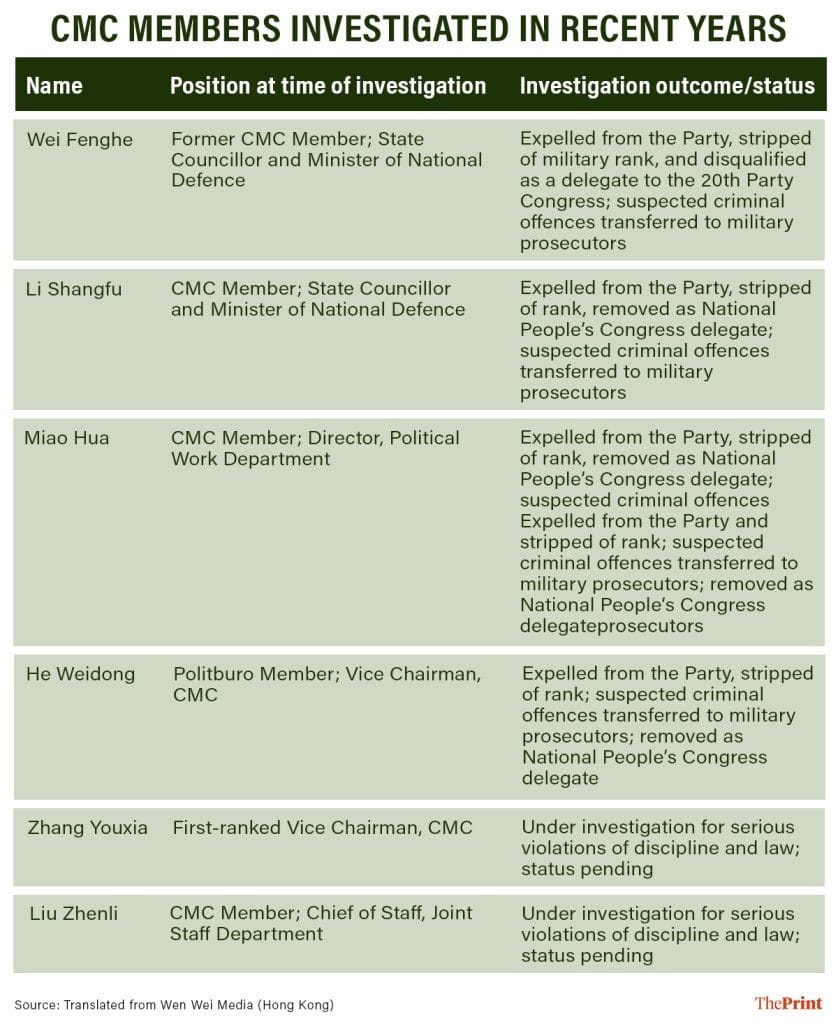
Considered one of the most powerful figures in the Chinese Communist Party and a long-time ‘trusted’ friend of Xi Jinping, the vice chairman of the Central Military Commission, Zhang Youxia, is now under investigation. Zhang, who joined the army in 1968 and the party decades ago, rose through the ranks to hold key posts on the17th, 18th, and 19th central committees, eventually reaching the Politburo and the Central Military Commission.
His fall, alongside Liu Zhenli, Chief of Staff of the Central Military Commission (CMC) Joint Staff Department, marks a continuation of Xi’s sweeping campaign to purge corruption and enforce absolute Party loyalty in the military. Nearly 30 generals of the People’s Liberation Army (PLA) have been dismissed in recent years, including 11 investigated last year alone, underscoring that no officer, however senior, is immune. Official reports cite “serious violations of discipline and law,” though details remain scarce, highlighting both the crackdown’s opacity and its uncompromising nature.
Loyalty without immunity
Zhang’s fall is striking, given his recent role as an ideological enforcer. Until last month, he was authoring articles reinforcing the 15th Five-Year Plan’s emphasis on the Chinese Communist Party’s (CCP) absolute leadership over the military, stressing that the PLA must remain politically loyal, ideologically aligned, and unconditionally obedient. He highlighted Xi Jinping Thought on strengthening the army, anti-corruption, and political education as central pillars of military modernisation, emphasising that combat readiness, governance reforms, and high-quality development must all align with these principles. The rapid transition from articulating loyalty to becoming a target underlines a defining feature of Xi-era politics—ideological conformity offers no protection, and no institutional post guarantees security.
Official and strategic discourse frames this development as part of the CCP’s intensifying anti-corruption campaign within the military. A widely circulated PLA Daily editorial, also shared on the Ministry of National Defense website, strongly endorsed the investigations into Zhang and Liu. It portrayed their alleged misconduct as a grave betrayal of trust, undermining the party leadership, military discipline, and the authority of the CMC. The editorial emphasised that the punishments were a major outcome of the military’s anti-corruption campaign, demonstrating the party and armed forces’ commitment to political and ideological unity.
Tang Renwu, professor at the School of Government and Management at Beijing Normal University, argues that corruption in the armed forces remains severe and structurally entrenched, necessitating sustained pressure. Military commentator Song Zhongping reinforces this view, asserting that anti-corruption in the military tolerates no forbidden zones, applies across all ranks, and operates with zero tolerance. Purges are framed as institutional self-purification aimed at restoring morale and strengthening the PLA’s capacity to fight and win.
A Zhihu user described the crackdown as a “shock bomb,” signalling three points: no one is untouchable, corruption at any level will be punished; entrenched cliques will be dismantled to ensure loyalty and unity; and the army’s integrity will be strengthened, keeping it combat-ready and politically reliable. Overall, the post underscores strict discipline, zero tolerance for corruption, and the vital role of a “pure” military in China’s security, portraying the PLA as a “Great Wall of Steel.”
On Weibo, discussion is muted, with state-owned platforms amplifying the official narrative. User comments largely express support, framing the crackdown as a justified fight against corruption. While external observers characterise such purges as coups, paranoia, or power struggles, the domestic narrative, largely self-censored or state-censored, emphasises trust in Xi’s anti-corruption campaign.
Also read: What the UAE President’s sudden visit to India reveals about regional strategic trust
Purges a tool of control
This round of purges stands out for both its scale and how it is being leveraged to consolidate Xi’s authority. Announced through the Ministry of National Defense and amplified by state media, the investigations are openly discussed within China’s tightly controlled information environment. This choreographed visibility signals transparency while normalising elite punishment as a routine instrument of governance, reinforcing the perception that Xi remains firmly in control.
In this context, Xi appears to be executing a modern version of Mao Zedong’s dictum of “cleaning the house before inviting guests,” consolidating internal authority before addressing external challenges and pursuing engagement, and accentuating that internal discipline and absolute loyalty take precedence over strategic posturing abroad.
The purges are, therefore, less about immediate military readiness and China’s strategic goals and more about securing the party’s control over the armed forces and reinforcing Xi’s personal authority. In Xi’s China, control over the gun, ensuring unconditional loyalty and ideological conformity, defines the political logic of the state, shaping both military governance and the country’s posture towards the world.
Sana Hashmi is a fellow at the Taiwan-Asia Exchange Foundation. She tweets @sanahashmi1. Views are personal.
(Edited by Saptak Datta)
“Xi’s military purges are less about China’s strategic goals, more about party control” A modified version of this title is more correct “… more about Xi’s control”, not “…party control”. But the problems of Xi is not over. Zhang Youxia is a veteran and the only living Chinese general who fought any war. And there is public unrest against communism, and there increasing economic troubles, and there is Xi’s old age. A 5-10 years of turmoil is guaranteed!