






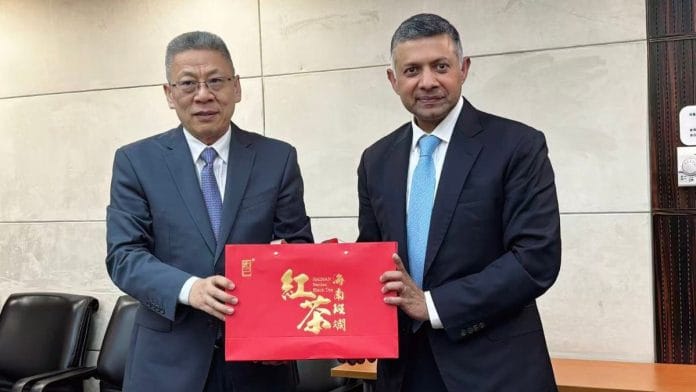

India’s appointment of Vikram Doraiswami as the Ambassador to China has sparked an unusual level of interest on the Chinese internet. His fluent Mandarin, his Chinese name, and even the tone and content of his public remarks have all been examined for clues about New Delhi’s intentions.
The posting to Beijing has long been one of the most coveted assignments in Indian diplomacy, typically reserved for senior officials with extensive experience. Doraiswami fits that mould. Over a distinguished career, he has served as Head of the Division for the South Asian Association for Regional Cooperation (SAARC), Joint Secretary of the Americas Division of the MEA, India’s Permanent Representative to the United Nations in New York, and as the Ambassador to South Korea, Bangladesh, and the United Kingdom. For many Chinese observers, however, his appointment is less about his resume than about what it signals for the future of India-China relations.
Among Chinese scholars and policy observers, the dominant interpretation is that India is seeking to place relations on a steadier footing. Li Hongmei, a researcher at the South Asia Research Center, the Shanghai Institutes for International Studies, argues that the appointment demonstrates the gradual stabilisation of ties following the Narendra Modi-Xi Jinping meeting in Kazan, Russia, in 2024 and the diplomatic engagement that followed.
Qian Feng, a researcher at Tsinghua University’s Institute for National Strategic Studies, offers a similar assessment. He describes the appointment as a professional and pragmatic decision, arguing that a China specialist is better equipped to manage a complex bilateral relationship. Since the Kazan meeting, he contends, ties have entered a relatively more stable phase, making experienced diplomacy particularly valuable.
A message read into symbolism
Doraiswami’s appointment has become a focal point for broader expectations about the future of India-China relations. That was evident after his latest interview with Phoenix TV on the sidelines of the World Peace Forum in Beijing on 5 July. He struck a conciliatory tone: “My idea is to cooperate as much as possible with our Chinese friends, government, media, and friends in the business and public art sectors. We can do many things together, and I welcome more friendship between us. The broader the relationship, the stronger it will be.”
The interview prompted discussion across Chinese social media. Many users interpreted his remarks as signalling India’s interest in attracting greater Chinese investment and expanding market access for Indian pharmaceuticals. Some also linked his comments to the recent visit of Japanese Prime Minister Sanae Takaichi to India, interpreting the timing as further evidence that New Delhi was seeking to normalise ties with Beijing.
Perhaps the most interesting moment in the Phoenix TV interview came when Doraiswami drew a distinction between friendship and alliance. India and China, he suggested, should aspire to be friends rather than allies. Friends can disagree openly, whereas alliances imply unconditional political support. It does capture a defining feature of India’s China policy — engaging where interests converge while preserving strategic autonomy.
Even his Chinese name became part of the conversation. Wei Jiameng, a name given to him by a Chinese friend three decades ago, inspired a Weibo hashtag noting that “the Indian ambassador has a Chinese name”, attracting millions of views. Users unpacked the meaning of each character, arguing that while the surname ‘Wei’ is common in China, the characters ‘Jia’ and ‘Meng’ evoked ideas of appreciation, friendship, and cooperation. For many, the name itself came to symbolise hopes for warmer bilateral ties.
Also read: China is expanding influence in Myanmar, Bangladesh. India has a geography advantage
What the discourse tells us
One Weibo user posed a question: does appointing a Mandarin-speaking China expert signal warmer ties? Similar discussions appeared across Chinese social media and policy platforms, where Doraiswami’s appointment was widely portrayed as a sensible effort to improve communication and restore stability after years of turbulence.
At the same time, many observers acknowledged the limits of what one ambassador can achieve. The unresolved boundary dispute, military deployments along the Line of Actual Control, trade imbalance, and wider strategic competition continue to shape the relationship. In this reading, Doraiswami’s role is not to transform India-China ties but to manage them more effectively.
Doraiswami’s posting comes at a moment when India and China are cautiously trying to stabilise ties after several difficult years. But stability should not be mistaken for a reset. The reaction to and discussion surrounding his appointment reveal that Beijing is paying close attention to India’s diplomatic choices and the signals they may carry. The interest in the Indian Ambassador, from his Mandarin fluency to the meaning attached to his Chinese name, suggests that China is watching India more closely than before and trying to understand how a rising India will shape the future of this complex relationship.
Sana Hashmi, PhD, is a fellow at the Taiwan-Asia Exchange Foundations. She tweets @sanahashmi1. Views are personal.