





Xi Jinping visited India last month, speaking of partnership and better ties. Chinese commentators online, however, are using India’s proposed 11,200-MW Siang dam in Arunachal Pradesh to revive Beijing’s claims over Indian territory.
Following reports of face-offs between the People’s Liberation Army (PLA) and Indian forces near Asaphila and Taksing in Upper Subansiri district, the project has attracted a wave of Chinese commentary questioning India’s activities and highlighting the strategic value of its water resources.
Chinese commentary has brought Arunachal Pradesh’s rivers into a dispute usually framed around troops and borders. The rhetoric exposes the gap between Xi’s language of partnership and the territorial claims and accusations directed at India in Chinese online discourse.
Water as leverage
Chinese commentator Shen Xinjigu argues that Arunachal Pradesh is often overlooked in discussions of China’s territorial disputes, despite being as important as Taiwan, the East China Sea and the South China Sea. Referring to the Indian state as “South Tibet”, the commentator writes: “Whoever controls the upstream areas holds leverage over water flows and hydropower development. Despite international rules governing transboundary rivers, water remains a strategic asset, making South Tibet an unavoidable piece of the geopolitical chessboard.”
Another commentator describes Arunachal Pradesh as rich in water and natural resources and therefore indispensable. The same commentary claims that, in the event of another war between China and India, India would inevitably lose and South Tibet would be liberated.
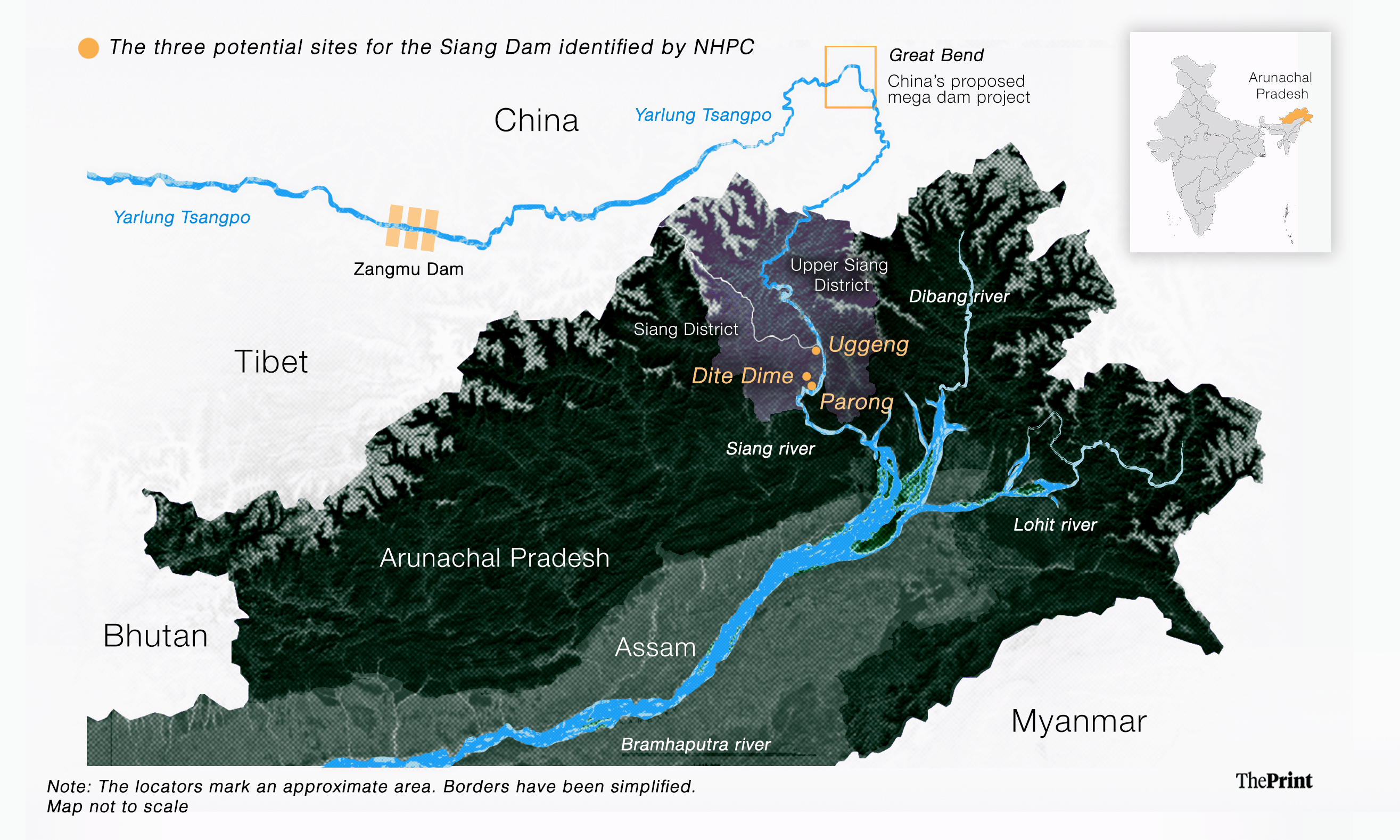
Water is central to these arguments. A Chinese commentary points to the hydropower potential of the Brahmaputra. It also highlights the region’s fertile valleys and potential for agriculture and tourism. Citing Chinese hydrological research, the commentator describes the Brahmaputra as a river with exceptionally high hydropower potential relative to its drainage area.
India’s proposed dam has become another vehicle for advancing Beijing’s territorial claims. The project is framed as a contest over who has the right to control the region’s resources. By linking hydropower development to sovereignty, Chinese commentators turn India’s plans into an argument for China’s claim over Arunachal Pradesh.
Portraying India as provocateur
Chinese commentary also questions India’s motives for building the dam. One commentator claims that India has not been innocent in its use of “water weapons”. Videos of protests in Arunachal Pradesh have circulated on Weibo, alongside claims that tensions between local residents and Indian security forces are escalating. Other Weibo posts have added to the coverage.
A Baijiahao commentary argues that India’s approach to Arunachal Pradesh is driven by military and strategic interests, with local livelihoods, culture and participation pushed aside. It accuses India of using the dam to consolidate control over disputed territory and exploit local resources at residents’ expense.
The commentary makes a broader point about communities affected by large dams. A project may generate electricity, store water and be justified in the name of national security, it argues, but people whose homes are submerged by a reservoir may find themselves excluded from the benefits promised in the name of the nation. It then applies this argument to India, accusing it of pushing ahead with projects on what it calls illegally occupied Chinese territory, motivated by resource extraction and personal gain rather than the welfare of local people.
Another commentator contrasts India’s hydropower projects with those built by China. Chinese projects are presented as engines of local development and improved livelihoods, while India’s are portrayed as instruments of territorial expansion and profit. The commentary also predicts that India’s large hydropower project will encounter difficulties because of its alleged disregard for local communities.
A convenient double standard
Calling Arunachal Pradesh “South Tibet” is a political statement that challenges India’s sovereignty and the legitimacy of its hydropower projects on its own territory.
China’s own hydropower projects, meanwhile, receive very different treatment. India’s proposed dam is portrayed as evidence of territorial ambition and resource exploitation, while Chinese projects are presented as serving development and public welfare. China has pursued major hydropower projects on the Tibetan Plateau for decades, raising concerns about environmental damage and the implications of upstream infrastructure for downstream countries.
One Baijiahao commentary makes a point that Beijing would do well to heed: “Dams can generate electricity, store water and serve strategic interests, but they cannot automatically create a sense of local identity. Infrastructure cannot, by itself, settle questions of identity or legitimise territorial claims.”
Chinese commentators use this argument to question India’s hydropower plans, yet conveniently overlook its implications for China’s own dam-building on the Tibetan Plateau. Their concern for local communities and territorial legitimacy appears to end where Beijing’s own interests begin, exposing the double standards in China’s discourse on India and its sovereignty.
Sana Hashmi, PhD, is a fellow at the Taiwan-Asia Exchange Foundation and George HW Bush Foundation for US-China Relations. She tweets @sanahashmi1. Views are personal.
(Edited by Prashant Dixit)