




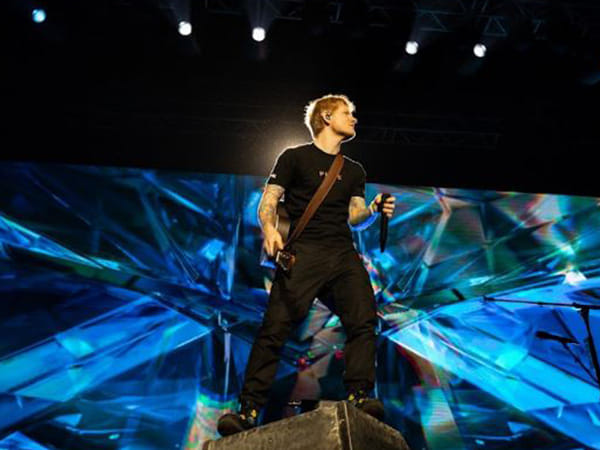

The great privilege of being apolitical is the luxury of believing that politics will leave you alone. The Ed Sheeran-Macklemore controversy is a neat illustration of why that luxury is increasingly untenable.
During his 4 September performance while opening for Sheeran, Macklemore said ‘Free Palestine’ on stage. He was subsequently removed from the remaining US tour dates after venue owners objected to his participation. Sheeran has said the decision was made by promoters and venues, not by him, and that he attempted to mediate.
Now, four other opening acts have quit in support of Macklemore and Sheeran has been heavily criticised for trying to be neutral and continuing the tour.
The episode contains the apolitical argument in miniature. Macklemore spoke and paid a price. Sheeran tried to keep politics out of his concerts and found himself in a political controversy anyway. Neither man could step outside the politics surrounding him. There is no neutral ground left to stand on.
The central fiction of apoliticism is that politics is something you can simply opt out of.
There is a particular kind of person one encounters with increasing frequency, online and off, who will tell you, with studied nonchalance, that they are “apolitical”. It is there on dating profiles, in conversations about films, art, music and books, and in workplaces where political disagreement is treated as an unfortunate breach of professional etiquette. “I don’t do politics” has become a declaration of one’s relationship to discomfort.
Increasingly, “apolitical” is also an elastic euphemism for political exhaustion, fear of consequences, indifference and, sometimes, a right-wing position one would rather not publicly admit.
But what exactly does it mean to be apolitical? To not vote? To have no opinions? To refuse to discuss politics? To avoid endorsing a party? To believe that politics is beneath you? None of these things makes someone apolitical. They make someone politically disengaged, politically private or politically quiet.
Refuge becomes liability
The curious thing is that the apolitical person is now being asked to account for their apoliticism. The refuge has become its own liability.
But the fantasy that one can simply step outside politics is harder to sustain. Politics is not only elections, parties and Parliament. It is the distribution of power: who gets heard, protected, censored, belongs and whose suffering is deemed somebody else’s problem. It determines what can be said, what can be taught, who can protest, who can marry, who can work and whose body is subject to somebody else’s legislation.
To be able to treat politics as an optional interest requires, at least sometimes, the luxury of believing that politics will not materially affect you. For someone whose rights, livelihood, citizenship, identity or bodily autonomy are being debated, politics is not an abstract disagreement to be avoided at dinner when it reaches the doorstep.
How does someone remain apolitical, then? The answer is simple: They don’t.
You can be silent. You can be private. You can decide that your Instagram account, your concert or your birthday party is not a political forum. You can even be uncomfortable with ideological labels. All of that is legitimate but it is not apoliticism. It is simply a choice about how publicly you engage with your politics.
Apoliticism is now presented as evidence of sophistication: the person who is “above politics”, who finds all sides equally tiresome, who refuses to have convictions because convictions are messy and disagreement is exhausting. On dating apps, “apolitical” can sit casually alongside “dog person” and “foodie”.
But politics is not a cuisine.
The ability to regard it as optional is a massive privilege. If your citizenship is secure, your livelihood untouched, your identity unthreatened and your bodily autonomy not being debated by strangers in Parliament, politics can remain an abstraction. For someone else, it is a matter of whether they can stay in their home, marry whom they love, practise their faith, speak their language or simply feel safe.
Apoliticism is not an absence of politics so much as the luxury of experiencing politics as somebody else’s problem.
But not having a public political opinion is not the same as having no politics. Privacy is not complicity; silence is not automatically endorsement. Celebrities, too, should not be compelled to turn private convictions into public performances simply because an audience demands them.
Shah Rukh Khan, Aamir Khan have faced threats and boycott calls for their critical comments on intolerance in India while Priyanka Chopra has been vilified for not taking a stand on Palestine. It happened years ago to several stars during the Emergency as well. Many protested, many complied.
Diljit Dosanjh, always political when it comes to his his art and his identity has recently towed the line and said he wouldn’t want to speak about politics because he is an artist.
The demand is perpetual: declare your opinions, explain yourself, and then explain your silence.
But the episodes do not automatically prove that these celebrities were ever apolitical. It is just what politics and choices they chose to reveal or conceal fearing professional and personal consequences.
Also Read: Sydney Sweeney has figured out how to make the male gaze pay
Politics loves you
Shashi Tharoor has put the problem rather neatly during an US interaction: political decisions affect everyone whether or not they take an interest in politics. Politics, in other words, is interested in you even when you are not interested in it.
Being apolitical is not necessarily immoral. Nor does political speech automatically make someone brave, correct or interesting. Celebrity activism can be shallow, opportunistic and spectacularly self-regarding; sometimes it is little more than the right hashtag at the right moment.
But we cannot pretend that neutrality is an immaculate space outside politics. In a political world, there is no such thing as a completely consequence-free perch. There is no balcony to watch the world from without being implicated in it.
The real fallacy of apoliticism is the belief that refusing to name your politics means you have escaped having any.
Views are personal.
Does Stell Dey xondone or condemn rhe terror attacks of Oct 7, 2023?