




Two open letters discussing the Election Commission of India were released last week. One was from an informal group of 42 former judges, and the other from 98 former civil servants from the apolitical and formal Constitutional Conduct Group. Both took diametrically opposite views on the functioning of the ECI in general, and the conduct of Special Intensive Revision, or SIR, of electoral rolls in particular.
Let us first see the former judges’ perception. Their letter expressed grave concern over what they perceive as a campaign to undermine the ECI. They questioned allegations of “vote theft” in the absence of supporting evidence, warning against repeatedly branding constitutional authorities as “thieves” and “compromised”. They expressed concern that the ECI stood at the centre of this supposed assault. According to them, a calculated campaign is currently underway, driven by vested political interests, with little regard for the potentially devastating consequences of destabilising the world’s largest democracy.
Defending the SIR, the judges emphasised that it is a legally established exercise aimed at ensuring clean and accurate voter lists. According to them, allegations of “vote theft” are made at press conferences, not before courts. Opposition parties blame Electronic Voting Machines (EVMs) only after defeat, and victories won on the same machines go unquestioned.
“A party that governed this nation for over five decades now claims that the very system that elected it is rigged,” the letter reads.
Then the statement takes on a toxic, partisan tone:
“It (the Opposition) does not act alone. Activist outfits with a long record of selective litigation lend these claims a veneer of legality. They file petition, one after the other. They seldom file proof. The courtroom becomes a stage, and when the judgment is delivered, it is criticised whenever it does not serve their interests. Vitriol is then amplified and disseminated on an industrial scale, with the deliberate aim of eroding public confidence in a well-established and widely trusted judicial system.”
What ex-civil servants say about ECI
Now, let us see what the former civil servants have to say about the ECI and SIR. According to them, the most glaring example of willful disregard of constitutional ethics is that of the present ECI (which currently consists entirely of former IAS officers) bringing about inexplicable changes in electoral registration processes. In introducing the “arbitrarily designed” SIR, the letter argues, the Commission used its constitutional authority to convert what until then was a routine administrative procedure into a measure designed “to exclude and disenfranchise millions of genuine voters for brazenly unconstitutional, partisan, and political ends”.
The process had no precedent, no clear basis in law, and no verified necessity. By shifting the onus on the citizens to enlist themselves as voters and show documentary proof of their legitimacy; by overturning the natural presumption of citizenship that existed in their favour and instead requiring them to show documents which few of them had access to (even when they were already registered as voters); and by introducing lineage as the basis of voting rights, the ECI ensured that the stated purpose of “purification” of the rolls created panic and fear in large sections of the Indian population.
For the former civil servants, the tragedy lies in the fact that the responsibility for converting the ECI once acclaimed for its independence into an instrument of State power—to create a class of stateless residents—lies with a group of people drawn from the IAS. This has been a particularly egregious example of political partisanship, perhaps unparalleled in the history of independent India. In one stroke, these officers have not merely irreparably damaged the reputation of an institution built by their predecessors with assiduous care, but they have damaged the very foundations of India’s electoral democracy.
Incidentally, the majority of the signatories of this letter are from the IAS, who, during their service, have functioned as Electoral Registration Officers (EROs), District Election Officers, Returning Officers, Election Observers and Chief Electoral Officers. In these capacities, they have overseen the preparation of electoral rolls and conducted/supervised/observed elections to Parliament and state Assemblies. They have also closely interacted with the ECI and are aware of its critical role and functioning as the watchdog and referee of India’s electoral democracy. Former judges, on the other hand, do not have this knowledge or experience. They sit in their chambers, see the papers before them, and hear the arguments from rival counsels. It is entirely possible that many of the signatories in the list might not have dealt with election-related cases at all.
Also read: Modi’s obsession with UP elections is blinding him to larger reality. He’s helping Rahul, CJP
What plagues the ECI
Be that as it may, where does the truth lie? In introducing the SIR and making several systemic and process changes, the ECI has weaponised its constitutional authority to introduce unnecessarily complicated processes that opened the space for large-scale manipulations in the electoral rolls. The project was ordered without proper discussion, deliberation, consultation, or framing of appropriate rules and training for lakhs of government officials undertaking the job.
“The decision on SIR was reportedly conveyed on WhatsApp and there is no file on this in the ECI,” read the letter by the former civil servants.
Across the country, SIR has led to the deletion of over 13 crore voters, a staggering 15 per cent of India’s electorate, presumably dominated by minorities and the elderly. This is due to the incompetent, arbitrary, autocratic, and unprofessional manner in which the project was carried out nationwide. It was a purely bureaucratic process. Ill-trained, poorly motivated junior part-time government officials called “Booth Level Officers” worked in a hurry and under duress, delivering incomplete and dishonest results due to the frequent conflicting decisions, orders, and directions issued by the ECI. Oversight of their work by the Assistant Electoral Registration Officers and EROs was, at best, perfunctory.
Now, an investigation by The Indian Express showed that two of the three Election Commissioners objected on record to several decisions, orders, and directions issued in the name of the ECI. They are stated to have recorded objections at least 14 times in 10 months, which, they said, were taken without their knowledge. The worst of these are the illegal alteration of Form 6 and the launch of ECINet, which centralised electoral rolls. The former severely restricted the addition of new voters and the latter sabotaged the role of EROs, who are the statutory authority for additions, deletions, and corrections in the voter’s list.
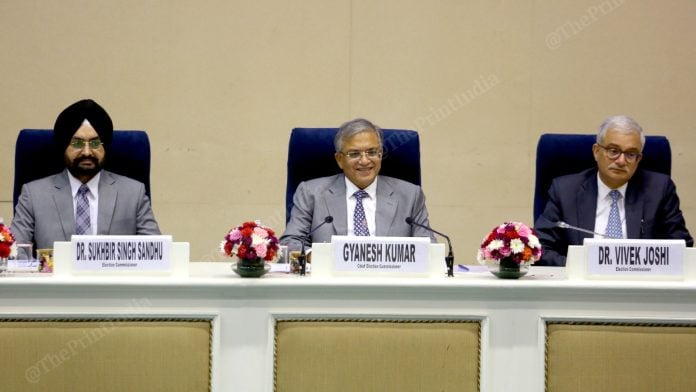
Chief Election Commissioner Gyanesh Kumar has violated the law on decision-making in the ECI, which states that all business of the Commission, including the procedure for transaction and allocation of business, shall, as far as possible, be transacted unanimously. If there is any difference, the matter “shall be decided according to the opinion of the majority”. Substantive decisions which the law vests in “the Election Commission” but were taken in its name without being placed before the Commission are ultra vires.
The ECI’s press release on 26 September said that alteration to Form 6 was approved by the Supreme Court, which was later repudiated by the Chief Justice of India. The Commission also announced a committee to review the functioning of ECINet involving independent experts from IIT/IIIT. It only confirms that the CEC has been functioning unilaterally in making decisions that have potentially deprived millions of citizens of their constitutional right to vote.
Also read: Counting the visible, missing the invisible—the limits of India’s disability rights system
Closed autocracy
This CEC faced an Impeachment motion by 193 Members from across both Houses of Parliament. The chargesheet, signed by 130 Lok Sabha MPs and 63 members of the Rajya Sabha, includes “partisan and discriminatory” conduct, “mass disenfranchisement” through the ongoing SIR of electoral rolls, “proven misbehavior”, actions that “undermine public confidence”, “partisan exercise” of Constitutional functions in favour of one party, and “deliberate obstruction” of investigations into complaints of “electoral fraud”. He was bailed out on these charges. But an impeachment motion signed by 73 Rajya Sabha MPs remains pending.
For the last few years, the ECI has been weaponising the EVM-based voting system by denying access to source code and CCTV recordings of the polling process, besides throttling the Voter Verifiable Paper Trail (VVPAT) and making Symbol Loading Units mysterious, thereby adversely impacting free and fair elections.
It is no wonder that Sweden’s V-Dem Institute, in its ‘Democracy Report 2024’, classified India as an electoral autocracy, reflecting a significant decline in democratic freedoms and civil liberties. The V-Dem Institute categorises countries into four regime types: Liberal Democracy, Electoral Democracy, Electoral Autocracy, and Closed Autocracy. India falls under electoral autocracy, a system where multiparty elections exist but fundamental democratic requisites—such as freedom of expression, free and fair elections, and civil liberties—are insufficiently protected. On electoral management and scrutiny, the report specifically says: “The autonomy of electoral bodies is weakening, and legislative oversight and public consultation have declined.”
Now, with the weaponisation of electoral rolls through SIR, India risks the possibility of moving into the category of “closed autocracy”, representing a restrictive form of autocratic governance.
It bears repeating that the letter from the former judges appears to be amateurish and does not hold water. Some opinions are better kept to oneself.
MG Devasahayam is a retired IAS officer and chairman of People-First. He also served in the Indian Army. He is the author of ‘Emergency and Neo-Emergency: Who Will Defend Democracy?’ Views are personal.
(Edited by Prasanna Bachchhav)