





In mainstream discourse, disability is often treated as a monolith and equated with what is visible — a wheelchair user, as one of the co-authors of this piece is, or a deaf or blind person. Yet disability is often not visible. As one of the co-authors intimately knows, it can take the form of enervating fatigue or an inability to stand due to chronic pain on bad days. Such disability rarely finds representation in the cinematic imagination or even in the language of rights.
The Rights of Persons with Disabilities (RPwD) Act, 2016, sought to challenge precisely this narrow imagination of what disability looks like. First, it shifted from a reductive, medicalised framing of disability to a socio-medical model that recognises how social barriers — not just impairments — restrict participation. Second, it significantly broadened the scope of legal protection by expanding the number of recognised disabilities from seven under the 1995 law to 21. Third, it introduced a rights-based vocabulary consistent with the United Nations Convention on the Rights of Persons with Disabilities (UNCRPD), replacing welfare-oriented terminology with enforceable guarantees of equality, dignity and full participation.
To understand whether this expanded legal imagination has translated into practice, we looked at one of the key mechanisms through which the Act is operationalised: the Unique Disability ID (UDID) system.
Also Read: India’s RPwD Act is continuing to evolve beyond 2016. Courts, citizens are still rewriting it
How inclusive is the UDID?
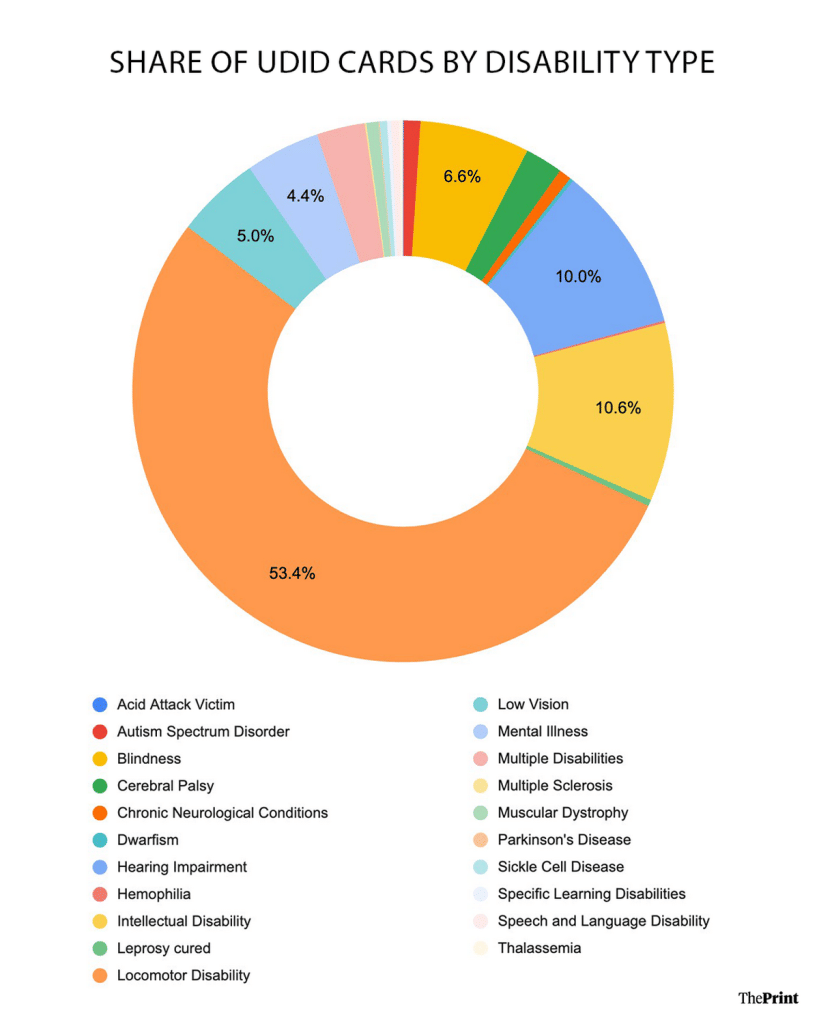
The distribution of UDID cards is revealing. The top five categories as of August 2026 were locomotor disability, accounting for more than half of all cards, followed by intellectual disability at 10.6 per cent, hearing disability at 10 per cent, blindness at 6.6 per cent and low vision at 5 per cent.
Among the disabilities newly recognised under the 2016 Act, chronic neurological conditions accounted for just 0.75 per cent of cards, followed by haemophilia at 0.14 per cent, sickle cell disease at 0.45 per cent and Parkinson’s disease at 0.06 per cent. These numbers, of course, cannot be read as prevalence estimates. A UDID card captures administrative recognition and registration, not the actual number of people living with a particular disability. But perhaps that is precisely what makes the numbers interesting. They tell us something about what becomes legible to the state.
The gap may be a result of differences in access to certification, awareness or registration itself, but it can also tell us something about the kinds of disabilities that our administrative systems find easier to recognise. This is particularly important for invisible disabilities. A chronic neurological condition or a disability that changes in intensity does not necessarily present itself to a bureaucratic system in a measurable and fixed form.
But the problem is not only whether a disability is recognised; it is also what happens after recognition. The haemophilia case makes this contradiction clear. While the RPwD Act recognises haemophilia among its 21 disabilities, the 4 per cent reservation in government employment applies only to specified categories of benchmark disabilities. A disability can therefore enter the rights framework without receiving the same entitlements. Recognition, in other words, does not automatically translate into equal rights.
The Census raises a related question. Its proposed enumeration of nine disability categories, including chronic neurological disease and blood disorders, is an important step. But what gets counted becomes visible to policy, while what remains invisible becomes harder to plan for.
This gap between recognition and lived experience also shapes everyday claims to accommodation. On a recent Metro ride, one of the co-authors wanted to take an empty seat but was asked to give it to a young mother with her child. It was, of course, an entirely understandable request. Yet under similar circumstances, when she is using a mobility aid or support, the dynamic changes. The need for accommodation remains the same; it is the visibility of that need that changes.
When disability meets gender bias
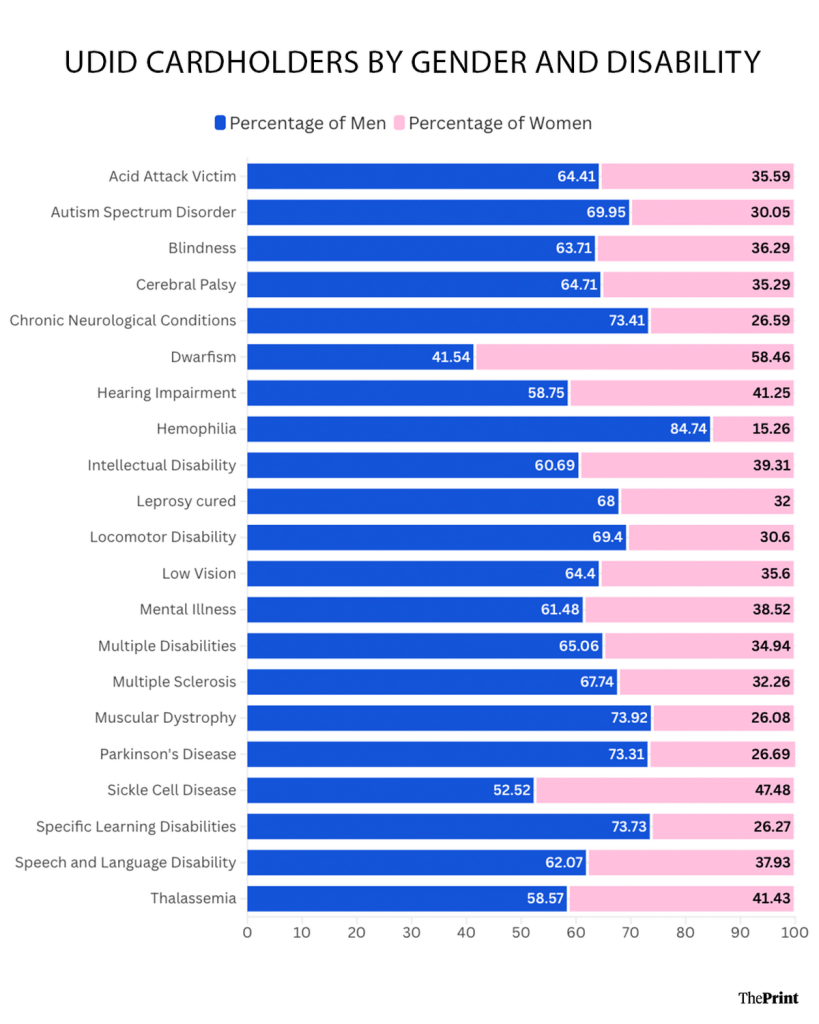
The UDID data also points to another fault line in how disability is recognised: gender. Women account for only 33.90 per cent of cards, compared to 66.09 per cent for men. This is particularly shocking because global evidence suggests that women experience higher rates of disability than men. In low- and middle-income countries, women are estimated to account for up to three-quarters of persons with disabilities.
The double whammy is that women are not only potentially under-recognised as persons with disabilities, but also face an additional layer of stigma around being recognised as disabled. Even for visible disabilities resulting from gendered crimes, the gap remains striking. Despite women making up the overwhelming majority of acid attack victims, over 64 per cent per cent of UDID cardholders registered as acid attack survivors are men.
Diagnosis can be gendered for some disabilities as well. For conditions such as autism and learning disabilities, bias can begin at that level. A delayed diagnosis is not simply a problem because someone may not receive a UDID card; it can mean years of navigating education without appropriate support, entering employment without reasonable accommodation, and often understanding one’s own needs only much later in life. For women, diagnostic biases around conditions such as autism or attention deficit hyperactivity disorder (ADHD) can shape how they are identified, making this delay even more pronounced.
The intersection of these two patterns — invisibility and gender — is particularly revealing. The further we move from disabilities that are immediately visible, the greater the distance seems to become between experiencing disability and being recognised as a person with a disability.
Among UDID cardholders, the gender gap is 46.82 percentage points for chronic neurological conditions, 47.45 percentage points for specific learning disabilities, 47.83 percentage points for muscular dystrophy, 46.62 percentage points for Parkinson’s disease and 39.90 percentage points for autism spectrum disorder. It rises to 69.45 percentage points for haemophilia, although this condition is much more common among men.
Overall, however, these figures do not necessarily reflect a gender disparity in prevalence. And they raise a more difficult question: what happens when disability is not only difficult for the state to see, but also difficult for the individual to disclose?
Registration is not only a question of administrative visibility; it is shaped by the social cost of being recognised as disabled. For women, disability stigma intersects with expectations around marriage and desirability. It makes disclosure potentially costly in a social institution where disability can still be perceived as a liability — perhaps reflected in the many state government schemes that continue to centre marriage-linked incentives for persons with disabilities.
Also Read: The RPwD Act has aged well. What are the gaps to be filled after a decade of progress
Toward being seen
The challenge is not simply that some disabilities are missing from administrative data, or that women are underrepresented among those who receive UDID cards. It is that disability is still too often understood as a fixed, visible and easily identifiable condition that can be diagnosed, documented and accommodated in the same way across people and across time.
Yet for many, disability is not a fixed state of being. It is an iterative and interactive experience, shaped by the interplay between a condition, treatment, relapse, recovery and the environment in which a person lives. This is particularly evident for persons with rare diseases, where the same condition can produce very different experiences of disability across time and circumstance.
The RPwD Act has made considerable strides in recognising this complexity and embedding the language of accessibility, reasonable accommodation, equality and dignity across our governance systems. Yet as the Act enters its second decade, the language of rights needs to travel further to those whose disabilities are invisible, intermittent or fluctuating, and to women for whom the social cost of disclosure can be particularly high.
The task ahead is therefore not simply to expand the definition of disability, but to expand our ability to recognise it — particularly when disability changes over time, when it is difficult to see, and when being seen itself can come at a cost.
This is the third article in a three-part series on 10 years of the RPwD Act.
Nipun Malhotra is Founder, Nipman Foundation, and Director, The Quantum Hub (TQH). He is on Instagram @nipunmalhotra007. Harshita Kumari is an Analyst at TQH. She is on Instagram @memoirs_of_a_bookaffair. They were supported in data visualisation by Mannat Mehra, who interned at TQH. Views are personal.
(Edited by Asavari Singh)