



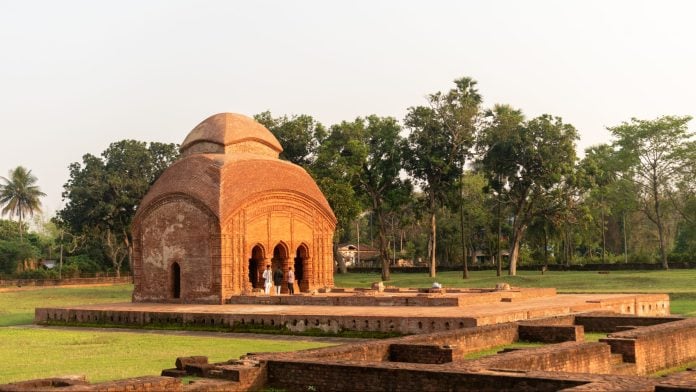
The heat catches me off guard; I wipe sweat from my brow as I push past waist-high thistle, searching for footing on crumbling makaro pathar, the native soil and rock giving way to black, porous craters under the grass. My guide, the local village head moonlighting in the role, says nothing, only motions for me to follow his steps. Past a scatter of kuccha ghar, we trace the boundary wall of one of the district’s oldest citadels.
The terracotta mass of the Rasika Raya Temple rises from the overgrowth within the fortified precinct of Haripurgarh, 15 kilometres northwest of Baripada. Commissioned by the Bhanja ruler Raja Vira Vikramaditya Bhanja between the 15th and 16th centuries, its surviving panel carries carvings of mythology, coronation, and war.
“The monument holds meaning for its memory,” my guide says. “The rest is gone.”
This was where the last Sultan of Bengal sought refuge 500 years ago. It’s Daud Khan Karrani’s final stand, immortalised in the Akbarnama. Once the Bhanja dynasty’s second capital for close to a century, it now holds less significance for many; fewer still would call themselves its custodians.
The jurisdictional gap
Cultural tourism is rising globally, and Odisha’s new tagline—Think India, Think Odisha—should reflect that. It doesn’t, not yet. The state recorded 53,392 foreign tourist visits in 2024, up from 45,173 in 2023 but still well below the 115,128 recorded in 2019. Domestic visits reached nearly 1.1 crore in 2024. However, tourism promotion remains centred on the familiar Bhubaneswar-Puri-Konark circuit, leaving much of the state’s built heritage outside the itineraries through which Odisha is presented to visitors.
Odisha’s monuments sit across two authorities and, functionally, a third that answers to no one. ASI’s Bhubaneswar Circle protects 78 Monuments of National Importance across 30 districts. The state’s own archaeology wing protects 222 more. Add Konark, Odisha’s sole UNESCO site, and the total comes to around 300.
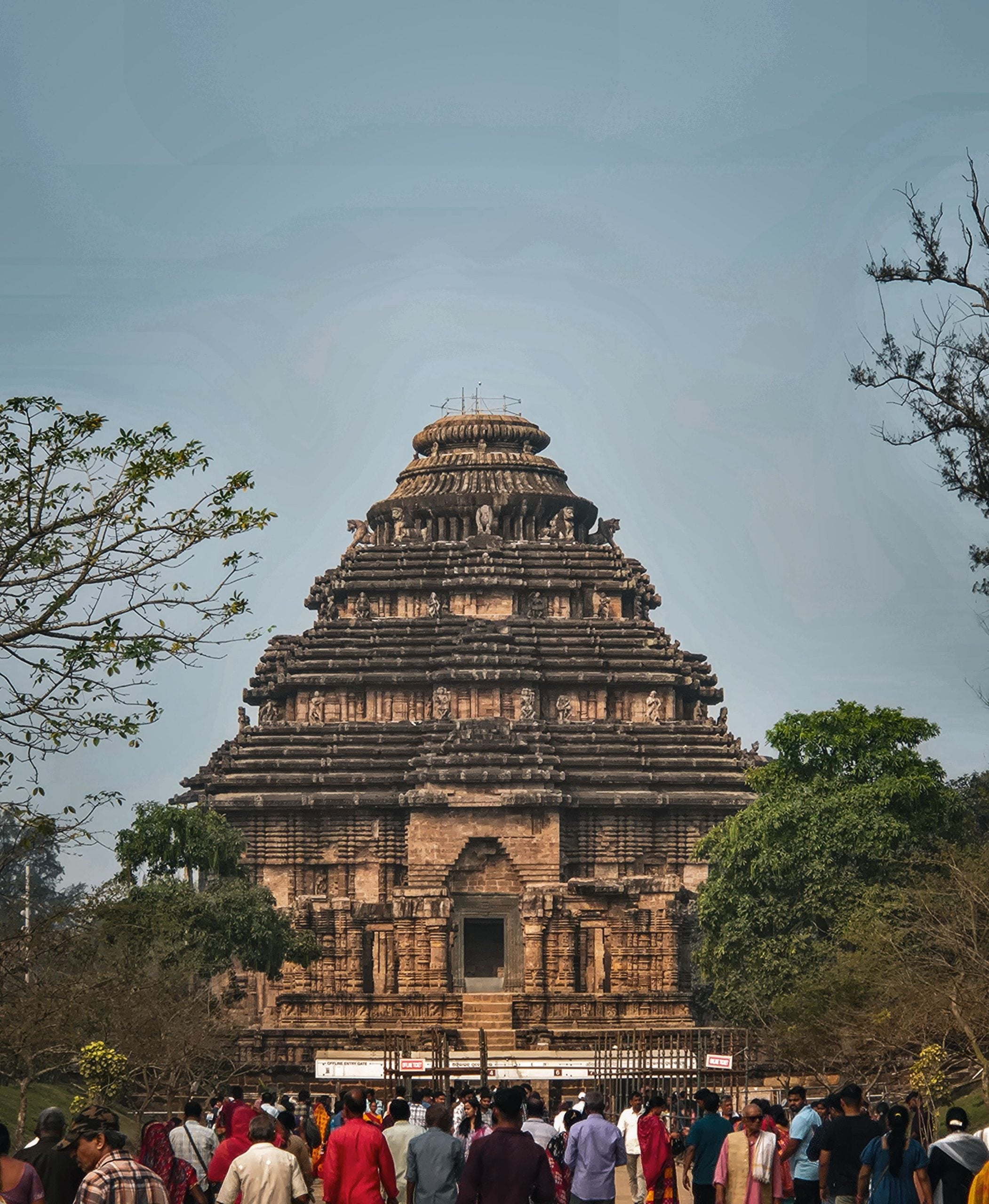
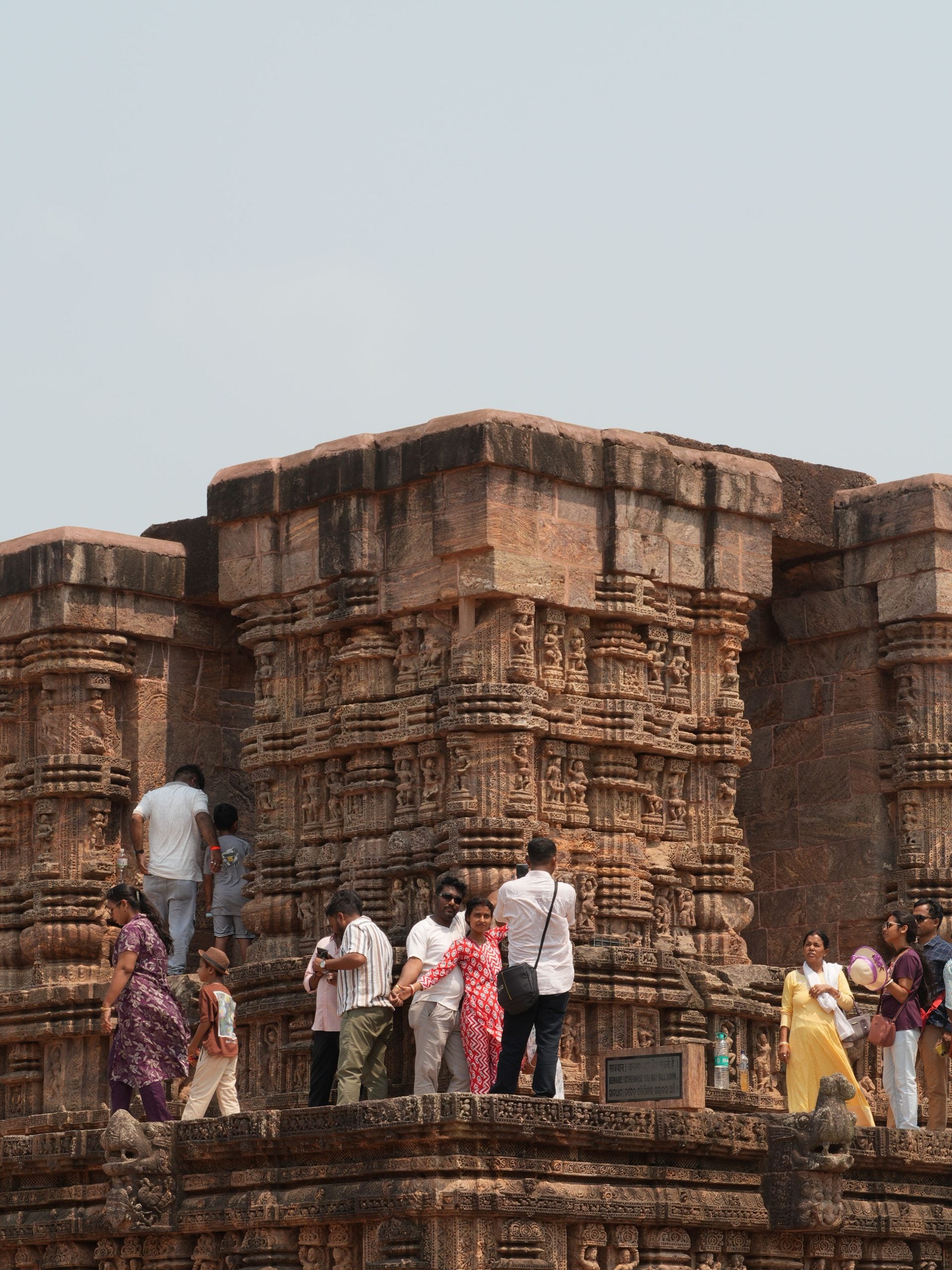
Anil Dhir of the INTACH Governing Body and member of the local chapter told me that he has independently documented over 6,500 heritage sites across 21 districts under a broad umbrella of heritage, including monuments and idols, pointing out that most of Odisha’s monuments have no legal protection and fall outside the ambit of protection. He asks a simple question: whom does a villager call when an idol is stolen within a monument, and who is responsible for tracing it, recovering it, and punishing the culprit? Without a specialised unit investigating theft and vandalism at historic sites, responsibility slips between agencies, and the chasm widens.
Conservation architect Abha Narain Lambah, whose 30-year practice spans the Ajanta Caves, Hampi, and the UNESCO nomination for Mumbai’s Victorian-Art Deco ensemble, traces the gap partly to how colonial Britain treated Indian monuments as a treasure hunt rather than a preservation project.
“Culture has fallen down the priority list,” she said. Rajasthan figured out decades ago that a fort or haveli could be an asset: revenue-generating, sustained as much by local entrepreneurship as by state policy. That kind of ground-up momentum hasn’t taken root in Odisha yet.
Also read: Durga Puja is India’s gift to the world. It is pan-India and global
The money is there, the blueprint isn’t
To support her argument, Lambah points to the absence of strategic planning. Fifteen years ago, preparing a conservation plan for ASI’s 5th-6th century Sisupalgarh site, she found plotted residential development sitting inside the archaeological zone, houses built on historic ground with no framework to inform anyone otherwise. Puri’s building bylaws today are functionally identical to urban Mumbai’s, because no one ever wrote conservation-specific planning guidelines for a temple town. In effect, the default agency that steps in is the PWD, whose instinct is to “beautify” rather than conserve. What’s missing isn’t capital—it seems to be a blueprint that starts from the ground up.
Archaeologist and curator Anica Mann, who conducted a 15-day survey of sites across the state, locates the deeper cause in a lack of sustained scholarship reaching the public. A scholarship built over decades by historians such as Upinder Singh and Nayanjot Lahiri has no bridge to a public reason to care.
“Listing follows lobbying, not merit. One UNESCO site measures institutional absence, not diminished heritage,“ Mann said, citing Lahiri.
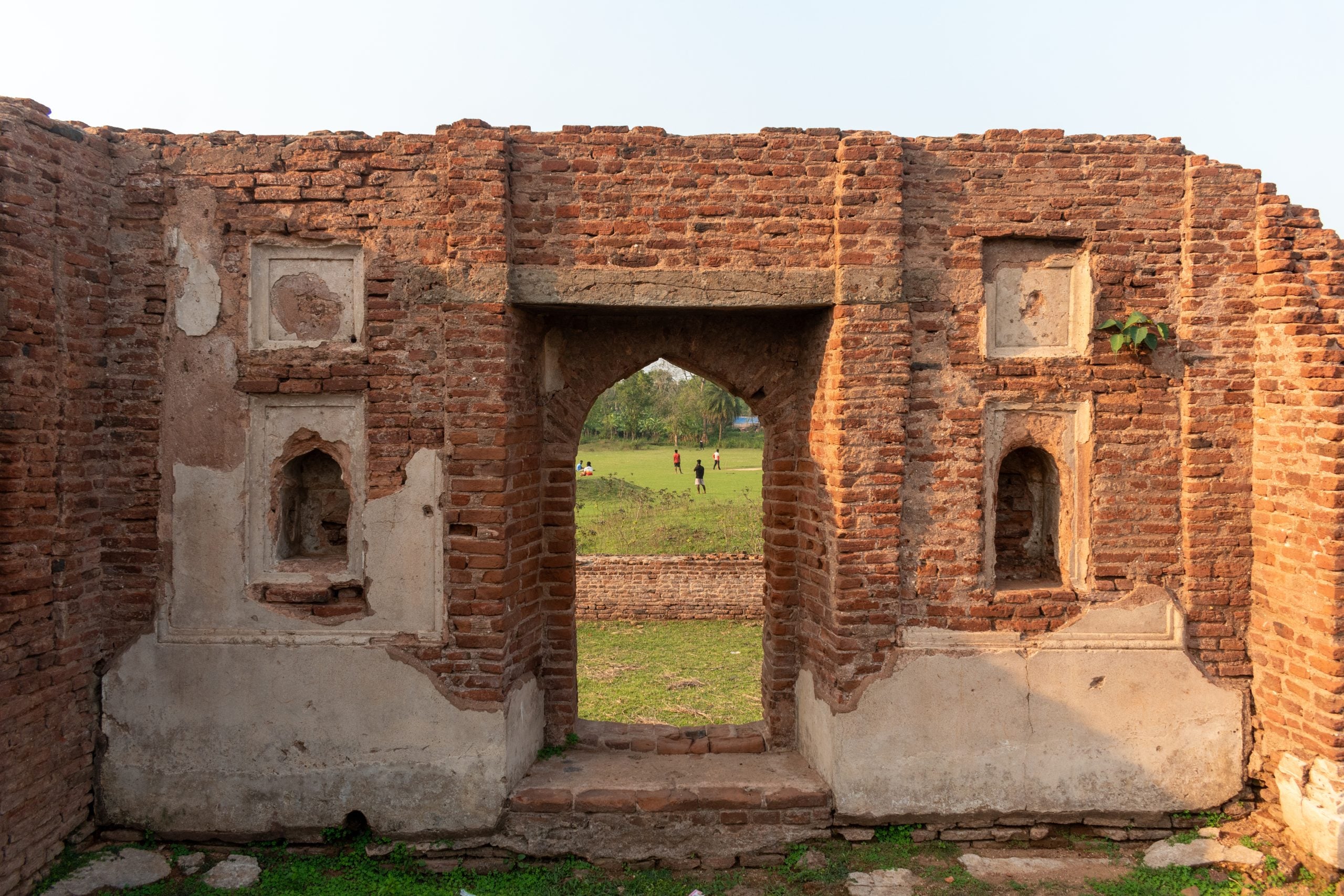
Mann points to Udayagiri-Khandagiri, Lalitgiri, and Ratnagiri, sites on the same Vajrayana Buddhist corridor that shaped practice across the Himalayas and into Southeast Asia.
“Sri Lanka and Indonesia built entire national tourism identities around exactly this kind of material,” she said. “Borobudur is shorthand for Southeast Asian Buddhism the way the Taj Mahal is shorthand for India. India possesses source material for that same story and has done almost nothing to narrate it.”
The regional bias in how Indian heritage circulates internationally was built by a century of Mughal and Rajput promotion, not inherited from the monuments themselves.
The instinct is to push for more: more lobbying, more policy, more capital flowing top-down. But Malini Thadani, executive director of the World Monuments Fund, points to something more specific: she can’t recall a meeting with any Indian state government lacking real interest in conservation.
“Growing interest can translate into patronage when conservation needs are clearly defined, local partnerships are strong, and projects offer meaningful long-term engagement,“ Thadani said.
Mann points out another problem.
“Schemes such as ‘Adopt a Heritage’ try to reintroduce private capital without reintroducing that sense of belonging. The result is a scheme that’s touched exactly one Odisha monument—the one that never needed the help,“ she said.
A blueprint handed down, without local ownership baked in from the start, doesn’t take. But one built with the community that lives alongside a monument, from the first draft, has a chance. The local community is the one that holds oral stories around the monument, understands its particular cause for concern, and can be the first line of defence when planning or a lack thereof goes awry.
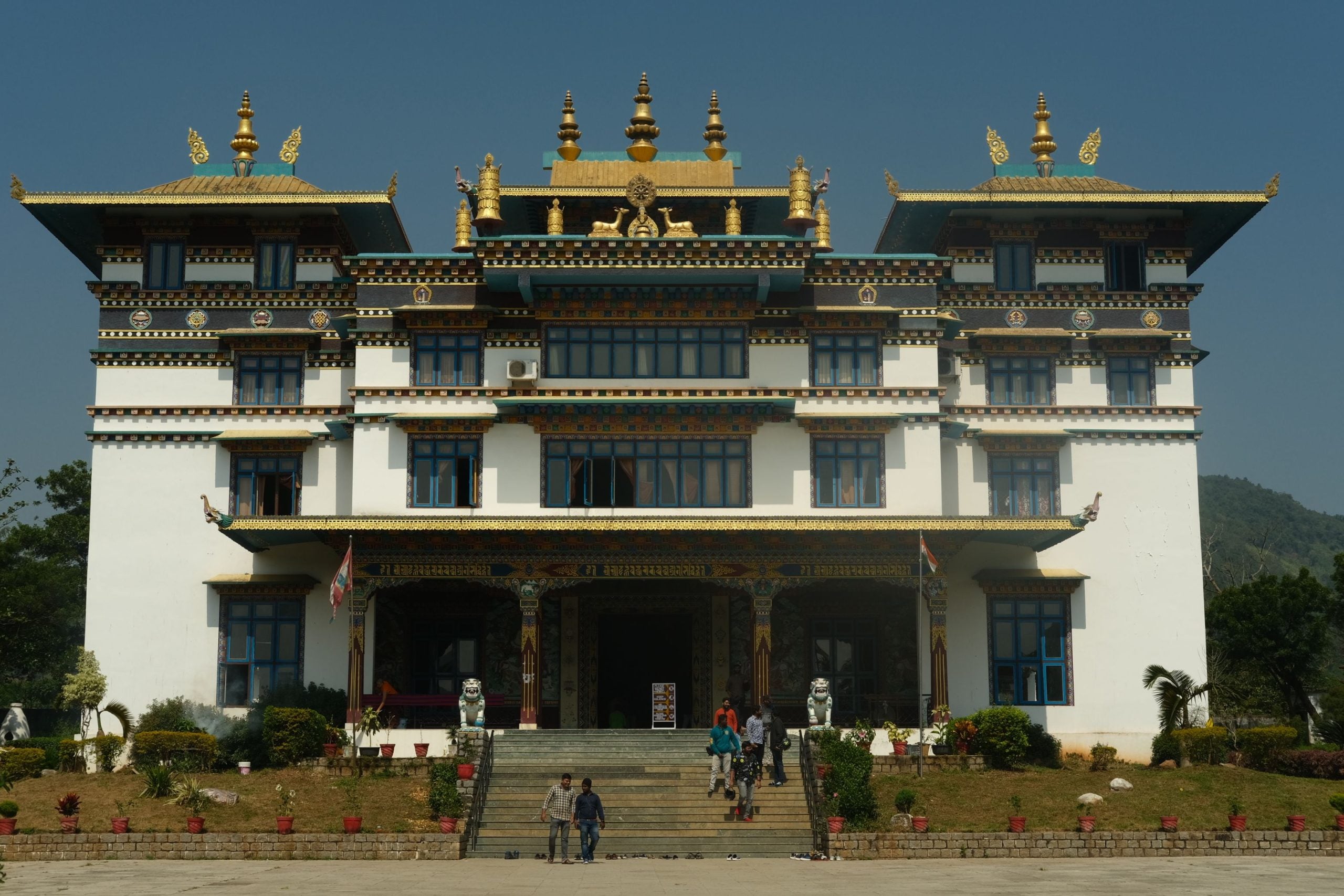
There are real signs of movement worth building on. The state’s Operational Guidelines for Promotion of Heritage Properties under the Tourism Department now offer capital subsidies to owners of pre-1950 structures who restore them into heritage hotels, homestays, or craft centres. This puts restoration in the hands of the people who own these structures. In addition, a new Directorate of Archaeology has Cabinet approval, being pulled out from under a larger ambit of arts, crafts, and language to be on a more focused footing. This May, Odisha State Archaeology partnered with IIT Kharagpur and SPA Bhopal to deploy LiDAR and GIS mapping across nearly 294 sites.
What determines whether these measures hold is whether the next layer—local bodies, village councils, the people who live beside the ruins—gets real agency in shaping it.
Also read: Kashmir brain drain is different from Kerala and Punjab
What the village remembers
Back in Haripurgarh that evening, the village head mentions, almost in passing, a set of grama devis (village guardians) near a tree worshipped for decades, with no record of when they appeared or under whose care. He catches himself, remembering that his job was to show me the ‘big’ monuments, and tries to move on. I ask him to stop and show me the deities instead.
It’s in the smallest materials of memory that a community holds its identity. Haripurgarh was built by my ancestors, but it belongs just as much to a community that includes them, and any blueprint for its future has to start from that belonging, not arrive after it. Heritage, it seems, survives when the people closest to it have the standing to decide what gets documented and can tell not just the great, but the small stories too, the ones that quietly become tomorrow’s lore.
Odisha still has strides to make. Not in ambition, which clearly exists, but in ground-level agency. Staying relevant takes more than the basic requirement of papers and funding—it takes a blueprint built with the community, not just for it.
Akshita M Bhanj Deo is the director of The Belgadia Palace and the Mayurbhanj Foundation. Her X handle is @TheGreatAshB, and she is on Instagram @abhanjdeo. Views are personal.
(Edited by Prasanna Bachchhav)