



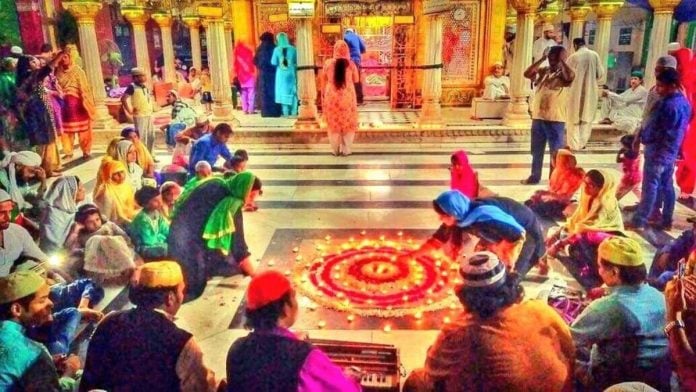
While people were busy celebrating Diwali, sharing sweets and exchanging warm wishes with friends and neighbours—a vocal corner of social media had a very different priority. Instead of joining the festive spirit, they spent their time lecturing Muslims that saying “Happy Diwali” somehow diminishes their faith or makes them less Muslim.
The controversy became even bigger when some social media accounts began attacking New York City Mayor Zohran Mamdani and Michigan politician Abdul El-Sayed for wishing people a Happy Diwali and participating in celebrations with Hindu communities.
There is a peculiar contradiction here. At a time when Muslims across the world are demanding respect for their religious identity, some Muslims are busy questioning the faith of fellow Muslims simply for showing respect to the religious traditions of others.
On 8 November, Mamdani shared a Diwali message with New Yorkers, while El-Sayed posted photographs of himself taking part in festivities in Michigan.
What I find interesting is that these were simply public figures acknowledging a festival celebrated by people in their communities. Yet for some, even that became a reason to question their religious commitment. But beneath this debate lies a much more consequential question: who gets to decide whether someone is a true Muslim?
This is something I have noticed on social media over the years, although I must admit that the whole idea was quite new to me when I first came across it.
I remember reading about it on Facebook around seven or eight years ago. At the time, I came across posts and news stories claiming that it was a crime in Egypt for Muslims to wish Christians a Merry Christmas.
I was genuinely shocked. How could simply wishing someone happiness on their religious festival be considered a crime?
Later, I learnt that those claims were false. But what stayed with me was the controversy surrounding something as simple as a Christmas greeting. There were people seriously debating whether a Muslim could wish a Christian friend or neighbour a Merry Christmas without compromising their own faith.
Faith & freedom to celebrate together
As a Pasmanda Muslim who grew up in a small village called Mangalpur in Varanasi (Kashi), my memories of Diwali are very different from the arguments I see on social media today.
My village was predominantly Pasmanda Muslim, with two mosques serving the entire village. On one side was an Ambedkar village, where Dalit families lived, and on the other side were settlements of different Hindu communities and castes. We all had our own religious identities, traditions and ways of life, but we also shared the same neighbourhood and many everyday experiences.
I remember that almost every Muslim family in my village would cook puri and suran ki sabzi on Diwali. And to be fair, I never even questioned why. It was simply something we did. Only much later, when I became curious and started reading about it, did I discover that preparing these dishes around Diwali was an old tradition in parts of North India.
Many Muslim families would also buy new things on Dhanteras. Although, looking back, I used to think that it had more to do with the festive shopping and good deals than anything religious.
But what I find particularly interesting is that many Muslim families would choose either Diwali or Shab-e-Barat for their annual house cleaning, whitewashing and painting. It was such a normal part of village life that nobody seemed to find anything unusual about it.
I realise that what we were practising was a shared culture that had been passed down through generations. Without even realising it, we were carrying forward centuries-old traditions, our shared heritage.
And then there was my father.
He was a deeply religious man. Having performed Hajj seven times, his devotion wasn’t merely talk; it was the foundation of how he lived. Looking back, I cannot recall a single fast he ever missed, or a moment he didn’t strive to pray as often as he possibly could. And every Diwali, he would specially hire a halwai to prepare kilos of sweets to distribute among our workers and Hindu neighbours.
My family had been involved in the Banarasi saree-weaving business for generations, and many people worked with us. Diwali was an occasion when my father made sure they received sweets and gifts. He would also send gifts to his Hindu friends, and our home would receive plenty of sweets and presents in return.
What I remember most is that nobody ever told us we were becoming less Muslim by doing any of this.
My father did not see a contradiction between being a practising Muslim and sharing in the happiness of his Hindu friends and neighbours. Neither did the people around us. It was simply how we lived.
And that is why I find these arguments on social media so strange today. Something that was once such a natural part of our everyday lives is now being presented as a threat to religious identity.
Also read: Toxic air, falling buildings, flooded roads. Nobody to blame in Delhi’s triple-engine govt
Shared cultural traditions
These ideas did not begin with social media. When I was growing up, some preachers tried to introduce a more puritanical understanding of Islam into our communities, following interpretations of Wahhabism. They would question some of the traditions and practices that had been part of our lives for generations.
I wouldn’t say they were particularly successful back then. Most people around me did not take such arguments very seriously. They continued living as they always had, practising their faith while sharing cultural traditions with their Hindu neighbours.
But looking at social media today, I sometimes wonder whether those ideas have gradually found a larger audience. Things that once seemed like the opinions of a few preachers are now being repeated online, often with the confidence that there is only one correct way to be a Muslim.
And this is one of the reasons I feel so strongly about creating awareness of Pasmanda Muslim communities, our history and our shared cultural practices.
Because these traditions are not simply about celebrating festivals or exchanging sweets. They are part of our social history, shaped by generations of Hindus and Muslims living alongside one another.
I believe we need to remember and talk about this kind of history, especially when divisive ideas try to convince us that respecting each other’s sentiments and festivals somehow weakens our own religious identity.
If we forget the shared culture we have inherited, how will the next generation of India know that the way of living together has always existed in India?
Amana Begam Ansari is a columnist, writer, and TV news panellist. She runs a weekly YouTube show called ‘India This Week by Amana and Khalid’. She tweets @Amana_Ansari. Views are personal.
(Edited by Saptak Datta)
A self-isolated and self-othering group can neither expect not see themselves to be assimilated into Bharat’s cultural ethos. NEVER.