




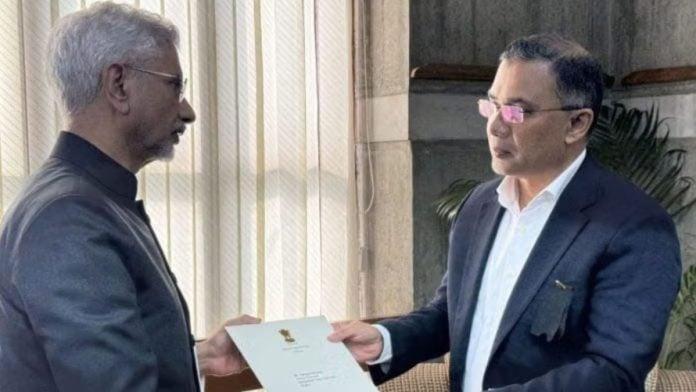

Dhaka may soon send a new envoy to New Delhi, with the diplomatic process reportedly underway between the two countries. The potential new envoy is said to be Foreign Secretary Asad Alam Siam, who might take charge in October. However, India is yet to approve the appointment.
The development comes as the two sides are reportedly renewing talks on Bangladesh Prime Minister Tarique Rahman’s first visit to India—a major diplomatic event the new envoy might lead.
This new envoy’s arrival would also mark the end of the current High Commissioner Riaz Hamidullah’s tenure. He served as the Bangladesh envoy for 18 months. Though brief, it was arguably the most crucial period in office, considering he arrived in New Delhi against the backdrop of tense ties between the two countries, ignited by the aftermath of the ‘July Uprising’ in 2024.
From major diplomatic, policy, and media convenings in New Delhi to taking the front row at India-Bangladesh discussions in the public domain, the high commissioner was often seen taking serious notes while panellists traded heated exchanges. Toward the end of any public session where Hamidullah was present or spoke, one could approach him with a query, and he would offer one key response: “I believe in this relationship.” But seeing is believing.
What follows is an attempt to read a Bangladeshi diplomat’s 18 months in India through the public record he leaves behind—lectures, recorded appearances, social-media accounts, and a few conversations on the sidelines of such covenings—to ask what that record reveals about ‘believing in the relationship.’
The paradox of diplomacy
One could not help but ask the high commissioner—especially on occasions when he spoke out or during public engagements in Delhi—what were the most difficult areas to manage: political, economic, or security?
Often, he reflected on the “paradox of diplomacy”, highlighting what could have been the toughest yet was easy to deliver: security. In ‘shared interests,’ driven by ‘mutual interdependence,’ as much of both States, but similarly the ‘organic’ relations the two people remain moored in.
“If security—which is supposed to be the most difficult of the dossiers—gets easier to address in all seriousness and sincerity, then isn’t it fair to ask that politics and economics should be easier? But I found those to be harder”, Hamidullah said on the sidelines of an event in New Delhi.
Following the dominant logic of dealing with close neighbours, security confidence creates space for economic and political cooperation—something proven during the Maoist Insurgency in Nepal (1996-2006) when, despite the odds at the political level, security ties provided stability. India-Bangladesh may have seen the same, yet some issues remain under discussion in the vast canvas of security, particularly around border infrastructure.
However, reflecting on political and economic ties, Bangladesh observers in New Delhi would second the view that political relations remain impacted by a trust deficit and competing narratives, and that they continue in the same rhythm.
At a recent lecture, “Building Resilient Relations: People as Stakeholders” at the India International Centre in New Delhi, Hamidullah reflected on people as the core to Dhaka-New Delhi ties by referring to his travels to the North-east of India and the people he met along the way. Travels to Northeast India happened four times in his brief tenure, and the last one was possibly to Agartala from Guwahati on a train—an account that he shared on X.
Sharing a glimpse of the 15-hour-long travel journey compared to what could have been just 50 minutes on a flight, he wrote, “The long journey was like time travel. I kept glued to window – seeing streams | rivers -tea gardens – foliage changing shades. There were stretches miles after miles with little human footprint. Uniquely unspoiled bio-diversity.”
The story runs parallel to what Western travellers often write in memoirs, but one such account from a neighbour makes it more personal.
However, travelling also becomes a mode of effective diplomatic outreach to a wider cross-section of people, helping address many ‘givens’ and lower the inhibitions both sides may have developed over time. The ‘India story’ goes back to many more diplomats from countries across the world who arrived in India briefly, but the affair lasted a long time.
Away from social media, the Zubeen Garg story appears prominently in his India story. Speaking at Bangladesh’s national day celebration this March, he remembered the singer, saying, “I miss one Indian friend whom I met last July in Guwahati. Zubeen Garg. Zubeen promised me that he would be on this stage to render the national anthems of Bangladesh and India, both anthems authored by Rabindranath Tagore. Much to the regret of millions – in Assam, the North-East, and Bangladesh – he left us for eternal rest.”
Garg was a celebrated musician and composer from Assam, who died in Singapore following a tragic accident in September last year.
Like Zubeen, Hamidullah remembers Indian music stalwart Bhupen Hazarika, who also hailed from Assam and whose music is cherished on both sides.
Well, if great names like Rabindranath Tagore, Uttam Kumar and Bhupen Hazarika are part of the shared cultural heritage of India and Bangladesh, contemporary artists like Zubeen have continued to forge similar bonds across the border. However, the question remains whether that shared heritage will continue, given the conclusions drawn on both sides about the political relationship between New Delhi and Dhaka.
Also read: Bangladesh’s Indemnity Act shields murderers from courts. It’s impunity institutionalised
Generational shift needs attention
For observers of India-Bangladesh ties, a relationship invested heavily in people-to-people connections, a shift in political understanding creates a dilemma. No matter the political dispensation, people remain at the core of the relationship, surely not as rhetoric. But that does not mean ignoring the fact that public understanding has taken a hit, given the shift in discourse—gradual and quieter over the longer term, but more explicit in the last two years.
Meanwhile, domestic developments in the region have a strong generational element that has, no doubt, influenced foreign policy. From Bangladesh to Nepal, history tends to take a back seat, and a renewed partnership with less history and more present takes primacy. The present actually becomes more crucial when demographic shifts are taken into account.
To reflect this, Bangladesh’s median age stands at 26 years—an age group whose impact was more visible during Bangladesh’s general elections this year, something similar to the Nepal story. Interestingly, interactions with new-age youth from neighbouring countries, be it Nepal or Bangladesh, often seem to suggest they would likely subscribe to the present rather than carry the ‘burden of history’—an element that could be necessitated in foreign policy discourses. That said, history remains central to the relationship, and the present offers opportunities. A balance of both must be managed.
To conclude, while a shift is necessary, the change could still take time. In the process, a new generation of foreign-policy observers may also be needed to understand what the youth seeking change on the other side envisage for foreign policy, especially with neighbours. Meanwhile, as India-Bangladesh relations enter a new era of conversations, contestations, and diplomatic disagreements, a diplomat’s account reminds us that relations between neighbours cannot be sustained by diplomatic channels alone.
Rishi Gupta is a commentator on global strategic affairs. The opinions expressed in this article are those of the author alone and do not reflect the views of the author’s current or past affiliations in any form.
(Edited by Saptak Datta)
Lol. The irony in the blogger’s argument is striking.. that entire “shared heritage” is literally undivided Bharatiya heritage.
Tagore’s songs and the cultural ties between West Bengal, Assam, and Sylhet aren’t some modern international bridge. They exist because Bengal and East Bengal were part of the same civilizational and territorial fabric before 1947.
So, waxing poetic phrases and scenic train rides won’t fix a failing neighborhood strategy.
Statecraft isn’t a soft-focus cultural exchange program, and civilizational history is a tool of leverage, not an obligation for endless charity.
Expecting Bharat to play the indulgent older sibling while Dhaka exploits anti-India rhetoric for domestic gain is a loser’s frame.
The real failure here was plain old laziness. Bharat’s foreign policy put all its eggs in one basket with Sheikh Hasina, and it ended up caught off guard when the house fell down. Smart statecraft means keeping an eye on everyone across the border and holding real leverage over them, whether you like them or not. That way, no matter who comes to power in Dhaka, they know damn well there’s a price to pay for messing with Bharat.