






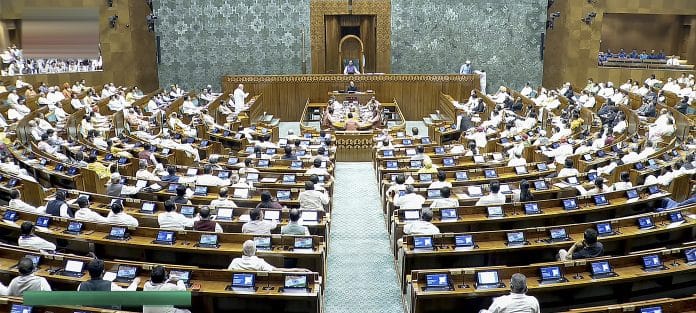


There is much talk of federalism and how the move to increase seats in parliament to give women 33 percent of the seats is somehow a threat to federalism.
Federalism is primarily about how powers are distributed (largely) between three levels of government, Central, state and local bodies. They actually have nothing to do with which state gets to sent how many MPs to parliament. Yes, one can agree that relative changes in the number of seats between states will increase or reduce the voting powers of those states on central legislation. But this does not in any way reduce the already devolved powers of states.
Let us note a few cases where federal powers were actually impacted severely, but very few states protested. The goods and services tax (GST) impacted the ability of states to raise or lower indirect taxes, but most of them agreed to let go on the assumption that their revenues would go up. But no one spoke up for local bodies, who now have to depend on grants from state governments – which the latter are bound to hand over, but still involve a loss of fiscal autonomy for local bodies. For municipal corporations like Mumbai, which had revenues from octroi that exceeded the budgets of some of the smaller states, this was a severe loss of federal powers, but states were happy to sacrifice the interests of their local bodies in the name of easier movement of goods across city and state borders. Currently, the compensation given to the Municipal Corporation of Greater Mumbai as substitute for octroi is Rs 15,000 crore+ annually. That’s the level of autonomy given up by Mumbai.
States are often the biggest culprits when it comes to curtailing federalism, purely because the constitution says that local bodies are part of the state list under entry 5. This needs to go and we must have a local bodies list as distinct from the state list.
The arbitrary surcharges imposed by the Centre on income tax, which are not part of the divisible pool of resources, continue endlessly. One can accept a temporary surcharge to meet exigent circumstances – like a war or covid – but when they are effectively a tax on high incomes, how can they be kept out of the divisible pool? The states should clearly challenge this in the constitutional courts as a serious assault on federalism, or at least make a big fuss over it. But apart from muttering under their breaths, few have challenged this politically or legally.
Third, the issue of gains or losses from delimitation have become a political football mostly – and mostly because – states are organised around a common language. If language (or tribalism of some kind) was not the basis of statehood, the heartburn over loss of seats would be limited.
Ask yourself, why does delimitation within states not raise as many hackles as between states? Why do urban areas always gain at the cost of rural seats, and why do the poor, who tend to beget more children, always get a larger voice share of the vote in any state, often at the cost of the better off, who are the ones helping with population control? Isn’t this the core of the argument put forth by the southern states, which claim they are being penalised because they brought down birth rates faster than the north.
The only federal principle worth fighting for is the redistribution of powers, especially fiscal powers. The day states realise that this is what matters, and not the number of seats in the Lok Sabha, everyone would be better off. We are into false arguments over federalism when the issue is the value of each voter’s vote in choosing her representatives to parliament or legislatures.
A democracy that gives each voter a roughly equal voice in who gets elected is much better when the same democracy devolves power to the lowest possible level, and the lowest level here is not the state, but local bodies. Most decisions that impact citizens are taken at the lowest tier of government. Not the middle or higher tiers.
R Jagannathan is an editor and the former editorial director at Swarajya magazine. He tweets @TheJaggi. Views are personal.
This article has been republished from the author’s personal blog. Read the original article here.