







A couple of decades ago, during one of my first trips to Shanghai, I noticed a lot of German sedans on the road. Having a German luxury sedan, or SUV nowadays, was and remains a sign of prosperity in China and the rest of the world. But there was something different about the German luxury vehicles in China. Many, if not most, carried an ‘L’ badge alongside the make and model badges.
That ‘L’ stood for long-wheelbase (LWB), a feature Chinese buyers have long preferred because these vehicles often serve as family cars, offering a little more room, particularly for second-row passengers. The wheelbase is the measured distance between the centre of the front and rear wheels. And LWB vehicles have an additional 10-12 centimetres of length, almost all for the second row.
And while that might not seem like much, if you have travelled in ‘cattle’ class on an airline, you know how precious the three-four extra inches on premium economy or the emergency exit rows can be.
Curious about these vehicles, I thought they could work in India too. After all, most luxury car buyers in India are driven around rather than driving themselves. A little bit of extra space to stretch your legs after a long day of work just feels nicer. And while the most luxurious sedans, such as the Mercedes-Benz S-Class and BMW 7 Series, were sold only in LWB versions, India generally got European-specification vehicles, which, for better or worse, prioritised the driving experience.
However, Mercedes-Benz changed that when it introduced the LWB variant of the E-Class in 2017, which is now in its second generation. And it has been a runaway success, continuing to be the best-selling luxury sedan in India. It was only obvious that other carmakers looked at this and wondered; even Hyundai decided to give the Grand i10 slightly more legroom at the rear compared to the European version.
‘BMW has widest range of LWB luxury cars in India’
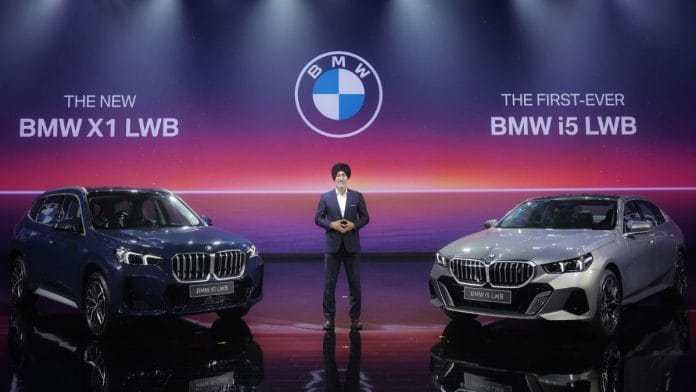
Of late, it has been BMW that has been running the hardest with its LWB strategy. On Friday, BMW launched the LWB petrol version of the X1 SUV to complement the existing variant of the electric iX1, which is India’s best-selling luxury electric vehicle and consistently pushes BMW into the top five electric carmakers in India in several months.
In fact, on the back of having multiple LWB models, BMW India did overtake Mercedes-Benz India in retail sales volume for the first half of 2026, according to the VAHAN portal of the Ministry of Road Transport and Highways.
Hardeep Brar, President, BMW India, said that long-wheelbase models account for 50 per cent of BMW’s sales volume in India and are growing fast, with volumes growing 24 per cent in the first half of 2026.
“BMW Group India now has the widest range of LWB luxury cars in India — a total of 7 models. And our strategy has a reason behind it. India has always had a strong appreciation for space, and it’s fast becoming a non-negotiable for the luxury experience for our customers,” he said.
But in a surprise announcement, BMW India also unveiled the LWB variant of their i5 electric sedan, a first in that segment. With both vehicles being assembled in India (albeit with kits coming from China), prices would have been moderated; the LWB X1 is priced at Rs 49.9 lakh, matching the electric version. The EV, however, gets some benefits in certain states, although many states such as Delhi-NCT cap benefits for EVs to those that cost 30 lakh and below.
Also read: Diesel, hybrid or electric? Living with three CSUVs gave me some answers
BMW’s conscious call for India
One argument against LWB models has been the fact that the additional length takes a toll on the driving experience, so a few days before the X1 LWB was unveiled, BMW India sent one over for me to drive. And it was surprisingly good. Now, the current-generation X1 petrol, marketed as the 18i, features a three-cylinder turbocharged petrol engine with ‘only’ 156 horsepower, which is slightly more than the short wheelbase model.
Which might not seem like much, but it is still surprisingly good fun to drive. The power comes on when you need it, and the additional length does not make the SUV roll about when taking corners hard. Maybe because you are not going all that fast in the first place, and if power is what you are after, there are other options out there, such as the Mercedes-Benz GLA 200, which has a 161 horsepower 1.3-litre engine (that is shared with the Renault Duster and Nissan Tekton) or even the expected 190PS two-litre motor on the new Audi Q3.
According to Brar, BMW India has taken a conscious call on rear legroom. They have seen LWB models like the 3-series and 5-series do very well.
“India has always had a strong appreciation for space, and it’s fast becoming a non-negotiable for the luxury experience for our customers”, Brar told ThePrint.
Kushan Mitra is an automotive journalist based in New Delhi. He tweets @kushanmitra. Views are personal.
(Edited by Saptak Datta)