






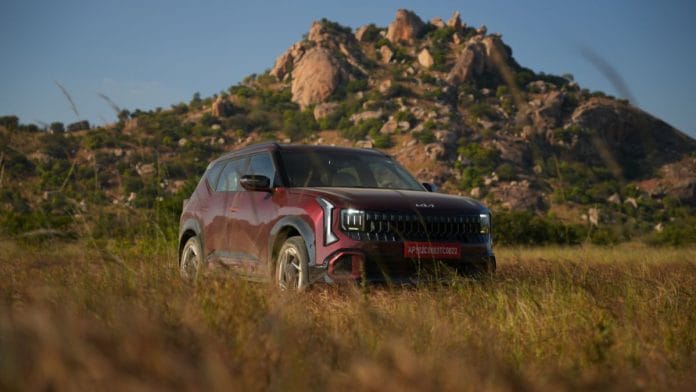


Over the past few weeks, I have had quite a few ‘long-term’ vehicles. These are vehicles I keep for over a month. Most of the time, we drive vehicles only for a few hours at a media drive, which is less of a review and more of a first-drive impression.
However, only when you live with a vehicle do you get to see it warts and all. Knowing the warts is important because during the first drive, you are usually driving a product fresh off the production line, and a three- or four-hour drive over a hundred-odd kilometres is rarely a ‘real-world’ drive.
The vehicles I have had over the past few weeks are all quite different, even though they are all in the same CSUV segment. One is the Kia Seltos diesel automatic, and I earlier had the Maruti-Suzuki Victoris Hybrid, which the carmaker replaced with its electric E Vitara. All three have very different drivetrains.
Diesel on the highway
Let me start with the Kia. As I said during my first drive of the second-generation Seltos, the Korean manufacturer has achieved a very high level of interior quality. I took the Seltos down to Jaipur, and as a highway cruiser, it is a great option.
The 1.5-litre diesel engine, while being the same engine that has been in service for over a decade, has been updated to meet Bharat Stage 6 Phase B standards. And because it uses Diesel Exhaust Fluid (DEF) and a Selective Catalytic Reduction (SCR) system, it is certain to meet Bharat Stage 7 (BS7) emission standards that will be enforced from 1 April 2027.
That is important because many people believe that BS7 standards will be the ‘Death of Diesel’, but I don’t agree. It might be the death of ‘cheap diesel’ cars, but because BS7 will standardise emissions, no matter what the fuel type, it will also mean the end of the ‘dirty diesel’. Honestly, with these emissions standards, BS6B and BS7, the Supreme Court and National Green Tribunal should seriously look into the 10-year diesel ownership rule in the NCR.
However, as a result of being cleaner, diesel engines have also lost some of their efficiency. That is reflected in the Seltos, where I have managed around 15-16 kilometres per litre on a combination of high-speed expressway and city driving. Weirdly, a larger-capacity diesel engine, like those used in a BMW or Mercedes-Benz, might have been more efficient on the highway, as it would have run at lower engine speeds.
There is also the issue of needing to fill up DEF every few thousand kilometres. Indian highways are full of roadside shacks selling DEF these days. If your DEF tank is low, the vehicle switches to a speed-limited ‘Limp’ mode. I experienced this first-hand when driving a Mahindra Scorpio-N a year or so ago.
Hybrid or electric?
So, should a hybrid be an option then? Honestly, I did not drive the Victoris Hybrid as much as I wanted to, but I still managed a healthy thousand-odd kilometres. But monsoon traffic jams—and getting stuck in Gurugram a couple of times—meant that efficiency was just around 18 kilometres per litre. That said, I asked Gaurav, my neighbour, who owns the mechanically identical Grand Vitara Hybrid, and he told me that over a couple of years, he has achieved an efficiency of 22-23 kilometres per litre. All this was achieved with E20 petrol.
While that number seems amazing, I drove the standard petrol automatic Victoris for three months and over 2,500 kilometres and got an efficiency of 14.5 kilometres per litre. I will add that this was over winter, and in Delhi that means not using the air-conditioner, which easily gives at least an additional kilometre per litre. But even then, the new K15C engine is fabulously efficient and makes me wonder whether the additional Rs 3 lakh for the Hybrid is worth it, especially considering the Hybrid also loses the ADAS features of the standard petrol.
This is where the ownership math comes in. Sure, the hybrid’s extra efficiency is tremendous, but if you are not driving over a thousand kilometres a month, it makes little sense for a car in this class. That is evident in the sales figures as well, because buyers are clearly choosing CNG variants of Maruti-Suzuki vehicles even when a Hybrid is available.
However, on larger-sized vehicles like the Toyota Innova Hycross, a hybrid can make a much larger difference, being 60-70 per cent more fuel-efficient. Again, that is reflected in sales and upcoming launches as well. Honda’s ZR-V and Kia’s Sorrento, both larger D-segment SUVs, will come with Hybrid options. And for better or for worse, hybrids do offer that ultimate peace of mind: no worry about chargers or grid reliability. The latter is actually a huge problem in many Indian cities, including Chennai and Pune.
But if I am driving in the city and even going on medium-distance drives, I am sticking to electrics. I have driven the E Vitara on longer drives before, but driving it inside Delhi has been a pleasure.
While it is slightly smaller inside compared to the other two cars, it is actually the cheapest—by a fairly large margin of Rs 4 lakh—of the three on-road in Delhi, where you get a road-tax and registration benefit for an electric vehicle. If you can install a charger at home or have regular access to a community or office charger, electric is the only way to go. And they are only getting better.
Kushan Mitra is an automotive journalist based in New Delhi. He tweets @kushanmitra. Views are personal.
(Edited by Prashant Dixit)