





Speaking at the NDTV Defence Summit on 27 September, Chief of Army Staff General Dhiraj Seth said, “land will always be the one and only tangible and useful factor of success. Victory was, is, and will always be measured in territorial terms, and that territory will be occupied, secured, and defended only by the force.”
The remark occupied only a small part of his speech, but it generated much of the subsequent debate. Some viewed the Army Chief’s formulation as absolutist or maximalist, while others read it against earlier statements by Air Chief Marshal AP Singh, who had spoken about the primacy of air power in the context of Operation Sindoor. One substantive response came from Group Captain Ajay Ahlawat (Retd), a former fighter pilot, writing in ThePrint.
In his article, Ahlawat rightly argues that wars must serve political objectives, and national security policy must retain the freedom to choose among punishment, denial, deterrence and, when necessary, limited occupation. There is therefore a legitimate case against making territory the sole measure of success. However, his reading of India’s wars pushes the argument too far in the opposite direction. He points to the 1965, 1971 and Kargil wars as having achieved victory without making net territorial gains, and uses them to question the primacy accorded to territory as a measure of victory.
That conclusion rests on too narrow a conception of what territory means in war. Strategic thought has never equated the importance of territory with its permanent annexation. The more relevant concept is control: the ability to use territory to impose a favourable outcome.
Also Read: From 1965 to Kargil and Sindoor, India’s wars show why land isn’t the only measure of victory
Territory is the most consequential marker of military victory
In several of India’s wars, control of ground was central to the military conditions through which the political outcome was secured. Let me take only two examples.
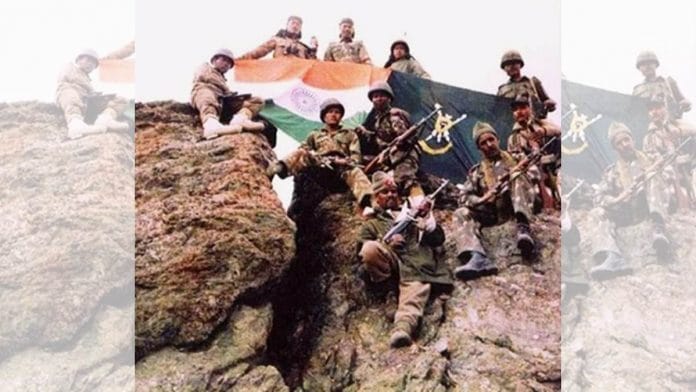
The Kargil war was entirely about territorial control. Pakistani forces had occupied areas on the Indian side of the Line of Control. Ahlawat is right that the political objective was eviction, not annexation. But that distinction does not diminish the centrality of territory. Victory lay in reversing Pakistan’s control over the occupied heights and restoring the territorial status quo.
The same conceptual problem runs through the treatment of the 1971 India-Pakistan war. Ahlawat states that the photograph of the surrender in Dhaka remains iconic precisely because it captured a political end-state, not because India captured Dhaka. This is a false choice because the two cannot be separated. The political end-state became possible because Pakistan had lost the ability to exercise military control over its eastern wing.
Land may not be the sole measure of success, but control of land remains the most consequential marker of military victory. It creates a physical condition that is difficult to dispute, reverse or narrate away. In the 1991 Gulf War, the US-led coalition conducted a devastating 38-day air campaign, but victory became tangible only when the ground offensive liberated Kuwait. In 2020, Azerbaijan’s use of drones drew close attention, yet the war over Nagorno-Karabakh ended only when Azerbaijani forces regained Shusha and other areas lost to Armenia in the 1990s.
Ukraine offers the starkest contemporary reminder. Drone warfare, long-range strikes, and extraordinary technological innovation are hallmarks of the Ukraine-Russia war, but the central question remains territorial. Success is measured in territory gained, or territory recaptured, and disagreements over how much loss of sovereign territory Kyiv is willing to accept remain central to any settlement.
Operation Sindoor needs to be viewed in this context. It was designed around the limited political objectives of destroying terrorist infrastructure and imposing costs on Pakistan. It would therefore make little sense to judge the operation by the yardstick of territory. However, it would be a serious error to turn the experience of Operation Sindoor into a vision of future war. Operations for punishment, deterrence or coercion are politically and militarily attractive and part of the repertoire of military options available to a state. But success in a deliberately limited operation does not necessarily tell us what will be required to prevail in war.
Also Read: India-China reset has limits. Don’t mistake it for a boundary settlement — see Taksing
India must prepare for prolonged wars
Seen in the context of his full speech, General Seth’s argument was broader than the single sentence on territory suggests. He warned that technology may shorten battles without necessarily shortening wars and spoke of conflicts becoming “wars with pause”. His larger point was therefore about preparing for wars that may be prolonged and difficult to terminate.
That argument has direct implications for capability building. How a country imagines future warfare eventually determines what kind of military it builds. Once future conflict is conceived primarily in terms of precision strikes, punishment and escalation management, force development will follow this trend. Doctrine, training and procurement will favour capabilities that support a limited conflict, even though the next war may impose very different demands.
Long-range targeting, drones, cyber and electronic warfare, and surveillance are all indispensable capabilities. The danger lies in allowing them to shape a concept of war in which the ability to generate effects from a distance is mistaken for the ability to impose a decisive outcome.
Given the budgetary pressure on a manpower-heavy Army, the argument for acquiring precision weapons instead of investing in land forces becomes easier to make. But over time, the less visible foundations of combat power essential for prolonged conflicts could weaken.
India’s principal military challenges along the western and northern borders are rooted in contested geography. It would be short-sighted to assume that future conflicts would remain limited. Political leaders may enter a crisis seeking calibrated objectives and controlled escalation, but the adversary also gets a vote. India can choose its political objectives, but it cannot unilaterally determine the duration, intensity and character of the conflict.
The most demanding test for the Indian military remains an extended continental conflict. This is not a remote or hypothetical contingency. India has fought major wars with China and Pakistan, and its most consequential risks lie along unsettled and heavily militarised borders. This is not an army-centric argument, nor a choice between traditional force structures and newer technologies. The real requirement is to build a joint force capable of prevailing when a limited confrontation expands, when coercion fails and the war becomes one of endurance and territorial control. This is the benchmark against which force structure, doctrine and capability development must be tested.
Lt Gen. D.S. Hooda (retd) is former General Officer Commanding-in-Chief of the Indian Army’s Northern Command and a senior fellow at the Delhi Policy Group. Views are personal.
(Edited by Asavari Singh)
Lack the knowledge to comment on such a scholarly column. Beyond agreeing that land is what India’s wars have always been all about. Most of it part of the diversified real estate holdings of Maharaja Hari Singh. Which is why I have been such a sceptic of Quad. Indo – Pacific. Net security provider. Blue water navy. Third aircraft carrier. Stick to the knitting. A developing country and a status quo power is already spending close to a hundred billion dollars on defence.