



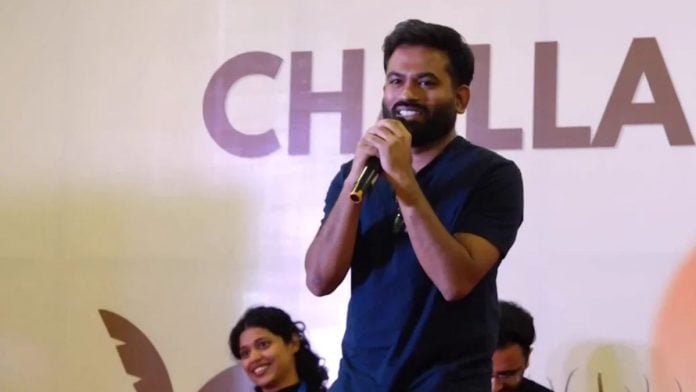
The large hall at Panjim Convention Centre in Goa was packed on Sunday evening. This is the kind of turnout you expect on the opening day of a heavily marketed Rs 4,000-crore film. But Sunday’s main attractions at the launch of the nationwide ‘Kya Bolti Public’ campaign were the national leadership of the Cockroach Janta Party.
Somewhere into the second hour of ‘Challa Kitem, Goa?’ (What’s happening, Goa), a “listening” platform that is part of the wider campaign, CJP founder Abhijeet Dipke turned to the matter of foreign funding. The accusation—of being bankrolled by Pakistan, or at least the US—has tailed the CJP since this summer, when the meme “party” outstripped the Bharatiya Janata Party’s own following on social media.
Dipke waved a hand around the hall and said, “Look at the chairs we are sitting on.” The gathered crowd erupted: partly because a revolution sponsored by our neighbours would at least have sprung for more than plastic seating, and partly because Dipke has always known exactly which of his lines will travel.
CJP’s comeback tour
It’s still remarkable what the CJP has been able to accomplish in just about six months. It was clear, when members of the ragtag coalition spilled out onto Jantar Mantar this summer, that they had lanced an abscess that had been building for years. The immediate trigger might have been anger over the NEET paper leaks, but the frustration and humiliation of a young and restless generation – contemptuously labelled “cockroaches” – ran much deeper.
Over the last few months, the CJP – with the help of several other political and non-political outfits – has been able to give that anger some much-needed validation. But after pulling off a historic victory, the resignation of former Union Education Minister Dharmendra Pradhan, the CJP’s other demands have been less than successful.
‘School Theek Karo’ movement, a well-meaning campaign to fix rural schools, has come and gone. In October, the movement turned its attention to the damage wrought by the Special Intensive Revision (SIR) of electoral rolls and demanded that Chief Election Commissioner Gyanesh Kumar step down. He is still in office, although two of CJP’s convenors have had stints at Tihar Jail. Once the CJP’s extended Diwali break began, its obituaries couldn’t have been far behind.
‘Kya Bolti Public’ is meant to be the CJP’s comeback tour. On this national campaign, a movement that encouraged a generation to talk back now proposes to sit down and take notes. These notes will eventually be compiled into a Youth Reform Charter. And Goa, which has entered the election season, is the first stop.
The tour will examine whether a movement built on viral moments has the patience to turn a country’s grievances into a single, meaningful argument. And whether it can persuade an adoring audience to stand with it through the slower, harder work of sustained mobilisation.
To the CJP’s credit, the evening hit several of the talking points that will matter to the Goan electorate in February. It also chose to spotlight Goan voices before the national leadership took to the stage. Activist Rama Kankonkar claimed that 90 per cent of the budget allocated for the development of tribal communities had remained unutilised. Jack Sukhija, councillor in the Corporation of the City of Panaji, spoke about the takeover of the capital by casinos, even as classrooms at premier institutions like Goa Engineering College didn’t even have fans. Architect Tallulah D’Silva focused on the hypocrisy of the state government organising sustainability conferences while its own practices were violently depleting the environment.
But the loudest cheers were reserved for architect and urban planner Tahir Noronha, a vocal critic of the detested Section 39A of the Goa Town and Country Planning Act. Noronha has spoken extensively against plot-level rezoning and land conversions in the state. He brought up the contested One Goa project in Karapur, which is being marketed as a mega township with a man-made beach and an artificial sea.
That was the opening Dipke needed to mount a direct attack on Goa Chief Minister Pramod Sawant, accusing him of selling Goa’s land and assets to his friends. At the height of the October agitation, Dipke pointed out, Sawant had suggested that protestors were “outsiders”, a word that has several unsavoury connotations in Goa.
“I just want to tell the CM, tukachi garaj na (we don’t need you),” Dipke said. “Who is an outsider? We are all Indians.”
He then went on to draw a through line connecting land, culture, migration, identity, and citizenship. This is an example of the kind of work CJP’s critics have accused it of avoiding.
“Aap vote chori ki baat karte hain, Goa mein toh MLA hi chori kar ke le gaye the (Forget vote chori, they stole MLAs in Goa),” Dipke said. He was referring to the 2017 state assembly elections when the BJP came to power with the help of defecting MLAs. Dipke also warned against the hero-worship of individuals – and the hall responded by applauding him.
Also read: India’s men have found new reasons to kill for honour—road rage to parking disputes
The missing action plan
Once the national leadership had spoken, the floor was opened to the public, the stated purpose of the entire exercise. Almost immediately, the gathering began to thin out. Dipke urged everyone to stay: This was why the CJP leadership was in Goa, to listen to the audience. But as far as most of CJP’s cheerleaders were concerned, the show was over.
That brisk exodus was most revealing. For months, the CJP’s energy has flowed in one direction – from its Instagram handle to the millions watching at home. ‘Kya Bolti Public’ is the movement’s first concerted attempt at reversing the current, with the public speaking and the leadership listening. Goa demonstrated how hard this will be, when you don’t have ready-made solutions to hand out.
This will be the challenge for CJP at every stop on its tour. Some of what was discussed on Sunday has national resonance: jobs, corruption, education and migration. Much else, like section 39A and casinos, will stay local. Collecting these complaints is the easy part. Uniting them on a campaign platform – even as a youth pressure group – will be the CJP’s real test.
Political researcher and columnist, Asim Ali, puts it more bluntly. “The CJP represents a failure of political articulation,” Ali wrote in The Telegraph. “By this, we mean the lack of will or ability on the part of its leadership to transform a widespread feeling of exclusion into a new political subjectivity.”
Ali compared the CJP to the student leaders of Bihar in 1974, who tied their own fury over unemployment and inflation to the grievances of backward-caste communities and farmers, until it presented as a coherent demand. Of course, the Bihar students had cadres and organisational strength behind them, something the CJP doesn’t have. The CJP insists it will remain a pressure group and not a political party, but even pressure needs leverage in the form of bodies on streets.
Dipke, who cut his teeth working with the Aam Aadmi Party, should know this. The public is already noticing.
In a sea of adulatory messages, a comment on one of his posts stood out: “Clarity of purpose matters most for any movement. Right now, it is unclear whether CJP’s main focus is ‘School Thik Karo’, the Gyanesh Kumar agitation, or expanding the Cockroach Club. Which of these is CJP’s true number-one priority, and how does it directly address what India needs most urgently right now? A clear roadmap will help everyone stand behind the right cause.”
As of now, the right cause is whatever the audience tells the CJP. A public waiting to be led and a leadership waiting to be told are in good company. But eventually, someone will have to draw that roadmap.
This article is part of the Goa Life series, which explores the new and the old of Goan culture.
Karanjeet Kaur is a journalist and a partner at TWO Design. She tweets @Kaju_Katri. Views are personal.
(Edited by Ratan Priya)