





There is a story found in the Puranas. An erstwhile Raja enjoyed listening to poetry, but with a catch. He would give the court poet a few words every morning, and the poet would spew out verse using those self-same words and be rewarded with gold coins. But courtiers, envious of the Raja’s fascination with the poet, decided to follow him to see his modus operandi. They were rather surprised to find him going from house to house like a mendicant, seeking alms. When questioned about what happened to his earnings, he said that the person who gives the words is the one who deserves the credit for the poetry, and therefore the earnings belong to the “prompter”.
Much like the person who gives the prompts to AI.
This was an interesting dilemma that was brought to my attention during a legal discussion. I was approached by a client to take up a brief involving music licences, ownership of copyright, and copyright infringement. During a heated discussion over AI, a hypothetical scenario was presented to me. A musician creates a song using ChatGPT by providing certain prompts. She then sets it to music and releases the ‘original’ song, which goes on to become a superhit. The song in question sets the musician onto a path to superstardom, and she generates a hefty income through live performances, sales on streaming platforms, collaborations, and more.
The question that came up was this: does AI or OpenAI have a share in the proceeds, earnings, or income so generated? To what extent can AI claim a percentage of the profits generated from the performances of this piece of music? This question can also be extended to royalties from books that have used AI for inspiration, brainstorming ideas, and plotting out the storyline.
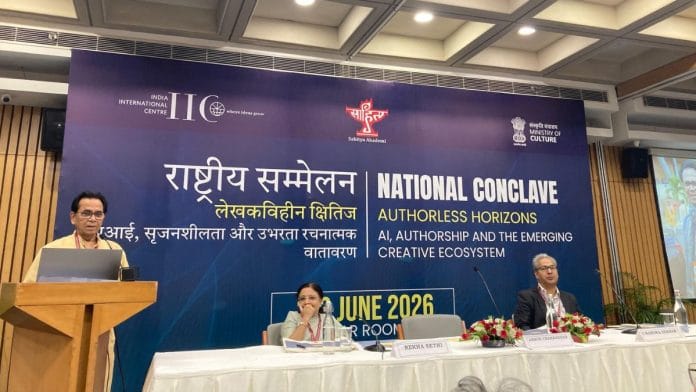
It raises a larger debate around authorship, ownership, and ethics, and was one of the issues discussed at the recently concluded national conclave, ‘Authorless Horizons: AI, Authorship, and the Emerging Creative Ecosystem’, at the India International Centre, New Delhi.
Also Read: From summer camps to ISRO missions—Indian women are leading STEM
Ethics and ownership of AI-generated content
At a conclave session titled ‘Authorship, Ownership and Ethics: Legal Challenges in the Age of AI’, authors of eminence, scholars, and academicians came together to engage in discourse on the numerous ethical and moral dilemmas that will arise as dependency on AI and its tools increases.
I read a lot on AI, and found that the session raised many pertinent and thought-provoking questions, with engaging discussions.
Academicians debate whether there are foolproof ways to analyse AI-generated work and flag it as such. Some college professors argue that students’ work, such as research papers and dissertations, should be pushed through AI-detection software such as Turnitin. If AI use is detected, then the student has to deal with the consequences, including, but not limited to, suspension, academic probation, an F grade, and, in the harshest cases, expulsion.
But students are resilient and innovative, and technology often fails to keep up with the ingenuity of young minds.
Many Western universities have adopted the policy, “If you can’t lick ’em, join ’em”, realising the futility of battling the onslaught of the AI tsunami. Rather, they are no longer penalising students for using large language models such as Anthropic’s Claude, OpenAI’s ChatGPT, or Perplexity AI for completing their assignments and academic work. The truth is that there really is no foolproof way to conclusively detect whether academic, literary, or written work is AI-generated.
There have been different outcomes in the case of legal challenges.
In February, a PhD student at Adelphi University successfully challenged his expulsion from the university on the charges of plagiarism by using AI on an assignment. Turnitin had flagged the student’s work as AI-generated, whereas two other AI-detection tools had decreed the work human-written.
Last year, a student of the University of Minnesota also filed a lawsuit against professors who accused him of using ChatGPT on a written exam, stating that the expulsion process was riddled with “procedural flaws, reliance on altered evidence, and denial of adequate notice and opportunity to respond.” However, in this case, the court upheld the university’s decision.
In India too, the University Grants Commission has tightened rules around plagiarism and the use of AI tools in doctoral research, with penalties for unoriginal work and greater responsibility on supervisors. But this is not a straightforward matter. PhD theses and research papers are often put up on public servers so that other scholars can access them. That very openness also makes them vulnerable to being mined by AI, without clear consent or credit.
Can AI-generated content truly be identified?
Linguists often claim that it is easy to identify literary work that has been produced with the help of large language models, such as ChatGPT. The prestigious Commonwealth Short Story Prize this year was riddled with unseemly allegations that three of the five regional winners may have had their origins in LLMs.
The story that generated the most debate was ‘The Serpent in the Grove’, the Caribbean regional winner by Jamir Nazir. The AI-detecting software Pangram Labs reportedly marked the story as 100 per cent AI-generated, though the author denied using AI. Several writers and readers pointed to “obvious markers” and “syntactical tics”, which are supposedly dead giveaways of AI usage.
But what are these “obvious” signs of AI use? I express a fondness for the term “leverage”, which I use quite often in my writing, and was shocked to learn that this is a word that apparently screams “AI-generated”. An MIT Technology Review article stated that excessive use of AI, and text without typos, are also common signs that the copy has not been written by a human. Looks like I need to stop using the spellcheck feature of my word processor to ensure that my work is not flagged by AI-detection software.
The publisher of controversial Commonwealth Prize story, meanwhile, says “perhaps we never will know” in respect to the “true authorship” of the said work.
In an era where every action of a public, or not-so-public, persona faces intense scrutiny from the online community, it is a fine tightrope that an author of any form of literary work must walk. The publisher Hachette recently pulled a horror novel on allegations of extensive AI use. Around 1,800 copies had been sold in the UK, and the book was set for its US release when readers flagged the author’s work as “ChatGPT-generated slop”.
It is worth recollecting that in India, Panini’s Ashtadhyayi set out the science of Sanskrit grammar in nearly 4,000 sutras with astonishing precision, long before modern machines began to process and produce language. It would be a pity if this intellectual inheritance were ceded entirely to AI.
Not just in India but across the globe, a total reliance on AI “slop” can become a slippery slope. Thus, adequate attention must be given to indigenisation, employment, upskilling, and the dumbing-down effect that such reliance can have on the general population.
AI-generated creative licence
For those of us who use Microsoft Word to type out our thoughts, we are often confused by a prompt that appears: “Rewrite with Copilot?”
For someone who’s never really been technically challenged, it is harder now to navigate the vagaries of the word processor. At what stage does the simple spellcheck and grammar check that one conducts on a document at the conclusion of the writing session get replaced by the prompt “Rewrite with Copilot”?
As a legal professional, does taking assistance from MS Copilot to improve syntax and sentence structure constitute a major deviation from the use of the thesaurus feature, or the spelling and grammar check feature of MS Word? At what point does it step into the legal quagmire of copyright or AI-generated creative licence?
A legal quagmire
The increased proliferation of AI in the creative field raises several legal and ethical questions, such as who owns AI-generated content, whether copyrighted material can be used to train AI systems without permission, and if users should be allowed to ask AI to imitate the work of specific creators or brands without their approval.
Cases have been filed in the US, such as Andersen v Stability AI et al, where AI platforms are being sued for using artists’ copyrighted works to generate new content sufficiently different from the original works, but still trained on them to replicate their style and form. These would obviously result in “unauthorised derivative works”.
Today, original content by public personalities, including speeches, articles, and published works available in the public domain, can be replicated with alarming ease by AI.
There have also been instances where AI-generated images have been used in lieu of real photographs of actors, politicians, and even everyday citizens. Everything from dressing style to a smile can be closely mimicked. Where AI often goes wrong, however, is in the eyes, which remain the window to consciousness. Nevertheless, deepfakes, though made by a machine, can actively harm real lives. This is why many celebrities have approached courts for protection of their digital identity.
It should be noted that when AI is used to create a fake image or voice in a person’s name, it can become more than a copyright problem. Where such content is used to deceive others by falsely assuming another person’s identity, it may attract criminal liability under Indian law.
Also Read: Central Vista to Gymkhana Club — Delhi must improve liveability for all, not just elites
Indian Copyright Act 1957 in the AI Age
Whether the Indian Copyright Act 1957 has been able to keep up with today’s AI environment is a topic for a follow-up article and an in-depth legal study. However, it does not specifically address ownership of content generated entirely by the brains of artificial intelligence.
Copyright protection in India is generally premised upon authorship by a human hand, and the Act recognises authors as natural persons who create original literary, musical, or dramatic work. As a consequence, purely AI-generated content faces dubious ambiguity regarding copyright protection and ownership. If a human exercises substantial creative input in prompting, selecting, editing, or even arranging AI-generated material, then copyright can subsist in the human-created elements — Section 2(d)(vi) of the Copyright Act treats the author of a computer-generated work as the person who causes the work to be created, though it does not factor in AI.
The legal framework in India needs to evolve to face such challenging questions arising from the permeation and penetration of AI into human society. The reproduction and storage of copyrighted works for training could possibly attract scrutiny under Section 51 of the Copyright Act, which sets out the specific actions that constitute copyright infringement. Questions could also arise as to whether AI-generated content is a transformative creation or an impermissible reproduction of existing works. It’s an important question for Indian lawmakers.
Meenakshi Lekhi is a BJP leader, lawyer, and social activist. She previously chaired the Joint Parliamentary Committee that examined the Personal Data Protection Bill, 2019. Her X handle is @M_Lekhi. Views are personal.