




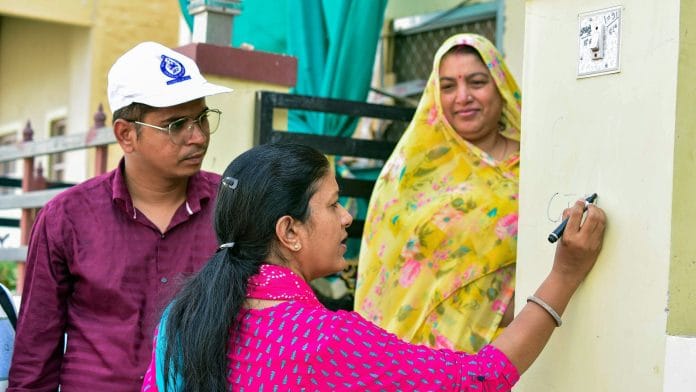

The government has notified the questions that will be asked of every individual during the second phase of the Census 2027. Many of these questions were never part of such an exercise. The particulars of the parents, spouse, and permanent address. A question on nationality that was not asked after the 1961 census has made a comeback.
United Nations defines a population census as, “the total process of planning, collecting, processing, analysing, disseminating and evaluating demographic, economic and social data at the smallest geographic level pertaining, at a specified time, to all persons in a country or in a well-delimited part of a country”. It is clear from this definition that the census is viewed as an activity to collect statistics about the population.
Now, take a look at the questions asked to every individual during the collection of data for the National Population Register in 2011.
- Name
- Name of the person as should appear in the NPR
- Relationship to head (of household)
- Sex
- Date of birth
- Marital status
- Educational qualification
- Occupation/Activity
- Names of father, mother and spouse
- Place of birth
- Nationality as declared
- Present address of usual residence
- Duration of stay at the present address
- Permanent residential address
All these, except numbers 2 and 12, are present in the census questions for 2027. Questions on name, relationship to head, sex, date of birth, marital status, educational qualification occupation, place of birth and duration of stay at the present address were present in the previous censuses and were used for generating various tables. Questions on name of the spouse and particulars of the parents as well as permanent address have never been collected in the census and are not useful for generating any statistics.
The government is also asking people for their mobile numbers, Aadhaar numbers, voter ID numbers and details of passports. Names, addresses and these numbers are of little use in any statistical exercise unless they are being used to tabulate data on names themselves, perhaps to find out how many people have a particular name or surname. One cannot, by any stretch of the imagination, envisage such a use in India. On the other hand, this information would be useful for creating a population database that links an individual’s mobile number, Aadhaar biometrics, voter registration and passport details.
It appears that the government is planning to use the data collected to update the National Population Register prepared in 2011 or prepare it afresh.
During the preparations for the 2021 census, which eventually did not take place, there were discussions about collecting information for NPR during the census. Some state governments had objected to the plan. As per the Census Act, the state governments appoint the staff for conducting the census including enumerators, supervisors, charge officers and district census officers. However, there is no provision in the Citizenship Act or the Census Act requiring the state governments to appoint staff for collecting information for preparing/updating NPR. Hence, the states have every right to refuse the use of the staff appointed for the census for NPR-related activities.
Can the data collected under the Census Act 1948 be shared with another organisation under the government to prepare/update the NPR?
Also read: A day in the life of a Delhi census worker. Houselisting survey with thick skin & patience
Potential for legal complications
India has adopted the United Nations Fundamental Principles of Official Statistics. Principle 6 states, “the Individual data collected by statistical agencies for statistical compilation, whether they refer to natural or legal persons, are to be strictly confidential and used exclusively for statistical purposes.”
So, if we accept the United Nations’ definition of a census and keep the above principle of confidentiality in mind, sharing individual information may not be acceptable. The Registrar General of India, appointed under the Registration of Births and Deaths Act, 1969, is also the ex-officio Registrar General of Citizen Registration, who is in charge of the NPR. He has also been appointed as the Census Commissioner. However, this does not automatically allow the sharing of data between the two government bodies.
Under Section 11 (1)(b) of the Census Act, any census officer who, without the previous sanction of the central government or the state government, discloses any information which he has received by means of, or for the purposes of, a census return, is punishable. If the phrase ‘without the previous sanction of the Central or the State Government’ is being interpreted as indicating that the Central Government can sanction the sharing of information from census schedules, then even if it is legally a correct position, it will go against all ethical considerations and the fundamental principles of official statistics.
Section 15 of the Census Act clearly says that the census records can not be used as evidence in any court. The entries in NPR, however, may have to be used as evidence. More precisely, the National Register of Citizens (NRC) is a list prepared under the law and may be used for issuing citizenship certificates. If the NRC is therefore based on information (taken during the census) that can not be produced as evidence in court, there may be unnecessary legal complications.
The author retired as Deputy Director General of the National Sample Survey Organisation from the Indian Statistical Service. Views are personal.
(Edited by Ratan Priya)
While the legal distinction between the Census Act, 1948 and the Citizenship Rules, 2003 (which govern the NPR) is a genuine statutory reality, opinion columns like these frequently use those precise legal nuances as political leverage.
By framing administrative changes as potential legal or international violations, bloggers advance a specific political critique while grounding it in the language of administrative lecturing.
Great job. It is actually an opportunity for true citizens and legally residing foreigners.