



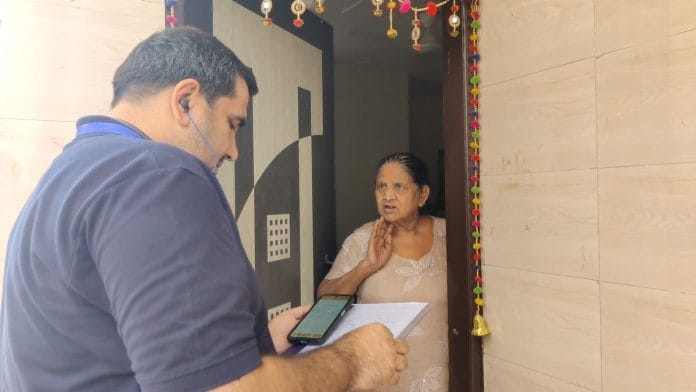
New Delhi: In 45-degree summer heat, Deepak Kumar’s face turns red and sweaty as he huffs his way up a steep staircase to a modest builder-floor apartment in Northwest Delhi’s Rohini area. He rings the bell and leans against the railing, waiting. After a while, he rings it again. An elderly woman cracks the door open, looking quizzically at him.
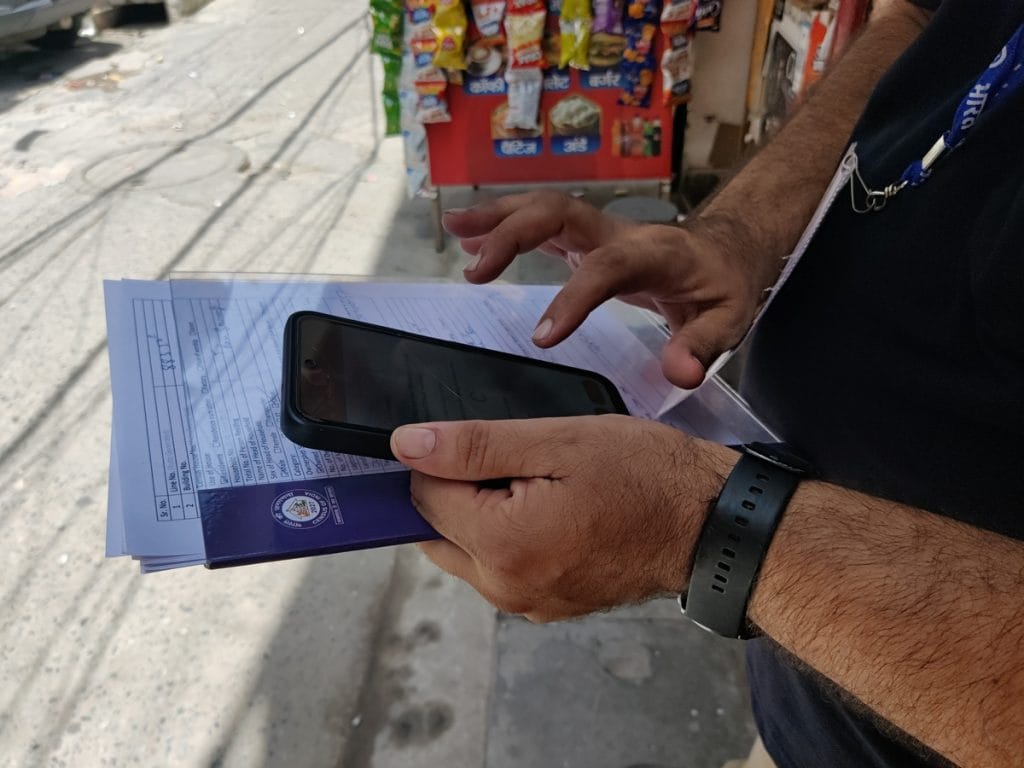
“I’m here for the census,” he says, holding up the ID card hanging from a blue lanyard and a slim folder with various papers for the Houselisting and Housing Census. Still standing on the threshold, he looks down at his Android phone—his main survey tool—and starts asking questions.
First are the simple ones—how many people live in the house, whether there is internet access, name of the head of household. Then comes a peculiarly granular one.
“What is the main cereal consumed by the household?” he asks.
The woman looks puzzled.
“Matlab?”
“Wheat or rice?”
“Arre, jo ghar pe banta hai,” she laughs—whatever is made at home.
After a brief back-and-forth, Kumar enters ‘wheat’ into his phone. It is just one of 33 questions he must ask at every single household as part of Delhi’s houselisting exercise for Census 2027.
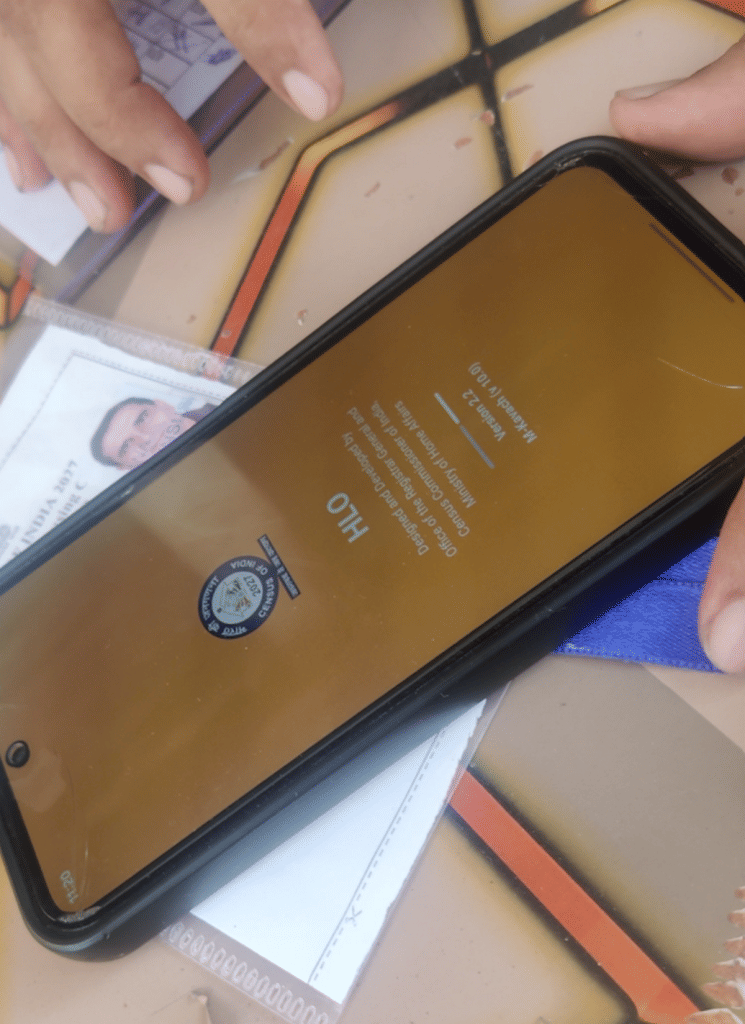
Kumar is one of 50,000 enumerators deployed across Delhi for India’s first fully digital census operation. The month-long drive covers nearly 46,000 blocks across MCD wards, with officials visiting an estimated 33 lakh households to map every structure and record housing conditions, amenities, and assets through a mobile application.
The survey now asks everything from type of latrine and cooking fuel to smartphones in the household. It also classifies the head of the household as Scheduled Caste, Scheduled Tribe or Other — an older category newly loaded by years of wrangling over a caste count. The exercise forms the foundation for the population census that will follow, including the politically contentious caste enumeration that has dominated public debate in recent years.
We do it happily because somewhere it feels like serving the country. Whether it was during COVID or now with the census, teachers are always part of ground-level government work, and we take that responsibility seriously
-Deepak Kumar, census enumerator and teacher
Census operations this year are delayed by six years. The last exercise was conducted in 2011, and experts have criticised the delay for creating a data vacuum in government planning and welfare delivery.
Kumar, a social science teacher in his mid-40s at Sarvodaya Vidyalaya in Rohini’s Avantika, was on census duty in 2011 too. His wife, also a teacher, is taking part in the exercise as well. Enumerators like him have not been given separate devices, so he records every answer diligently into his own smartphone.
Officials say digitisation has made collection and verification easier than in previous census rounds. But though there’s less paperwork baggage, the work is still house-to-house, staircase-by-staircase.

For Kumar, the task is an essential civic duty for a greater cause. The data he records will help the government track detailed indicators of living standards. But it also comes with uncertainty and hard labour. He remains unsure about the promised Rs 25,000 incentive and additional leave days, with no clear confirmation on payment timelines. There’s also a weighty legal responsibility. Under the Census Act, negligence or knowingly recording false information can attract penalties of up to three years’ imprisonment.
The exercise, which began in mid-May, is now in its final stretch ahead of the June 15 deadline. The days are long, the heat is relentless, and locked homes mean repeat visits, often early in the morning, late in the evening, or on Sundays when residents are more likely to be home.
The experience varies from door to door. Occasionally, people invite him in and offer water. More often, the conversation takes place at a partially opened door. Some dismiss the questions as unnecessary. Others ask how the information will be used. A few shut the door with a curt “come later”. Elderly residents sometimes struggle with questions about internet access and digital devices. In market areas, a single building can contain multiple shops and flats, which means that one address turns into an hours-long slog.
Through it all, Kumar remains committed to the integrity of the exercise. Every locked door must be revisited. Every household must be accounted for. Every answer, however mundane, becomes part of a larger statistical portrait of the country.
“Even during summer holidays, teachers are doing this work. We do it happily because somewhere it feels like serving the country,” he said. “Whether it was during COVID or now with the census, teachers are always part of ground-level government work, and we take that responsibility seriously.”
Also Read: Delhi guest teachers say they’re ‘bullied’ into census duty. ‘Principal, DM all pressuring us’
Mapping the neighbourhood
Before Kumar could knock on a single door, he had to draw a map of his mission targets. For the first three days of the exercise, he walked every lane of his assigned block in Rohini, identifying buildings, marking routes, and matching the physical reality on the ground with official maps.
“What we get is not a list of houses,” he said, pulling up the Houselisting Operations (HLO) map on his phone. “We are given a defined area. Every structure inside that area becomes our responsibility.”
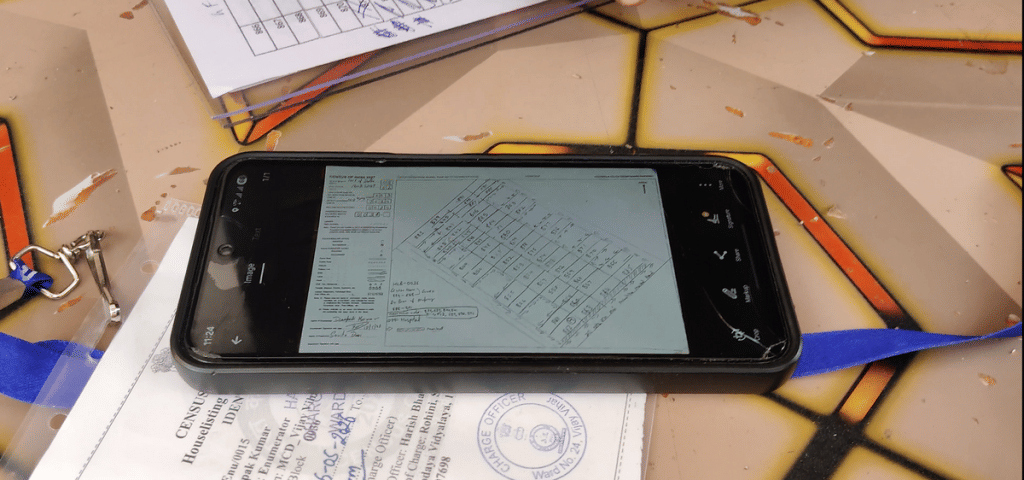
The process, known as ground-truthing, forms the backbone of the houselisting exercise. Enumerators must identify every building—whether it is residential, commercial, or mixed-use—and update the digital map accordingly. The precision of these maps will help guide the population enumeration that follows in 2027.
Complications are par for the course. In many parts of Rohini, a building that appears to be a single structure from the street can contain multiple shops, several rented rooms and additional floors added over the years. A building that looks like one entry on the map can eventually become five or six separate census records.
“Sometimes a person has added an extra floor. Sometimes there is a room on the terrace rented out to someone else,” Kumar said. “Until we complete everything, we don’t know exactly how many households there are.”
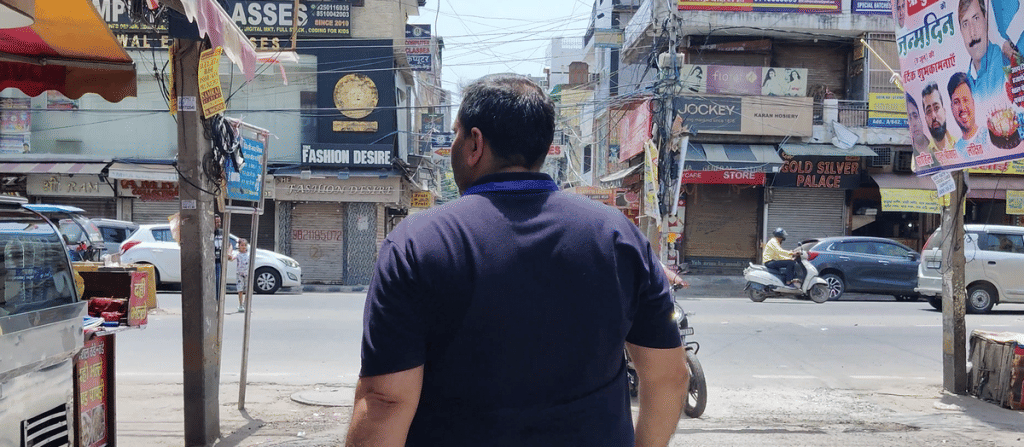
His current assignment contains 53 primary structures. By the time shops, tenants, additional floors, and rooftop rooms are counted, he estimates the final figure could reach 150 to 200 households.
Kumar usually parks his car inside the block and sets off on foot. The block is a raggle-taggle, lower-middle-class pocket of Rohini, with cramped lanes lined with shops below and homes above. Most residents either run small businesses or work private jobs, according to him. By now, he is a familiar face in the lanes, with shopkeepers and residents greeting him along the way.
This time it is much simpler. Earlier we would go crazy managing so many pages and documents
-Deepak Kumar
Once a building is identified and data about it noted, it is assigned a census number generated through the mobile app. Shops and commercial establishments are listed too, but separately. They are not required to answer the full set of household questions, but must still be pinned to the grid.
“This way, when we return for the actual census, we know exactly what is where,” Kumar said.
Lighter and faster
Having participated in the 2011 census, this round is a much lighter load for Kumar. Back then, he had to lug around stacks of forms, registers, and files, unlike now.
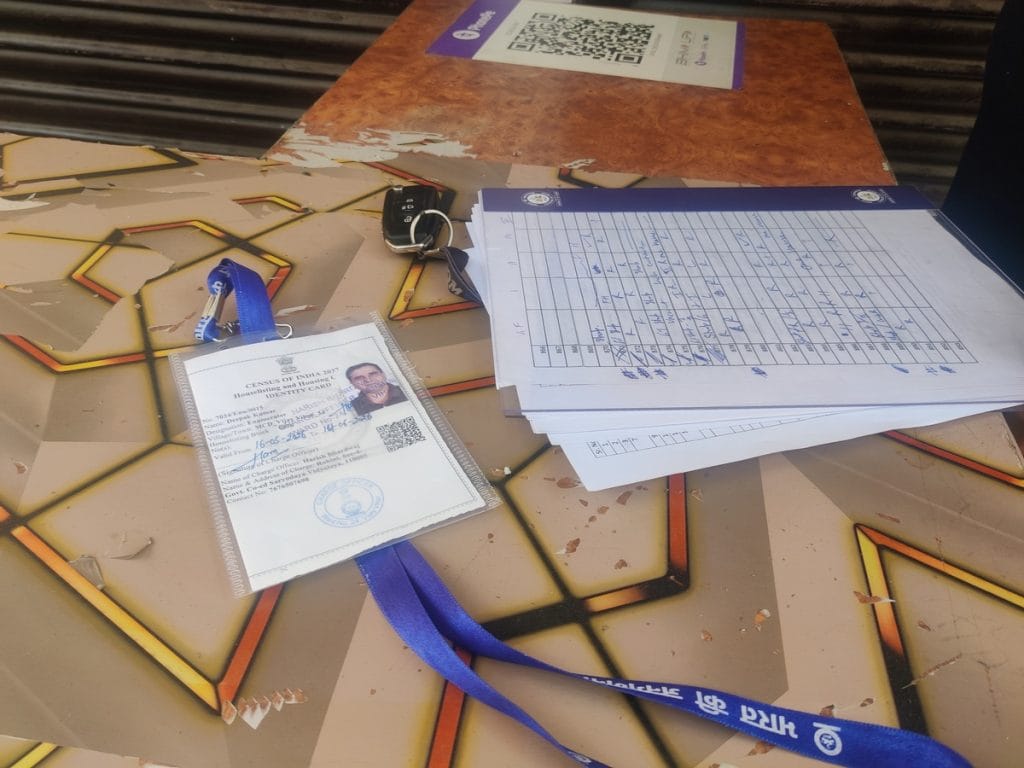
“This time it is much simpler,” he said. “Earlier we would go crazy managing so many pages and documents.” All Kumar carries in his folder now is a backup list of homes and floors in his assigned block.
The Census 2027 HLO app has replaced most of that paperwork. Every completed survey appears instantly in a summary dashboard on his phone. Once Kumar verifies the information, he syncs it to the central database. The app automatically generates census house numbers and tracks progress across his assigned area.
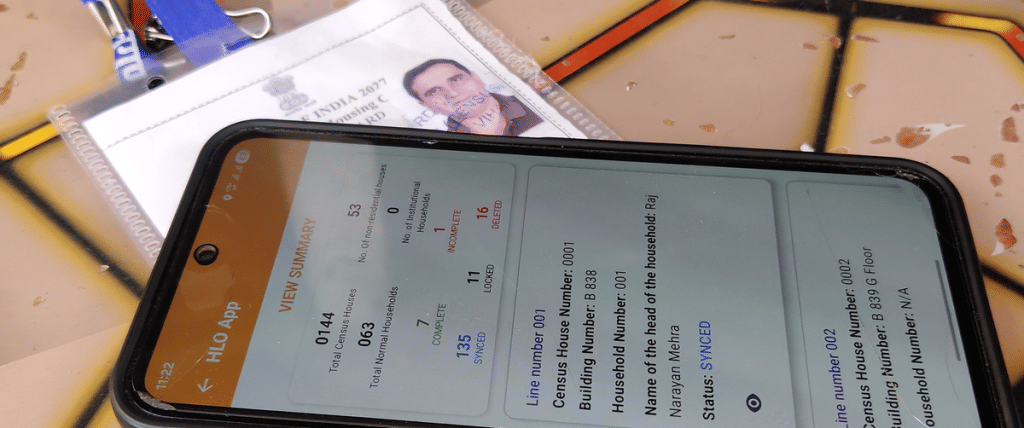
For the first time, residents were also allowed to self-enumerate online before field visits began.
Kumar said the feature is useful — when people actually use it.
“On my phone it shows 21 self-enumerated households, but only four have given me their code so far,” he added.
For those digital-savvy households, Kumar’s verification process takes barely a minute. The reality, however, is that he has to meet residents to get the job done. Many have never heard of self-enumeration. Others are unsure how it works. As a result, the high-tech census still relies heavily on a decades-old tradition: a person knocking on a door.
33 questions and endless patience
The questionnaire itself compels Kumar to interrogate nearly every aspect of domestic life. Some data points he can observe himself. The floor is tiled. The walls are concrete. The roof is permanent. Other questions don’t always have straight answers and require careful probing.
A question about ownership can lead to a ten-minute explanation about migration, inheritance, and family disputes before Kumar finally figures out whether the house is rented or owned.
Few answers come in a simple “yes” or “no”.
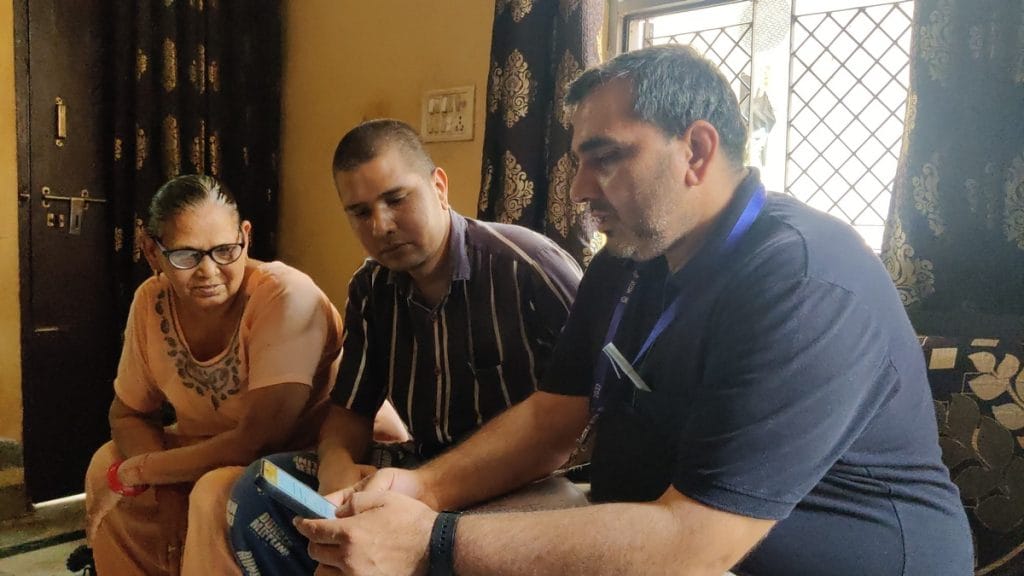
One resident begins narrating how he arrived in Delhi 20 years ago from Uttar Pradesh. Another explains the history of the building before eventually revealing that the upper floor is rented out.
“The answer is somewhere inside the story,” Kumar said with a smile. He listens, nods, lets people finish their long explanations, and then gently steers them back to the form. He slips in small jokes and remarks to make residents comfortable before returning to the question at hand.
In his allotted area, most working-age adults leave home early and return late, so census visits are often conducted with elderly parents or homemakers.
They ask us a lot of questions too. Why should we give our data? What will the government do with it?
-Deepak Kumar
“Most of the time it is older women who open the door,” Kumar said, adding that many of them are not sure of answers about internet access, smartphones, or tenants living upstairs. “Sometimes they tell us, ‘Come back when my children are home, they know all this’.”
Most questions are neutral ones about household size, drinking water, electricity, sanitation, cooking fuel, vehicles and so on. But at times, things can get a little tense when Kumar asks whether the head of the household belongs to Scheduled Caste, Scheduled Tribe, or Other category. In Census 2027, this will lay the groundwork for the broader caste enumeration during the population census phase.
Most people answer without hesitation. Others want to know why the information is needed.
“They ask us a lot of questions too,” Kumar said. “Why should we give our data? What will the government do with it?”
He gives them all the same answer.
“I tell them this information helps the government understand what people need over the next ten years,” he said.
Eventually, most cooperate.
Also Read: Delhi’s firefighters under strain. City has only 71 stations, 1,030 vacancies, old equipment
A greater purpose
If patience is the primary requirement for the census, persistence is a close second. A massive chunk of Kumar’s day is spent revisiting addresses where he has already knocked.
He times his visits for early mornings and after office hours, when residents are more likely to be home, but even that is no guarantee of completing the mandate. During the summer break, he is racing to fill in details for houses he could not complete earlier.
Sometimes the residents are at the office. Sometimes they are asleep. Often, the door is cracked open by children on summer break or elderly citizens in no mood to talk after being woken from an afternoon nap. And sometimes nobody opens the door at all. Those houses are marked as locked and revisited repeatedly until their status can be confirmed.
“I have to check whether someone has moved in, whether the house is vacant, or whether they are simply away,” Kumar said.
Kumar’s phone buzzes constantly through the afternoon. One call is from a supervisor asking how many households are left, another a reminder to sync and file the data. Between visits he checks a ward-wide WhatsApp group where enumerators are posting updates on their surveys. Kumar has been responding with the same explanation he has been repeating all day: several homes needed to be revisited one final time.
“These are ways to create pressure,” Kumar said matter-of-factly. “The deadline is near.”
He is yet to receive any compensation, but that does not stop him from setting out each day with fresh resolve. He says the fieldwork is still easier for him than for many female enumerators. Some are accompanied by husbands, fathers or other male relatives during door-to-door visits; others work in pairs for safety. To minimise time spent moving through unfamiliar neighbourhoods, many complete their household visits quickly and enter the data into the app later.
A thick skin is an unspoken requirement too. Kumar said the work can sometimes feel “humiliating”. There are days when doors are shut in his face, when residents question why he is asking about their household, or when he has to return to the same address three or four times before finding someone home.
What keeps Kumar going is his conviction that the census only works if every household is counted. By evening, he is still moving through the lanes of Rohini, phone in hand, checking off addresses one by one. No home can be left out. It is a national service, even if it is laborious and comes across as pesky.
Most residents will forget the interaction within days. The data, however, will remain for years. And for Kumar, that is reason enough to keep climbing the next staircase.
(Edited by Asavari Singh)
good report