



The Platinum Jubilee of the Bodo Sahitya Sabha is far more than the commemoration of an institution completing 75 years of existence. It is a celebration of an extraordinary civilisational journey—a testament to the resilience of a language, the intellectual awakening of a people, the preservation of an indigenous heritage and the enduring human aspiration for dignity, recognition and self-expression.
It is an occasion to reflect upon the historical odyssey of one of the oldest indigenous linguistic communities of Northeast India. The community’s language, cultural traditions and collective consciousness have endured through successive generations, historical transitions and sociopolitical transformations.
For the Bodo people, language is the living repository of collective memory, the custodian of ancestral wisdom, the embodiment of cultural consciousness and the spiritual continuum connecting the past, the present and the future. The establishment of the Bodo Sahitya Sabha on 16 November 1952, at Basugaon, therefore represented a defining moment in the modern history of the Bodo people.
It transformed a dispersed aspiration for linguistic preservation and recognition into an organised intellectual and literary movement and provided an institutional foundation for the systematic cultivation of the Bodo language, the enrichment of its literature and cultural elements, and the advancement of mother-tongue education.
Roots of language and civilisation
Bodo belongs to the Tibeto-Burman branch of the Chinese-Tibetan language family and constitutes an important linguistic heritage of the Brahmaputra Valley and the wider Northeast Indian region.
Long before the emergence of modern literary institutions and printing technology, Bodo society possessed an extensive and vibrant oral literary heritage. Folk narratives, Bathou prayers, Bwisagu songs, legends, proverbs, riddles, folktales, traditional performances and indigenous
knowledge systems served as vital instruments of intergenerational transmission.
The early 20th century witnessed a significant intellectual awakening among educated young people of the Bodo community. The establishment of the Bodo Chatra Sanmilani in 1919 reflected the community’s growing consciousness regarding education, social reform, linguistic identity and collective advancement and marked the awakening of a broader historical transformation.
The dawn of modern Bodo literature
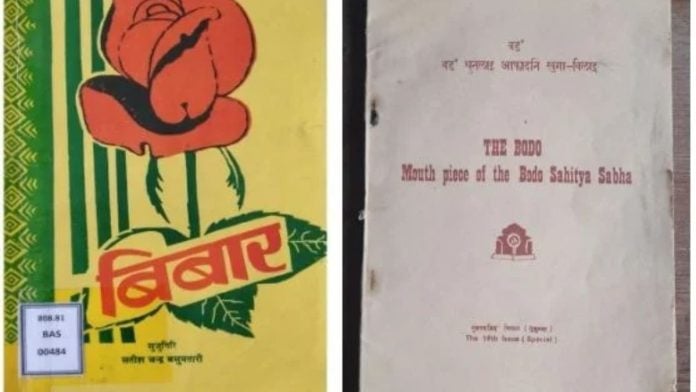
The evolution of modern Bodo literature cannot be adequately understood without acknowledging the formative contributions of the Bodo-language magazines Bibar and Alongbar. The publication of Bibar in 1924 constituted a landmark in the emergence of modern written Bodo literature. It provided an important literary platform for aspiring writers, intellectuals and socially conscious individuals to articulate their thoughts in their mother tongue and stimulate critical engagement with questions of social reform, education, cultural identity and community advancement.
Subsequently, the publication of Alongbar in 1938 marked another significant milestone in the expansion of Bodo literary expression. Among the pioneering personalities associated with this literary awakening were Modaram Brahma, Satish Chandra Basumatary, Rupnath Brahma, Ishan Chandra Muchahary and Pramad Chandra Brahma, among others.
The establishment of the Bodo Sahitya Sabha on 16 November 1952 was one of the most consequential developments in the modern history of the Bodo community. The historic gathering at Basugaon brought together visionary individuals who recognised that the preservation and advancement of the Bodo language required a dedicated, organised and enduring literary institution.
Late Jaybhadra Hagjer became the first President, while late Sonaram Thaosen assumed the responsibility of the first General Secretary. Poet and dramatist Satish Chandra Basumatary also made important contributions to the formation and early organisational development of the Sabha.
Through sustained endeavours, the Bodo Sahitya Sabha emerged as the principal literary institution representing the linguistic and literary
aspirations of the Bodo-speaking population and ushered in a period of institutional renaissance.
Among the most enduring contributions of the Bodo Sahitya Sabha was its determined struggle for the introduction and expansion of mother-tongue education.
A historic breakthrough was finally achieved on 18 May 1963, when the then Chief Minister of Assam, Bimala Prasad Chaliha, introduced Bodo as a medium of instruction at the lower-primary level in selected Bodo-dominated areas. In 1968, Bodo was extended as a medium of instruction to the secondary level, creating new possibilities for students to pursue formal education through their mother tongue.
The script movement
During the 19th and early 20th centuries, Bodo was written using different scripts, including Roman, Assamese and Bengali. With the expansion of formal education and literary activities, the question of adopting a common and standardised writing system acquired increasing importance.
The Bodo Sahitya Sabha undertook extensive deliberations to determine an appropriate script capable of sustaining the long-term development of the language. During the late 1960s and early 1970s, the Roman script emerged as an important demand among certain sections, with the introduction of the Roman-script primary school textbook Bithorai in 1974 further intensifying the debate.
What followed was a period of agitation, confrontation and profound sacrifice. The script movement of 1974-75 occupies an indelible place in the collective historical consciousness of the Bodo people. Following discussions with the government of India and the intervention of Indira Gandhi, the Devanagari script was accepted by the Bodo Sahitya Sabha at its 16th annual conference held at Dhing on 25 April 1975. This decision established Devanagari as the standard script for the formal development of Bodo education and literature.
Constitutional recognition
The transformation of Bodo from a regional indigenous language into one of India’s constitutionally recognised languages represents an extraordinary chapter in the democratic history of linguistic recognition. A significant milestone was achieved in 1985, when the Assam Official Language (Amendment) Act provided for the use of Bodo as an Associate Official Language for specified official purposes in areas having a substantial Bodo population.
The most consequential constitutional achievement came in December 2003, when Bodo was included in the Eighth Schedule of the Constitution of India through the 92nd Constitutional Amendment Act, 2003. This recognition brought the Bodo language into the broader constitutional framework of India’s linguistic plurality.
Emergence of Bodo intellectual scholarship
Over the decades, Bodo literature has witnessed a remarkable expansion in both its thematic breadth and literary sophistication. Poetry, novels, short stories, drama, literary criticism, children’s literature, folklore, translation, research publications and academic discourse have progressively enriched its literary universe.
The development of standardised orthography, grammar, dictionaries, scientific terminology and literary journals has strengthened the language’s
expressive capacity and its ability to engage with contemporary intellectual developments.
National literary recognition has further enhanced the visibility of Bodo literature.
The Sahitya Akademi began recognising Bodo literature through its annual awards in 2005. Since then, several Bodo writers have received this prestigious national distinction for their literary contributions.
Among the recognised writers are (2005) Mangal Singh Hazowary, (2006) Katindra Swargiary, (2007) Janil Kumar Brahma, (2008) Bidyasagar Narzary, (2009) Manoranjan Lahary, (2010) Aurobindo Uzir, (2011) Premananda Mosahary, (2012) Guneswar Musahary, (2013) Anil Kumar Boro, (2014) Urkhao Gwra Brahma, (2015) Brajendra Kumar Brahma, (2016) Anjali Narzary, (2017) Rita Boro, (2018) Rituraj Basumatary, (2019) Phukan Chandra Basumatary, (2020) Dharanidhar Owari, (2021) Mwdai Gahai, (2022) Rashmi Choudhury, (2023) Nandeswar Daimari, (2024) Aron Raja and (2025) Sahaisuli Brahma.
The conferment of the Padma Shri upon Mangal Singh Hazowary in 2021 and Professor Anil Kumar Boro in 2025 constituted another moment of immense pride for the Bodo literary fraternity. Their contributions have helped bring the intellectual and cultural heritage of the community to wider national and international attention.
Contemporary challenges
The future trajectory of development of the Bodo language must be founded upon a comprehensive and forward-looking intellectual agenda.
First, strengthening mother-tongue education.
Bodo-medium educational institutions require adequately trained teachers, updated textbooks, contemporary pedagogical resources, digital learning materials and a coherent academic framework. The quality of mother-tongue education must be strengthened at every stage, from early childhood to higher education.
Second, expanding the frontiers of higher education and research.
Bodo must progressively evolve as a language of advanced scholarship and specialised knowledge. Greater emphasis should be placed on scientific research, technology, economics, medicine, law, environmental studies and contemporary social sciences.
Third, embracing the digital and technological revolution.
The future of linguistic survival will increasingly be determined by the ability of languages to participate in the digital ecosystem. We must accelerate the development of Unicode-based resources, digital dictionaries, electronic archives, speech-recognition systems, machine-translation applications, artificial intelligence tools and online educational platforms in Bodo.
Fourth, promoting translation and international literary exchange.
The finest works of Bodo poetry, fiction, folklore and research must find their way into Assamese, Hindi, English and other international languages. Equally important is the translation of world literature into Bodo so that its readers can engage with the universal intellectual and creative heritage of humanity.
Fifth, creating a supportive literary ecosystem.
Emerging writers, poets, researchers, journalists, translators and independent publishers require institutional encouragement, fellowships, research grants, literary awards and opportunities to participate in national and international literary forums.
Sixth, preserving linguistic plurality within the community.
The dialectal richness, oral traditions, regional expressions and indigenous knowledge systems of the Bodo-speaking population must be systematically documented and preserved.
Seventh, making literature responsive to contemporary civilisation.
Modern Bodo literature must engage with the pressing questions of our time, including climate change, indigenous rights, gender equality, social justice, democratic values, peace, human dignity, migration, employment and technological transformation.
The larger responsibility towards India’s linguistic and cultural pluralism
As we commemorate the Platinum Jubilee, our reflections must extend beyond the boundaries of our own linguistic community.
India represents one of the world’s most extraordinary reservoirs of linguistic, cultural and civilisational diversity. Its historical strength lies in the coexistence of numerous languages, dialects, indigenous knowledge systems and cultural traditions.
Although the Eighth Schedule recognises 22 languages, many other regional and indigenous languages across different parts of the country continue to require greater institutional encouragement, educational opportunities and technological support.
The future of India’s linguistic diversity must also be evaluated by the extent to which smaller linguistic communities are empowered to preserve, develop and transmit their mother tongues to future generations.
The Bodo experience offers important lessons that a historically marginalised linguistic community can secure constitutional recognition and contribute meaningfully to the national literary heritage.
Also read: Bodoland Happiness Mission may not work in Manipur, but Manipur Happiness Mission will
Toward the centenary in 2052
On this historic occasion, I offer my profound reverence and heartfelt gratitude to every individual who contributed to the preservation, enrichment and advancement of Bodo language and literature. I pay my respectful homage to the founding leaders, particularly Jaybhadra Hagjer and Sonaram Thaosen; the pioneering literary personalities; the teachers who introduced Bodo into classrooms; the writers and poets who enriched its literary corpus; the scholars who developed its grammar and terminology; the publishers who brought literature to readers; and the martyrs who made sacrifices over time.
As we look towards the centenary of the Bodo Sahitya Sabha in 2052, we must articulate an ambitious yet achievable vision for the next 25 years.
We must, therefore, work toward establishing:
- A world-class Bodo literary and cultural archive.
- A comprehensive digital Bodo dictionary and linguistic database.
- An advanced centre for translation and comparative literature.
- A dedicated institute for indigenous language research.
- A strong national and international network of Bodo scholars.
- A sustainable ecosystem for young writers, researchers and publishers.
- A digital knowledge repository preserving the oral and written heritage of the Bodo people.
Let us all, on this historic occasion, pledge to make the next 25 years a period of unprecedented literary creativity, academic excellence, technological advancement and cultural renaissance that contributes to the universal treasury of human knowledge, imagination and wisdom.
Long live Bodo language and literature.
Long live the spirit of linguistic diversity and cultural coexistence.
Long live the enduring legacy of Bodo Sahitya Sabha.
Jai Boro Thunlai. Jai Boro Harimu. Jai Peaceful Bodoland.
Pramod Boro is a member of Rajya Sabha. Views are personal.
(Edited by Ratan Priya)