





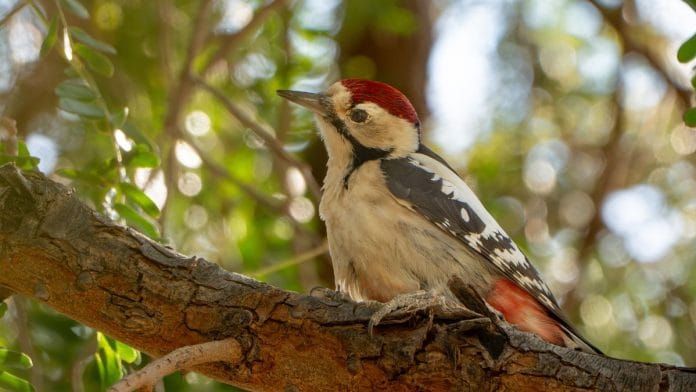


Meet Dendrocopos assimilis, or the Sind Woodpecker—it’s abundant in Pakistan’s Sind and Punjab and a rarity in India. As we approach the 80th year of India’s Partition, the woodpecker embodies a sliver of this history.
In 2011, scientists from the Wildlife Institute of India (WII) were evaluating a site near the Sind border in Jaisalmer for introducing the African Cheetah when they stumbled upon the bird. They gave India the first photographic record of the bird, although it was by no means the first record. A specimen collected from Sirsa, Haryana, in 1870, credited to British civil servant and amateur birder AO Hume, is the first.
Keen birders have rushed to see the rarity since then. A modest string of birders began a pilgrimage after this ‘re-discovery.’ However, significant research is required because camping and combing a border area is not viable. Harish Thangarajan and Sudhir Paul, recalling their 2025 sighting in Bird Count India, explained, “The area where the bird was sighted lay among sand dunes, separated by sandy gaps with sparse tree cover—roughly 15-20 trees per 100 sq.m. Estimates from Google Earth indicated that the suitable habitat spanned about 1.5 sq.km within Indian boundaries.”
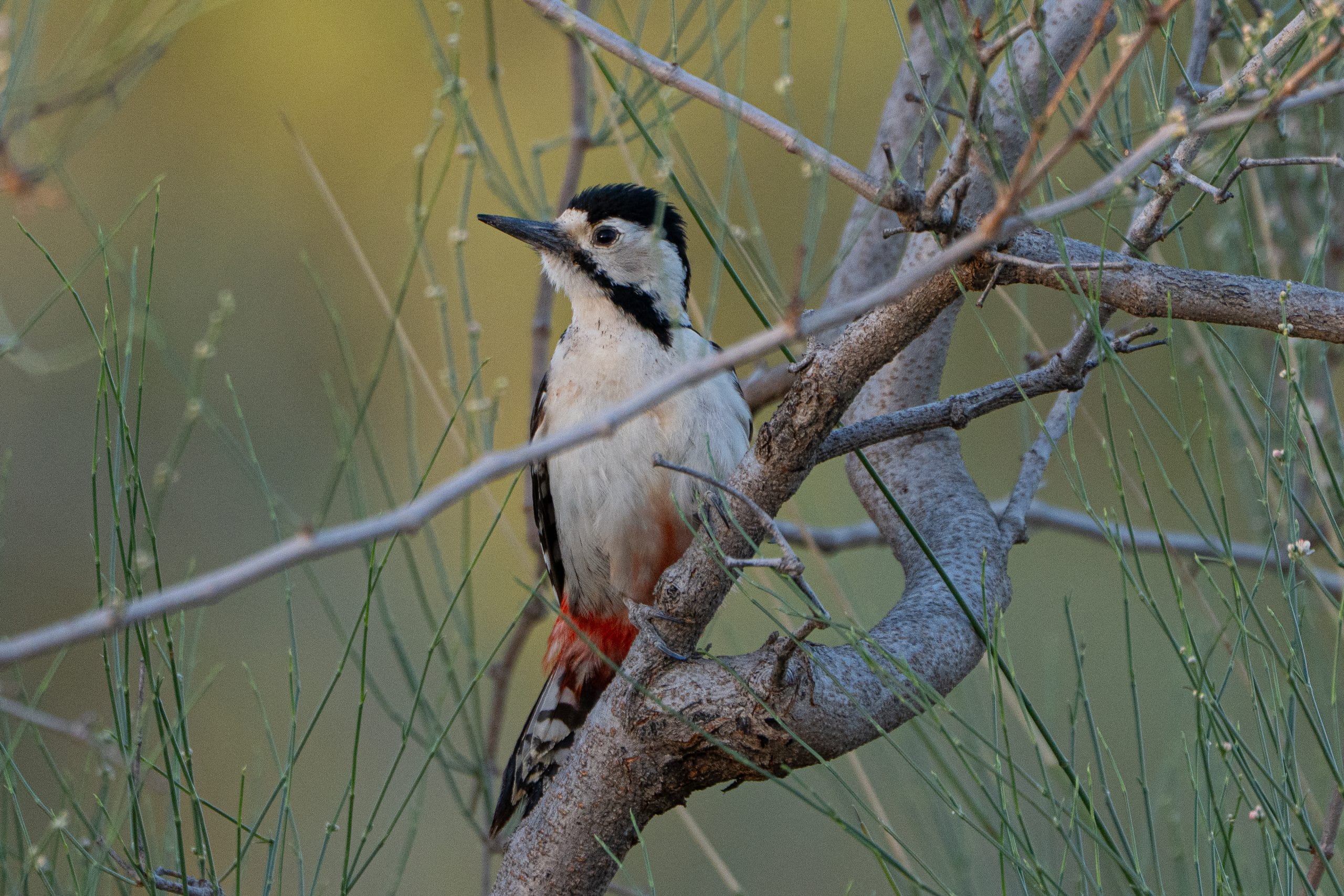
In 2012, Uras Khan, who trained himself to become an outstanding bird guide for the Jaisalmer ecosystem, claimed to have seen four individual birds in a single morning. But without a photograph, this claim could not be verified. He was part of Thangarajan and Paul’s team in 2025 too.
Also read: Lodhi Garden’s immigrant hornbill has a new name—Mausi Ma
My experience with the woodpecker
I saw the Sind Woodpecker on an expedition organised by Digvijay Singh Rathore, one of India’s most knowledgeable and respected birders. Among his credentials is his extraordinary record of a Big Year—trying to see as many birds as possible in a given year. Rathore scored a magnificent 1164, but the Sind Woodpecker was not one of his sightings.
I joined Rathore’s motley group: his literary-minded Gen Z daughter, Uras Khan—a mandatory part of all our birding in Jaisalmer—and a filmmaker.
Murad village, where the woodpecker was spotted, is otherworldly. Anand Pandey of WII, who reported the sighting in 2011, recorded the landscape as the Shahgarh grasslands, in the Desert-Thar biogeographic zone. Amidst buttery yellow sand dunes are gnarled Jaal trees, their wisdom tautly braided in their twisted trunks. Khejri trees count as their neighbours, the two standing tall in the sparse landscape. Grasses rise up in clumps, between glowing stretches of flat, cushiony sand.
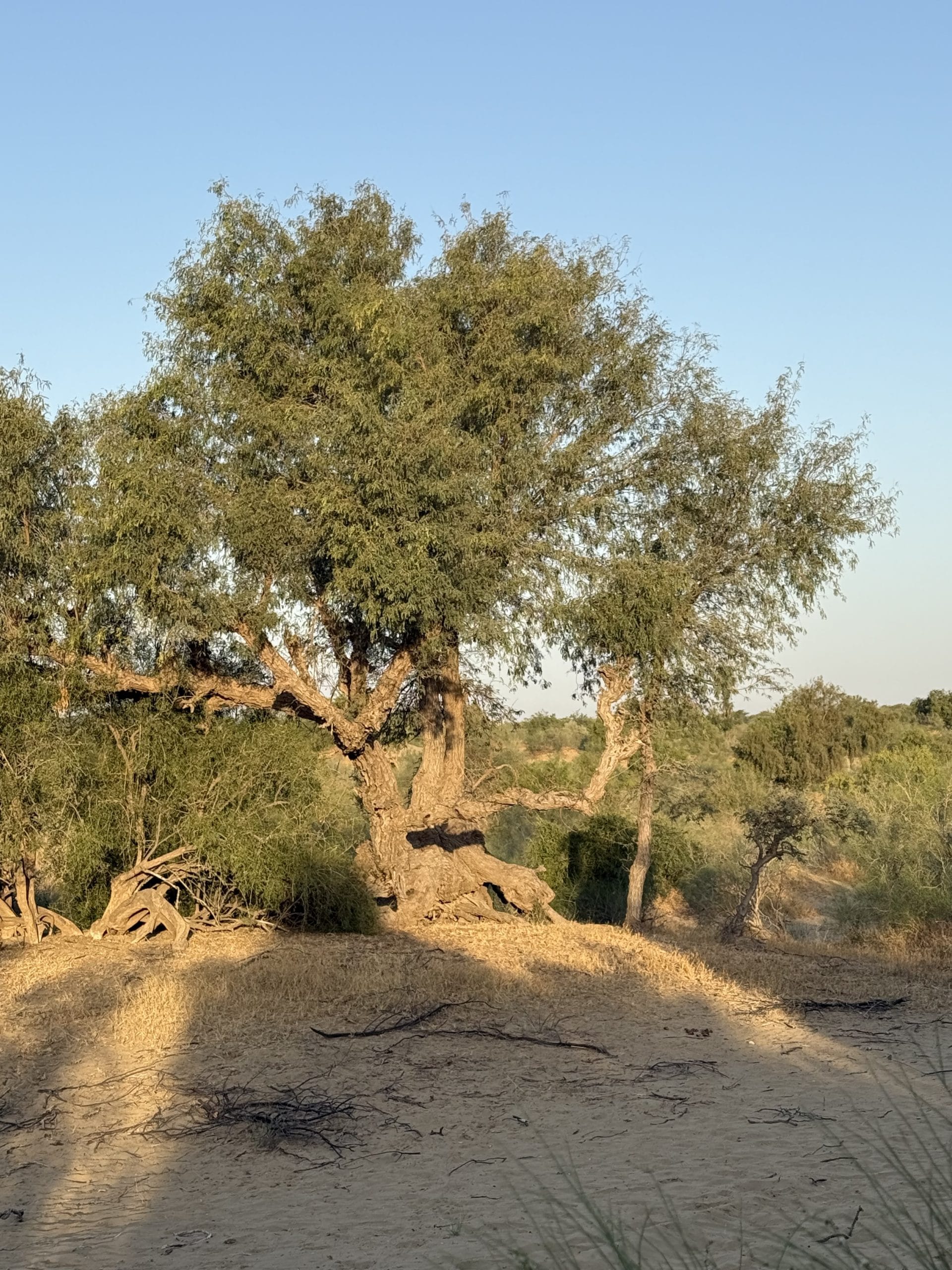
This wildly beautiful habitat nurtures this elusive bird.
We saw it before we heard it. It let out a friendly monosyllabic “tschwep”. Then it burst across the sky, landing on a Kejri tree. We saw four of them just on the first day.
The woodpecker is a slender, medium-sized bird, most striking because of its black and white colour. A malar stripe runs down its face from the base of the lower mandible. It is the only black marking along the white shoulders and cheeks. From below, you can see the bird’s red vent, seeping out into its lower body.
Beyond borders
After two days of sightings, we climbed onto a ridge-like sand dune. Sind seemed next door. It took us to the brutal days of 1947, when these lines were finalised.
So deeply entwined were the relationships between people on either side of the Sind-Rajasthan border were so deeply entwined that weekly train services would run from Jodhpur to Karachi, crossing the Indian border at Munabao and the Pakistani one right after it at Khokhrapar. The border stayed socially porous; marriages and trade continued on both sides. A break in visas and train services since 2019 has made it harder to maintain these engagements.
Unlike human beings, the Sind Woodpecker can still fly to and fro, if it does so at all. But what is its home? We know the habitat it thrives in is well protected along the Rajasthan-Sind border. The bird has never been seen in other patches of wilderness in Jaisalmer—perhaps it cannot fly that far out. Although India’s earliest specimen is from Sirsa, in Haryana, that landscape has changed with development.
In Pakistan, you can see it in the Sind and Punjab provinces. Could the bird still be found at India’s Punjab border, where the landscape is likely to be untouched in many parts? But we can’t easily explore these heavily-securitised areas, so that remains unknown.
Until we learn more, the Sind Woodpecker is present only in a strip of the desert, right at the Pakistan border. By all accounts, the Sind woodpecker has also found a home on this side, beyond borders.
(Edited by Theres Sudeep)